
Our youngest child is addicted to a computer game called Minecraft™.
If life could be as he wanted it—if his dream could become reality—each day would consist of spending his waking hours immersed within this environment of pixels. For those of you who have miraculously escaped the news of this particular computer game, the premise is extremely simple: You mine, and yes—you guessed it—you craft, in a virtual world where everything is formed by blocks. And I mean everything. With the exception of the round eggs that the square chickens lay and the odd corner of rail track, Minecraft takes a purist approach to right angles. The vivid landscapes of mountains and forests, and the pigs, Mooshrooms, people and monsters which inhabit them, are all fashioned from blocks.
Cubes.
Cuboids.
No arcs, bends or radii allowed.
When you first enter this rectilinear paradise/purgatory (depending on how you want to look at it), you’ll find yourself being launched into a land stocked full of resources; a dystopian, unblemished canvas, where, after excavating the raw materials and mixing them with huge dollops of imagination, you can ‘build whatever you like’—to use my son’s terminology. The terrain’s loaded up, and ready and waiting for you to breathe your personality all over it. Every nanobyte of this pixelated world and all it contains belongs to you, and you are free to do whatever you desire to do with it—within programming limits, of course. And so long as it doesn’t require curves.
As far as computer games go, Minecraft has split opinion in our home. As parents, Steph and I love the creative aspect of the game; our son has to imagine and execute his ideas. This is far better, we feel, than following predetermined stories which only help to refine the motor skill of ‘button-bashing’.
That aside, Steph’s still nicknamed the game ‘Bore-Craft’; it’s hardly entertaining to watch and the soundtrack either lulls you to sleep or drives you insane.
I, on the other hand, differ. I was intrigued by this world of perpendicular possibilities and took a more direct approach; which involved grabbing a control-pad and tagging along with Eaden in his virtual experiences. It was time for a Dad-and-Lad team-up as we began to cast our artistic vision into the world.
But that’s when the problems started.
It goes without saying that you can’t build the world as you would want it when there’s two of you on the scene. Instead, it’s dappled with “make do’s” and conflict.
Why? Well, I could blame it all on the fact that my eight-year-old takes a different approach to mine when it comes to construction; after all, he’s not here to defend himself. But I’ll hold my hands up and confess that I’m equally responsible for the chaos that ensued.
All right, I’ll admit it; it’s all my fault.
Call me a traditionalist, but when I build a wall, and the game offers me the raw materials of brick, stone, or purple wool, I’m going to avoid the latter. Even pixelated wool probably lacks the strength and integrity that I believe is required of a wall. Not to mention the devastation that a torrent of rain would cause! But not my son, Eaden. Oh no. It’s wool all the way; as above, so below. Wool walls, combined with wool roofs, and wool fireplaces.
And when there is no wool left? Slime.
Not only did we clash on materials, but colour schemes presented further tensions. I wanted sandstone walls, terracotta roof tiles, and nice oak flooring—all in their natural, realistic hues, please. Is that too much to ask? But not my son—my beautiful, wonderful son, whom I happen to love very much, I should add. His world was a collage of vibrant contrasts; an explosion of colour. Like it had been caught between a giant game of paintball and a Holi Festival.
All of this drove me round the bend—or at least a faceted version of a bend.
We both had different ideas; our dreams clashed, our wills collided, and the world we were crafting became collateral damage caught up in the procession of our egos. Instead of paradise, a dystopia of division and disharmony emerged.
Nothing demonstrates this more than my granite-grey Norman castle standing in the looming shadow of a giant statue of Sponge Bob Square Pants (made of wool, of course).
It turned out that the virtual world of Minecraft wasn’t big enough to house both of us; we both couldn’t play God.
But imagine for a moment a world that was big enough. And then populate it with over seven billion people.
Seven billion ways.
Seven billion wills.
Seven billion dreams.
Within that world, there would be an existence of harmony amongst certain groups of people—places where dreams would merge and a kind of “truce” would occur on a macro-sociological scale. But between the other groups, and in the cracks of those that appeared to be cohesive at large, dreams would clash, tensions would intensify, and oppression, struggle and disharmony would exist.
Give those seven billion inhabitants the same, shared volume of resource, the same building blocks—the raw material of our planet—and there will be those who gather and hoard mass quantities of it from others; along with those who would steal, kill and conquer in order to control that resource; and many who would be left with nothing at all. Unlike players of Minecraft, we’re not so geometrically restricted when we build. And yet, despite the abundance of geometric options available to us, there’s always one shape that consistently emerges. Whether we consider things physically, socially, politically, technologically, religiously, or economically, pyramids always seem to arise. And at the top of those pyramids, within the fraction that controls and owns much, a further subdivision of people will exist; those who, motivated through individualistic or tribal tendencies and driven by materialistic and consumeristic greed, will unbelievably hold to the notion that they have hardly anything at all.
Then tell that fraction—the well-resourced and “blessed” part—to go and live their dreams; go and fill the world with their personality and make it theirs! Then stand back and observe as things go crazy. Especially as that privileged fraction doesn’t recognise that from much of the world’s perspective, they’re already living the dream. That fact rarely enters into the brains of the few. They don’t see what their global neighbours have or haven’t got, so appreciation only ever peaks in the stunted form of gratitude, and never matures into generosity. Instead, what captures their attention and grabs at their hearts, is what those next door possess or what the industrial, money-grabbing conveyors of dreams tell us we should have. And so the grasping for more—more power, more resource, more mining of what we feel is rightfully mine—continues to play on a perpetual loop.
It’s difficult to resist the human compulsion to mine; to covet, take, control, horde and label as mine as much as possible. To act in opposition to this drive, to label things as yours or ours, seems unnatural at times within the Western hemisphere. Unless, of course, it’s with regards to those things which are undesirable, like war, poverty, disease and disaster.
As a result of all this mining, a world of contrasts emerges, and the contrasts should hit us hard. For many in our world, the biggest causes of death are malnutrition, disease, and war. For others, its greed, health problems related to obesity, and lack of exercise.
It’s rather out-of-balance, isn’t it? The world, as it currently finds itself, is full of more stark and disturbing disparities than that of a Norman castle with Sponge-Bob as its neighbour.
And yet, are any of us living the dream? It seems the more we try to make the world in our image, the more problems arise. It’s suffocating, to some extent. Life, real life—whatever we believe that consists of—gets stifled as we, alongside everyone else, fight to breathe our expression of self into the world. Like continually breathing into a paper bag, it feels good at the start, cathartic almost, to fill the world with I. But if we do it for long enough, we end up choking; choking on our own expression. We keep breathing heavily into this paper bag called self, trying to expand it further, because we’ve been sold the lie that there is enough for all of us to have as much as we want, whenever we want, however we want it. Sadly—but also thankfully—this isn’t true.
Russian novelist Fyodor Dostoyevsky poignantly wrote:
The world says: “You have needs—satisfy them. You have as much right as the rich and the mighty. Don’t hesitate to satisfy your needs; indeed expand your needs and demand more.” This is the worldly doctrine of today. And they believe that this is freedom. The result for the rich is isolation and suicide, for the poor, envy and murder.[1]
It goes without saying that you can’t build the world as you would want it when there is more than you on the scene.
But I’m not talking solely about the world here.
Within some branches of Christianity, the Minecraft way of thinking is not too far beneath the surface: The world and all it contains belongs to you, and you can do whatever you want to do with it—within faceted moral limits—because God wants what you want. God is for you, after all, and against those who would disagree with your colour scheme or choice of building materials. Repeating the “worldly doctrine” that Dostoyevsky expressed, some streams even tell us to expand our needs; believe and pray for bigger and for more and never doubt your “God-given potential” (which can be a veiled way of talking about demanding what you want). Accumulating wealth and resource within this theological framework is then understood as a blessing, ordained by God as proof of your devotion and “special-ness” in comparison to everyone else. Proof that God wants more of me and less of them. Or more like me, and less like them.
Mining is the goal, and losing, or so this way of thinking believes, is not what following Jesus looks like. ‘Laying your life down for the Gospel’, is interpreted as ‘Be prepared to go through hell to get what you want’, and ‘Picking up your cross’ is taken as the price-tag on our own dreams coming to fruition; the cost of self-realisation and self-actualisation. In the Prosperity, Self-help, Seven-steps-to-success “gospels”, you is the image that is called to be expressed on the world’s stage. And the world has become sadly distorted as a stage for human ego; a temporary proving ground full of resource for the transcendence of our humanity.
Winning, achieving your personal goals and life-hacks are the commission, benediction and liturgy of the modern age. Consumerism, Materialism, and Individualism have crept into the body of Christ like a cancerous parasite. So instead of resembling an organism of blessing to the world, we often resemble a self-serving hive of ego.
Maybe it’s only a coincidence that the bestsellers at my local Christian bookshop don’t look all that different from the contents of a gamer’s “hints and tips” guide to Minecraft?
Admittedly, some of this isn’t too easy to detect; it’s not glaringly obvious all the time. It’s often subtly wrapped up in the guise of religion, accompanied by faux incense and smoke (glitz and glamour), and acted out to a soundtrack of praise. And in the euphoria-steeped moments of this charade, it’s easy to find yourself being dragged along with the current. As I said, the human compulsion to mine is a difficult tendency to resist. Especially when it’s being endorsed. But if we would only pause to consider for a moment on a Sunday morning, and like Dorothy from the Wizard of Oz, if we only had the courage to draw back the curtain on our theology, maybe we too would discover that there is no divine life pulsating through this form of religion, other than the man-made, man-operated, smoke-and-mirrors light show.
Then again, would we want this not to be about us? Perhaps we’d prefer to keep the curtain? Maybe we’re worried that if we did pull back the drapes on our religion, we’d catch a glimpse of me behind the veil, pushing all the pedals and pulling all the levers?
But what if—and I know I might have to stretch some thinking here—this life isn’t about me, or I, or solely even us? What if the world isn’t a stage or a testing ground? What if all of this is not about you at all, but about everything? And by everything, I mean everything. Including all the things we would prefer to write off as the construction materials for the citadels of our egos.
What if the centre of all this, the purpose of all this, wasn’t to mine?
It’s time to reboot the programming. So with that in mind, let’s go back to the beginning.
But what do I mean by beginning exactly?
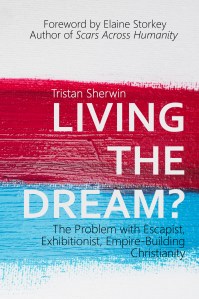
Want to read more? Then check out my new book: Living the Dream? The Problem with Escapist, Exhibitionist, Empire-Building Christianity
[1] Fyodor Dostoyevsky (AD 1821-1881), The Brothers Karamazov.
 TRISTAN SHERWIN
Leave a comment