THE HUMBLE, SPIT-COVERED, KING
Jesus was humble. I would even go as far as to say that Jesus was the most humble person to ever walk the planet. And yet He was neither self-centred nor self-destructive, but self-giving.
The Apostle Paul writes in his letter to the church in Philippi, as an example of the attitude we should adopt, that, ‘Even though [Jesus] was God, he didn’t demand or cling to his rights as God. He made himself nothing, he took the humble position of a slave and appeared in human flesh. And in human form he obediently humbled himself even further by dying a criminal’s death on a cross’[i]. Picture that:
God, the one outside of everything, the source of everything, becoming nothing.
God, the most unrestricted entity that exists, becoming a slave.
God, the source of all that is good, undeservedly dying a criminal’s death on a cross.
This is God, giving the fullness of Himself to the whole of creation. From the crib to the cross, Jesus empties Himself, laying down His power, never demanding His rights, refusing to pull rank.
This is God laying low. Emmanuel, God with us. Disguised, and yet fully disclosed, in human flesh.
I don’t know how much this will impact you, but I need you to know that Jesus wasn’t bling. A man with such resources could have really put on a show! But He’s not ostentatious, He’s not about glamour. He doesn’t use His glory or His power to manipulate, coerce or bedazzle people into following Him. I’ve got to admit, if I had the powers of God, I think I’d be more like Bruce Almighty than Jesus Christ!
Yet Jesus doesn’t use right-handed, strong-armed methods of power – forcefully dominating people through violence or buying their allegiance by giving them whatever they want. He’s left-handed in His approach. Serving. Loving. Compassionate. Discrete. Inviting others to participate in His Kingdom.
He’s not a man empty of purpose and passion, so He’s not someone who allows Himself to be walked over – pulled by everyone else’s whim – but He doesn’t trample over people to get what He wants either.
Jesus leaves himself wide open to be embraced, or to be rejected.
And Jesus understood what it was to be rejected.
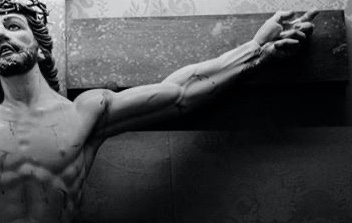
Rejected to such an extent, that Jesus permits a faux crown of thorns to be pushed on His head. He allows Himself to be mocked and beaten as He’s draped in the costume of a king. A cross becomes His throne, with His royal title also nailed with His body, just above His head. There’s no recognition of His status in this inscription – the placard speaks of His crime – the whole scene is one of forsakenness. Instead of being received and welcomed as ‘King of kings’, instead of being anointed with oil to mark His status, He’s spat out and spat at.
Spit.
Forgive me here, as I feel we really need to see this scene, but I’m conscious that this might not be to everyone’s taste. Spit’s an odd thing. We don’t mind having our own spit in our own mouths, but once we’ve ejected it from our own bodies, few seldom want it back. I can’t think of anybody who would be happy to drink their own spit after they’ve spat it out into a glass. I’m certain we’d all refuse if it was someone else’s.
It’s repulsive stuff. We don’t want it. And sometimes we’ve even used the stuff to signify, in a powerfully potent way, our repulsion of others. To borrow some of the philosopher Raymond Tallis’ words:
‘Spitting on someone is the ultimate insult… It has the brutal immediacy of a fist on the face. It is halfway between a curse and a blow. But it has a particular sinister aspect. It is a forced intimacy, a little rape: the spat-upon is directly exposed to material drawn from the intimate recesses of another’s body… The asymmetry of the one who spits and the one who is spat upon is profound: it plumbs the depth of the power relations between humans to its existential bedrock. Which makes this line in Handel’s Messiah – “He hid not His face from shame and spitting” – arresting as well as poignant. The image of the Son of God, with sputum trickling down His sweat-glistening, blood-stained cheek is a shocking confrontation with the mad notion of the Author of the Universe taking on the human condition.’[iv]
This was Jesus’ anointing. Not of olive oil, but the unwanted, yellowish-green discharge from the throats of the Roman soldiers who beat Him, declaring as they did so, ‘Hail! King of the Jews’[v].
But Jesus doesn’t spit back. As Isaiah foresaw: ‘I do not rebel or turn away. I give my back to those who beat me and my cheeks to those who pull out my beard. I do not hide from the shame, for they mock me and spit in my face’[vi].
He’s forsaken, but only words of acceptance are discharged from His mouth.
Here is God. Humbled. Rejected. Crucified. Loving creation through the outpouring of His life. Here is a man of real passion.
WORLD PEACE
I need to point out here that Jesus wasn’t weak, just being pulled into anyone’s agenda without thought. Jesus was a single-minded person. He had a will, a mission that He was aiming towards – a mission that brought Him into this conflict, a conflict that couldn’t be avoided. I need to say this just to clarify any negative connotations that last passage of text might have placed in our minds. I am not suggesting that we willingly and needlessly place ourselves into situations where we allow ourselves to be abused or afflicted or spat at.
But I need us to see Jesus’ attitude within His mission, His suffering, His passion, an attitude that Paul says should be an example to us when it comes to living a life of love expressed through humility.
Jesus was humble. Jesus was passionate.
We might not feel that those words sit together. We might feel that Passion and Humility should be seen as exact opposites. And yet, for many centuries, the scenes surrounding and including Jesus’ crucifixion have been known as The Passion narratives or The Passion of the Christ.
I can understand why we would want to separate these two words from the other. Passion is often assumed to be humilities opposite because passion can be understood as unbridled, out of control and reckless.
And I’m sure that we have all met people who have been very passionate and zealous, but we wouldn’t describe as being humble. We’ve met those zealots who are arrogant and argumentative.
Actually, Passionate people can be scary people.
Sometimes, passionate people are dominating, opinionated, or exclusive and hateful. People can be so passionate about things or causes, that they lose all sense of reason, doing whatever it takes to achieve their dream for the world. Even if that means eliminating those that they feel are “scum”.
Passion can be scary.
It’s a known fact, but maybe one we don’t consider often, that the most violent individuals who have ever lived were extremely passionate. Whether that’s dictators of the past, modern nationalistic leaders, terrorists, extremists, religious fanatics… all of them have been zealous people.
Doing whatever it takes to achieve their goals.
The frightening thing is that when you strip away all their apparent differences, they all share the same ideology – they all believe that the cause they are fighting for, the regime that they’re passionate about, is one that will ultimately make the world a better place to live in!
It may shock you to think of it that way. But few people are willing to die for something they truly believe will lead to a future that is worse than the present they currently possess. These zealots believe that the kingdom they are trying to bring in through their violence and aggression is The Kingdom, The World Order that will bring about peace. Whether you agree with them or not, they’re all trying to save the world.
The Roman Empire, for example, was passionate about world peace. They called it the Pax Romana – the peace of Rome. They were fanatical about this peace, spreading it everywhere through their military campaigns, and if you threatened to disturb it, they would kill you. Their kingdom had a symbol for this world peace, a logo that they would plaster along roadsides and hillsides to demonstrate just how serious they were about it – a cross – a weapon, a method of execution. This may sound hypocritical, but has anything really changed since then? Even today, when we talk about world peace, and ‘keeping it’, although we hide behind the picture of a dove, the real symbols at street level are still those of guns, and bombs, and tanks.
It’s also worth noting that some nations, both past and present, even invoke God into their passionate pursuit of a better world order, whether that’s the Roman Empire, Christendom, the British Empire, Nazi Germany or even ISIS – saying that God supports them and their means of achieving of their goal. ‘After all,’ they may say, ‘it’s his vision we’re passionate about…’
I do believe God is passionate about world peace, about saving the world, but I think His passion looks a whole lot different.
THE PASSION OF THE CHRIST
In the fifteenth chapter of Mark’s Gospel, we’re given the scene of Jesus standing before the crowds prior to His crucifixion, as the Roman procurator, Pontius Pilate, gives them an ultimatum of who should be set free – Jesus or Barabbas[vii].
This scene is full of passion. The crowd that gathers is a fanatical group of people. Many in the crowd are obsessed with the idea of liberty from Rome. They long for revolution. And this doesn’t just stem from religious tensions, it is also sociological and political – in the ancient world these ideas were seldom separate from each other – it’s a hotchpotch of emotions, history and legacy. This crowd longs for freedom. They long for a better world order. They long for peace, but not the peace that Rome has forced upon them. However, they’re still willing to use the same methods as Rome to get it – they’re willing to fight to achieve it.
All of this is crucial for understanding the choice they are about to make. And to help them in this important decision, some of the religious leaders are circulating within the crowd (or the mob, as the NLT text translates this impassioned gathering), stirring them up, helping them to make their choice a more unanimous one.
They might have picked Jesus. Only a week prior to these events, some of this same crowd were following Him into Jerusalem, passionately waving palm branches, laying down their robes for Him to ride over and shouting out things like, ‘Hosanna to the Son of David!’.
To some of us, the word Hosanna sounds like the nice word we use in praise and worship services, another way of saying, ‘We love you’. But it literally means, ‘Save now’. When the crowd are shouting this they’re not thinking about 21st century worship meetings – they’re thinking ‘Here is the rightful ruler, the true King’. But He can’t be King until He’s dealt with the foreign, ruling parties. Remember that Messiah that some hoped for, the one who would be a warrior like King David? Their Hosanna is laden with the expectation that a revolution is just about to begin. They’re thinking war – even though Jesus is giving them an opposite picture by riding a donkey into Jerusalem and not a horse. ‘Hosanna!’ they cry. ‘Save us’, they shout. ‘Let the war begin’, is what they really mean.
But since entering Jerusalem, Jesus hasn’t done much in the way of a Holy Crusade. He’s spent most of His time in the Temple, and most of His protest doesn’t appear to be against the Roman enemy – He seems more concerned with the religious leaders, the Temple worship, and trying to tell people that they have the wrong idea of Kingdom. This ‘Son of David’ hasn’t done much towards getting an army together, or even stirring up hatred about the oppressors – He actually teaches crazy things about loving them, and blessing them, and ‘carrying their equipment for an extra mile’.
From the mob’s perspective, there’s no fight in this Jesus. He’s no commando, He’s a compromiser. He’s even allowed himself to be captured, telling His closest followers not to raise swords –they’ve abandoned Him, too. And now He stands there, next to Pontius Pilate, silent, dormant almost. There’s no passion to this Jesus, they feel, just weakness.
So the crowd rejects Him.
But Barabbas… now here’s a different character altogether. Excuse my artistic licence here, but I imagine Barabbas not silently standing by. I can picture him pulling on his chains, protesting energetically about his imprisonment, spitting at his captors and cursing them in his own language (probably calling them something cruder than scum).
Barabbas is a man who possesses qualities that the crowd admire. Some may wonder why they would choose a crook over Jesus, but Barabbas isn’t a common crook or a petty thief – Barabbas is a freedom fighter. He’s already been part of an insurrection, an attempted uprising, he’s a zealous man whose proof of passion is displayed on his already bloodstained hands. The scary thing is, if you asked Barabbas why he did it, why he murdered someone, his answer would probably be something along the lines of, ‘For God and His Kingdom’.
The crowd chooses Barabbas. He meets their definition of what it means to be passionate about world peace.
As a bit of trivia here, though an important piece – some translations tell us that this insurrectionist’s full name was ‘Jesus Barabbas’. If we remember the story of Jesus’ nativity, we’ll remember that Jesus means ‘The LORD saves’. Barabbas, incidentally, means ‘Son of the Father’.
Can you see the contrast that the writer is putting together in this scene?
It’s a contrast highlighting the different ideas about how God will bring about this desired world order, a Kingdom that will bring in peace and salvation. Through the passion of Jesus, we’re given an alternative to the passionate violence of Barabbas.
And believe me, Jesus is passionate.
Throughout this whole scene, Jesus’ actions clearly portray how passionate He is. Not in a typical way, through being extrovert, shouting, jumping and stirring up the crowd. He stands there silent, refusing to be a part of the circus of violence that is going on around Him. In all the versions of this scene that the Gospel writers give us, it’s poignant how few of the words spoken actually belong to God.
God loves the world. God is passionate about the future of every nation, passionate about world peace. God longs, as discussed in the previous chapter, to see His dream for this world live and bear fruit. But unlike the fanatics, He refuses to fight for it. God could come, in all His power and enforce His rule, but that would mean His peace would be an illusion just like the Pax Romana – a forced peace isn’t peace.
God so loves the world that He gives instead of conquers. He serves, instead of slaying. He heals, instead of inflicting hurt and humiliation. God allows himself to become a victim of our violence in order to show us how ridiculous the idea of saving the world through violence really is.
Some might want to proclaim that God is behind them and in support of their passionate, violent pursuit of peace – but here is God, in flesh, showing us that this simply isn’t true. He’s not sponsoring the state violence, but suffering under it. Here’s God, having a crown of thorns pushed on to His head and being mocked. Here’s God being scourged and nailed to a ‘symbol of peace’. Here’s God, crucified, dying from asphyxiation, looking on as people laugh at Him and gamble for His clothes.
Here’s God, being spat out and spat at by humanity. God being treated like scum.
And in the midst of this brutality – brutality done in passion – God doesn’t cry out for vengeance, or seek to close the doors of His Kingdom to His murderers, He cries out, ‘Father, forgive these people, because they don’t know what they are doing’[viii].
Jesus is so passionate, so humble, that He gives His life to the cause, and not someone else’s.
LOVE ONE ANOTHER
Churches should be the most passionate communities on the planet. Passionate about Jesus. Passionate about life. Passionate about our world and its future. Passionate about our neighbours. Passionate about our enemies – perceived, or real.
But let’s be careful not to lose the source of that passion and become fanatical, divisive and destructive. If our passion causes us to become aggressive, defensive (in the negative sense), argumentative or violent, then we are misunderstanding the dream God has for this world, and how He has acted within history to bring it about.
If our so-called “passion” for God’s dream causes us to see enemies of the dream, or scum who are unworthy to benefit from that dream, then we have let go of the way of Jesus.
We need humility to accept and to express our world’s need for the passionate love of God.
So love the world. Love it like God loves it. Because real love doesn’t express itself through what we’ll kill for, or fight for, and exclude people from – but in what we’ll live for, serve for, suffer for, and invite people into.
‘This is real love. It is not that we loved God, but that he loved us and sent his Son as a sacrifice to take away our sins. Dear friends, since God loved us that much, we surely ought to love each other. No one has ever seen God. But if we love each other, God lives in us, and his love has been brought to full expression through us’ – 1 John 4:10-12 (NLT)
The words above are an edited extract from Love:Expressed, by Tristan Sherwin
END NOTES FROM ORIGINAL MANUSCRIPT
[i] Philippians 2:5-8 (NLT)
[iii] 1 Peter 2:23
[iv] Raymond Tallis, The Kingdom of Infinite Space: A Fantastical Journey around your Head, Atlantic Books, 2009, pp. 20-21.
[v] Matthew 27:27-31 (NLT)
[vi] Isaiah 50:6 (NLT)
[vii] Mark 15:1-20
[viii] Luke 23:34 (NLT)
 TRISTAN SHERWIN
Leave a comment