Scapegoat
In the first-ever episode of the British television show Black Mirror, entitled ‘The National Anthem’, writer Charlie Brooker takes a dark look at society’s unknown collusion with terrorism.
In the episode, a young member of the Royal family has been kidnapped and threatened with death, unless the U.K. Prime Minister meets the ransom demands. But it’s not money that the terrorist asks for, or the removal of British armies from overseas. All this sole individual wants is for the PM to disgrace himself live on public television by having sex with a pig.
At first, the threat is treated like a large, twisted practical joke. And the public, who have been let in on this demand because the terrorist has posted it directly onto YouTube, are initially in favour of the PM’s decision to refuse such terms. But when a finger arrives in the post with the threat of more body parts to follow, the nation’s opinions change abruptly.
Again, the kidnapper shares this information publicly—posting a video on the internet which appears to show the princess’ digit being hacked off. And the public, in their concern for the fate of the victim and in their willingness to air their own opinions on what the government should do, continue to virally spread the terrorist’s messages through their own social media channels and public conversation. Soon, the whole country is awash with the sentiment that the PM is an idiot for refusing to indulge in this sexual perversion and he’s tainted as someone who is more concerned with his own reputation than with the life of an innocent girl.
Finding himself on the receiving end of a barrage of hate, and with no options left, the PM has to swallow the reality of the predicament before him, and in a broken, humiliated mess, proceeds to do what needs to be done. As he does so, the vast majority of the U.K. gathers around television sets—in pubs, hospital wards, sitting rooms and on the street pavements outside of their local audiovisual stores—to spectate this live-feed spectacle.
Except that they aren’t spectators; they’ve colluded with this act of terrorism. The general public could have refused to share the initial ransom video, but they don’t, and maybe understandably so. But when it comes to the actual “performance”, none of them has to meet the ransom demands. Despite the fact that it is being aired on live TV, none of them has to watch. They could switch off their TV sets and refuse to be seduced by the terrorist’s sick game. They could stop ‘hash-tagging’ and sharing the terrorist’s videos on their social media accounts, thus stemming the flow of the kidnapper’s influence and power. But they don’t. Instead, they become the audience in attendance, unaware that they’re all complicit accomplices in this vulgar act of terrorism.
As I said, the episode’s title is ‘The National Anthem’, and there’s probably a purposeful play on words here by the scriptwriter(s). Because maybe a better label on this episode would be The National Anathema—the National Abomination, the Nation’s Scapegoating.
Would any of the characters in this fictitious story have seen themselves as being under the influence of evil, or acting as a network of terrorists? Probably not. But when you watch this critically from the perspective of an outsider, it’s easy to spot and name the malign stimulus they are all acting under.
It’s difficult to admit the evil that influences us until a mirror is lifted up in front of us, exposing our likeness.
Black Mirror ‘The National Anthem’, shows us how elusive evil can be, how subtle its influence. Even though we feel that we could all put a face to evil, how many of us would put our own? It’s easier to project evil onto others. It’s easier to view another individual or people group as doing evil or as being the source of the violence. Even God is scapegoated in this regard. And yet, as we’ve discovered in the last section, Scripture takes us on the journey of lifting the lid on this idolatry. If the Old Testament didn’t do enough in moving us forward in the revelation of God’s real nature—a nature which puts forth mercy, a nature which lays down power, a nature which acts in liberating love—then the New Testament closes this loop for good. The Word made flesh, God incarnate, puts the nails into the coffin of our idolatry. Literally.
The crucifixion is the unveiling of our nature, the uncovering of our desire to scapegoat, the revelation of our bondage to Sin, to idolatry. We meet the darkness that lurks within ourselves at the cross of Christ, as we recognise that it is our face behind the mask.
Agnus Dei
Jesus has made it all the way to Jerusalem. And, as he had told his disciples many times en route, his journey there has culminated with his own crucifixion.
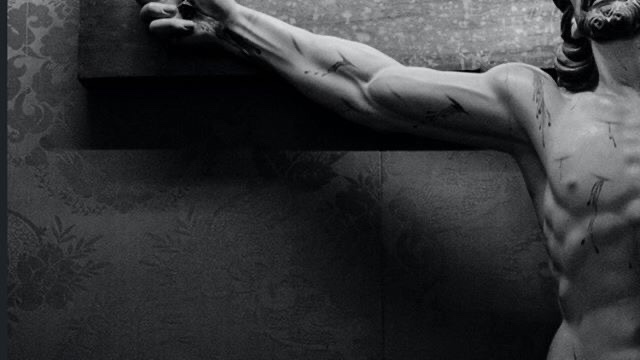
Stripped naked, Jesus hangs as a spectacle before a world of onlookers. The crowd’s motivations for being there are various. Some are his followers, mourning this perceived end to the world-changing movement they had become a part of, mourning the death of the warrior Messiah that God had sent them. Others are there because they were behind the plot to execute this ‘blasphemer’; motivated by their jealousy of his popularity and by a concern for their sacred position on God. Others gather because they are the ones who have nailed his hands and feet, following the ordinances of the “divinely appointed” Caesar they serve. And whilst they wait for the inevitable last breath of their empire’s victim, they cast lots over his clothing in the hope that their ideas of God will bless them. Others, pulled in by the commotion, have come for the spectacle; with no allegiances to anybody, waiting to see what happens next.
There have been countless books discussing who was strictly to blame for killing Jesus. But Luke, in the book of Acts, quotes the Apostle Peter as saying, ‘For Herod Antipas, Pontius Pilate the governor, the Gentiles, and the people of Israel were all united against Jesus…’[i]
This is a universal anathema—an act of humanity, as they scapegoat an innocent man in the name of their nationality, their empire’s peace, or in the name of God.
Writing many centuries before the crucifixion of Jesus, the prophet Isaiah is said to have foreseen this event when he wrote these harrowing words about the Lord’s suffering servant:
People despised and avoided him,
a man of pains,
well acquainted with illness.
Like someone from whom people turn their faces,
he was despised;
we did not value him.
In fact, it was our disease he bore,
our pains from which he suffered;
Yet we regarded him as punished,
stricken and afflicted by God.
But he was wounded because of our crimes,
crushed because of our sins;
the disciplining that makes us whole fell on him,
and by his bruises we are healed.
We all, like sheep, went astray;
we turned, each one, to his own way;
Yet Adonai laid on him the guilt of all of us.
Though mistreated, he was submissive
—he did not open his mouth.
Like a lamb led to be slaughtered,
like a sheep before its shearers,
he did not open his mouth.[ii]
As this song makes clear, we have a knack of looking upon the crucified Jesus and believing that it is God who is punishing and forsaking him, but it’s our crimes that are wounding him, our sins that are crushing him. It is humanity’s Sin that Jesus bore, as humanity unloads and transfers its Sin upon him. We did our violence upon Jesus. We lynched Christ.
In other words, it’s not that Christ becomes our sin on the cross, and then is rejected by God in our place, therefore making a way for us to be forgiven. But it is rather that Christ bears the image of our Sin; Jesus exposes our rejection of God’s likeness, our rejection of God’s Kingdom. Jesus’ broken, marred and pierced frame holds a mirror before us, unmasking our transgression of the human vocation.
Jesus bore our idolatrous disease. It is our evil, our tendency towards violence and scapegoating that is revealed in the twisted features and broken body of Christ. We would like to pretend that we’re the reasonable ones, that we’re objective and peace-loving and benign, and that it is God who is cruel, vindictive and to blame for the world’s sorrows. But as the prophet Isaiah foresaw, it is our Sin that puts purity and innocence to death.
To a certain degree, the crucifixion of Christ is history’s most glorious act of Culture Jamming. God artfully uses the symbol of Rome’s peace, a cross—human empire’s violent means of enforcing itself—to demonstrate that God is not the violent one at all. We might have cast God as vindictive, malign, distant, angry, vengeful and brutally vicious, but at the cross we see this turned around. God is sharing in the suffering of the oppressed, and it’s the human powers which are dealing out the brutality. God is being rejected and forsaken, but it’s humanity that’s the alienating force.[iii] God is dying, and emptying himself sacrificially, but its mankind’s leaders scapegoating God, whilst others toss dice in his presence. In the crucified incarnation, the Divine allows humankind to project itself upon him. Our Sin is made manifest in his wounds because, like Abel’s blood after being murdered by his brother Cain, Christ’s issue of blood attests to humanity’s ability to be less than human. The old Latin proverb proves true, Homo homini lupus est (Man is wolf to man).[iv] We are the wolves, and God’s lamb-like posture exposes our hunger for desecration.
Through becoming the victim of mankind, God puts a face and a name to our evil scapegoating. God unmasks our collusion with the dark side. God becomes the black mirror. On the cross, we come face to face with the darkness within us.
The reformed theologian, T. F. Torrance would describe the crucifixion as having both a dark and a light side: the dark side is the shadow that this dastardly act casts upon on our inhumanity, but the light side is the glory of God in his unflinching embrace of mankind.[v] And so, all is not lost in this exposure. Even here, in this disclosure of our Sin, mercy is put forward because God’s true likeness is also revealed. Yes, on the cross we witness the blood-spilling, destructive effects of our belief in lies, but we also witness the radical, self-emptying, loving nature of the Divine, as God (to once again echo Torrance), submits to humanity’s outrage and bears it all in love.
Jesus’ sacrifice is not trying to convince God to approach us, forgive us and heal us. It’s not, as some have suggested, that Jesus’s death pacifies a vengeful God, allowing God to get past his “problem with us”. The Dying Deity is an echo of Eden’s ‘Where are you?’; it is God, through the body we have broken, pouring out his life in pursuit of us and calling us back into fellowship within the Divine. And so God calls us, as he did with Cain, to listen to the prophetic voice of the blood we have spilt so that we can turn away from our idolatry. Christ’s blood, like Abel’s blood, certainly testifies to our violence, but it also proclaims a far better verdict on us than Abel’s blood does. As the writer of Hebrews reminds us, Jesus’s blood does not call out for violent retribution. The blood of Christ speaks forgiveness.[vi] And if we choose to listen to it, Jesus’ sacrificial issue of blood provides the means for our exodus from the serpent’s enslaving, death-dealing lies.
To add nuance to this thought, it’s also worth noting what our violence didn’t do to Christ. Jesus bears the image of our violence and sin, but Jesus doesn’t become violent and sinful—Jesus keeps exposing us to the divine image. As the Orthodox Bishop, Kallistos Ware points out in his remarkable book, The Orthodox Way:
At his Agony in the garden and at his Crucifixion the forces of darkness assail him with all their violence, but they cannot change his compassion into hatred; they cannot prevent his love continuing to be itself. His love is tested to the furthest point, but it is not overwhelmed […]. We should not say that Christ has suffered “instead of us”, but rather that he has suffered on our behalf […]; not substitution, but saving companionship.[vii]
At the cross, God’s raw, life-giving, passion for his creation is exhibited; we see a détournement of our violent symbolism. The cross, an instrument of torture and victimisation, the diadem of human justice, becomes the judgement seat of Christ and the place where forgiveness is dispensed, mercy is put forth and our evil is absorbed. It’s where the lies that have enslaved us are put to death, and divine life, love and liberty are made available to us. By his stripes, we are healed. In his wounds, peace (shalom) is extended to a broken world. The call to turn from self, now that we have seen our darkest self, is given and grace for the turning flows.
The cross makes everything clear. The cross kills the lie. God has not estranged himself from us. God is not vengeful. God is not violent. God is not demanding blood before forgiveness can flow. God is not for some, and against others. God is not a tyrant. God is not a Caesar. God is not a monster. God is not indifferent. God has not turned away from us in disgust.
God is love.
God is love.
God. Is. Love.
The above words are an edited extract from Living the Dream? The Problem with Escapist, Exhibitionist, Empire-Building Christianity, by Tristan Sherwin
END NOTES FROM ORIGINAL MANUSCRIPT
[i] Acts 4:27 (NLT).
[ii] Isaiah 53:3-7 (CJB). The full section is found in Isaiah 52:13-53:12
[iii] I know someone is going to want to quote Jesus’ last words given in Matthew 27:46 and Mark 16:34 (‘My God, My God, why have you forsaken me?’) as being against this idea. However, Jesus’ final words are a recital of the opening verse from Psalm 22—an important Messianic Psalm. And so it’s not that Jesus is only saying these nine words, but, as Jewish custom expects, the full thrust of the Psalm is invoked and would begin to echo into his listeners’ ears. (Or, if you hold to the view that Jesus didn’t say these words, the Gospel writers are using this verse to invoke the whole Psalm.) If you read Psalm 22, you will see that it is not God who has physically abandoned the Psalmist to a painful plight, but that the suffering is being inflicted by other humans wishing to victimise and scapegoat the Psalmist. Also, the Psalm concludes, not on a note of feeling abandonment by God, but on a note of confidence that God will vindicate the one suffering; God will rescue the Psalmist and put his enemies to shame.
Some people refute this suggestion that the entire psalm is being invoked through Jesus’ quoting of its opening verse, but it’s insightful to also take note of the response of those hearing Jesus say these words. None of the bystanders say, ‘Yes, you are forsaken!’ Some of them think he’s calling out for the Old Testament prophet Elijah to come and rescue him. Whereas a few others interpret Jesus’s cry as being one of thirst, probably mishearing his words, and begin to lift up a wine-soaked sponge to Jesus’ lips. As they do so, though, those who thought that Jesus was calling for Elijah intervene, saying, ‘Leave him alone. Let’s see whether Elijah will come and save him’ (Matt. 27:49). Again, it’s telling that those who hear Jesus’ cry of “Eli, Eli, lema sabachthani” are anticipating a rescue. In other words, although they miss the connection with Psalm 22, his immediate listeners begin to look for Jesus’ vindication from this violent death via an act of divine intervention. In short, it’s not a question of divine forsakenness that hangs in the atmosphere after these words are spoken in Matthew and Mark, but hope: will God rescue the one suffering and how will God go about it?
Additionally, it’s crucial to remember that only Matthew and Mark record this so-called “cry of dereliction”, as some have come to name it.
Luke’s Gospel only records Jesus quoting the first of half of Psalm 31:15 (Luke 23:46: ‘Father, into your hands I entrust my spirit’), which, in line with what I have said above, is also a cry for vindication and rescue, especially as the verse concludes with, ‘Rescue me, LORD, for you are a faithful God’.
John’s Gospel, on the other hand, has Jesus saying, ‘I am thirsty’ (John 19:28) and then records the bystanders lifting up a wine-soaked sponge to his lips. In this way, John’s narrative helps to shed light on why, in Matthew and Mark’s account, some people offer Jesus a drink of wine after he quotes Psalm 22:1; the fifteenth verse of this Psalm also has the psalmist poetically expressing his thirst for rescue and vindication by saying, ‘My tongue sticks to the roof of my mouth’. Therefore, based on John’s record, it could be argued that the bystanders at the crucifixion in Matthew and Mark’s gospel do understand Jesus to be invoking more of Psalm 22 than the first verse alone.
[iv] Attributed to the Roman playwright, Titus Maccius Plautus (c. 254 – 184 BC), from his comedy Asinaria. The full quote is: ‘Man is wolf to man, when he doesn’t know what sort he is’.
[v] T. F. Torrance, Incarnation: The Person and Life of Christ (Downers Grove, IL: IVP Academic, 2008), pp. 245-246.
[vi] See Hebrews 12:24.
[vii] Bishop Kallistos Ware, The Orthodox Way, rev. ed., “Chapter 4, God as Man” (Crestwood, NY: St Vladimir’s Seminary Press, 1995), pp. 81-82. Used with permission.
 TRISTAN SHERWIN
Leave a comment