I don’t know about you, but I have seen my fair share of nativity plays and, like many, had the privilege of starring in a few of them. When I was a child, of course.
One year, I reached the dizzy heights of playing Joseph. It was a non-speaking role, however, which basically involved me knocking on invisible doors and then standing silently next to the girl who played Mary. The kid who played the donkey in that year’s nativity made more noise than I did.
A year or two before that, I was a shepherd. Again, it was a non-speaking part. They obviously didn’t trust me with lines. All I had to do was sit there with a tea-towel on my head. That year wasn’t the best of years for me, either, with regards to nativity plays. The girl who played Mary that year was my girlfriend. It wasn’t a serious relationship—we were only five or six. But she ended up dumping me on the day of the performance and started dating the boy who played Joseph. If you’d witnessed the Nativity that year, you would have seen Joseph gloating at one of the shepherd’s, and that shepherd scowling back because Joseph had ran off with his girlfriend. That same shepherd “may” have also aggressively shoved Joseph when paying his respects to the new-born Saviour. It wasn’t exactly the most accurate portrayal of the Nativity story!
But sometimes we need that. Sometimes we need to hear the nativity in a different way now and then. Maybe, because we are so used to hearing it, and seeing it performed in a cosy way, it’s easy for us to get complacent and miss the significance of what is unfolding in this event.
So I’m going to do something a little bit risky this Christmas season, and share with you the Nativity story in a different way than what we’re normally used to, by using a portion of scripture that is seldom (if ever) read at this time of year, even though it speaks about the events that we recall and retell at Christmas.
And so we’re going to turn to the book of Revelation, chapter 12.
REVELATION
Before we read from it, though, it’s worth stating a few things about this particular book.
Anyone who has ever delved into Revelation will be aware that it is a book full of fantastic imagery. It’s well known for this fantastic imagery both inside and outside of the Church, and, because of that imagery, people from both inside and outside of the Church have come up with some very fantastical understandings of his book. Some have understood this letter as being a coded video-transcript of what is going to happen in our future and even in our present. And to help them interpret the symbols and fantastic images in this book, they turn to current news headlines and paranoid conspiracy theories, hoping to align the symbols of Revelation with what they “perceive” to be happening in current world events.
Even though I do believe Revelation can speak to us today, I’m not of the persuasion of scanning newspaper headlines, for a number of reasons. To give a couple: Firstly, this letter already tells us what it’s about: it’s a revelation about Jesus (Rev 1.1). So if reading Revelation pulls your attention to headlines and not towards Jesus, then we’re misunderstanding John’s reasons for recording these visions. Secondly, and I’ve not counted this myself, but Revelation, in the space of its 404 verses, echoes the Old Testament 635 times.[i] In other words, newspapers and listening to conspiracy theories won’t help in figuring this book out—knowing the story of the Old Testament will. Revelation is not about predication, it’s about prophetic fulfilment.
Revelation connects the Old Testament promises of God to what God has now done through Jesus Christ, and it does so by employing a series of very visual, symbolic, poetic dramas—dramas that make use of Old Testament images, and which also appropriate and invert some of the claims made by the Roman Empire. And these dramas enfold into each other and overlap each other, and purposely repeat, again and again, the significance and the implications of Jesus’ life, death, resurrection and ascension.
That’s not to say that it’s an easy book to understand—it’s certainly not. But it shouldn’t be read as a coded chronological script of the end-time’s that needs to be deciphered. To a great extent, Revelation is to be watched, more than read, and it’s to be heard, more than analysed.
In Revelation, John, who is in exile in Patmos, receives a series of visions. Some of them blend together, some of them have a transition in between. If you want a very loose analogy of how Revelation functions, think of it like going to the cinemas in those days when you could see a few films back-to-back. And imagine that those films tell the same story, but in multiple ways. And that between each film, there’s a transition, when the screen fades, the cinema goes dark, and then the next film begins with a loud startling noise.
There’s a transition happening here between chapters eleven and twelve of Revelation. John has just finished witnessing a set of images stressing the importance of what has happened through Jesus’s life, death and resurrection. In that previous vision, John has just been exposed to the Lamb of God, and to a series of visions that echo the Exodus of Israel from Egypt—the most influential narrative in (what we call) the Old Testament. And John is recording these visions because he wants the early church to connect what has happened through Jesus to the Exodus of Egypt: God has led us out of enslavement, oppression, and darkness; God has overcome the powers that held us in bondage; God has redeemed us; Jesus has accomplished the ultimate Passover. At the end of that series of Exodus–themed pictures, the screen then goes dark … and then the orchestral music strikes up once more, and a new set of images begins to play out, to repeat the story once more, in a different way.
Or to put that scene transition poetically as John does in the last verse of Revelation 11; “Lighting flashed, thunder crashed and roared; there was a great hailstorm and the world was shaken… “
‘Then,’ John continues, describing what is now appearing on the screen (and reading from Revelation 12: 1, NIV)…
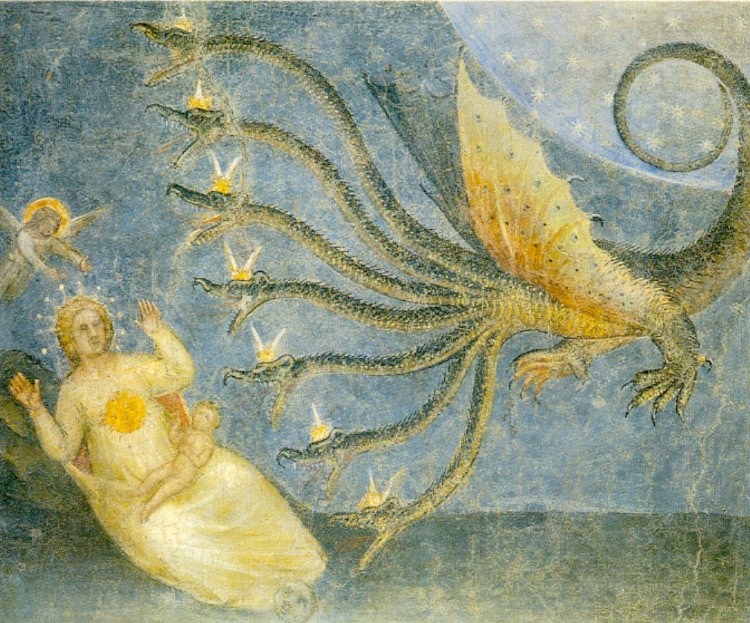
‘A great sign appeared in heaven: a woman clothed with the sun, with the moon under her feet and a crown of twelve stars on her head. She was pregnant and cried out in pain as she was about to give birth. Then another sign appeared in heaven: an enormous red dragon with seven heads and ten horns and seven crowns on its heads. Its tail swept a third of the stars out of the sky and flung them to the earth. The dragon stood in front of the woman who was about to give birth, so that it might devour her child the moment he was born. She gave birth to a son, a male child, who “will rule all the nations with an iron sceptre.” And her child was snatched up to God and to his throne. The woman fled into the wilderness to a place prepared for her by God, where she might be taken care of for 1,260 days.
Then war broke out in heaven. Michael and his angels fought against the dragon, and the dragon and his angels fought back. But he was not strong enough, and they lost their place in heaven. The great dragon was hurled down—that ancient serpent called the devil, or Satan, who leads the whole world astray. He was hurled to the earth, and his angels with him.
Then I heard a loud voice in heaven say:
“Now have come the salvation and the power
and the kingdom of our God,
and the authority of his Messiah.
For the accuser of our brothers and sisters,
who accuses them before our God day and night,
has been hurled down.
They triumphed over him
by the blood of the Lamb
and by the word of their testimony;
they did not love their lives so much
as to shrink from death.
Therefore rejoice, you heavens
and you who dwell in them!
But woe to the earth and the sea,
because the devil has gone down to you!
He is filled with fury,
because he knows that his time is short.” (Rev 12:1-12, NIV)
A DRAMATIC RETELLING
What a strange thing to read at Christmas. But this is the nativity story. It’s not the nativity story that we grew up with—it doesn’t involve wearing a tea-towel on your head—but it’s the nativity story all the same! (to paraphrase Eugene Peterson).
To help see this, there are clues here that instantly connect this child with Jesus. This Dragon is waiting, ready to devour the baby when it is born. We know the story of Herod, from Matthew’s gospel, and that from the time of his birth, Jesus’ life was under great danger. Revelation then says that the child is snatched away from the Dragon and caught up to the throne of God—which is probably the shortest summary of the gospel accounts that you’ll ever read. This child occupies the throne of God, just like the Lamb that John has already seen in Revelation chapter 5).
This child, in verse 5, is described as the one ‘who was to rule the nations with an iron rod/sceptre.’ That’s a direct reference to Psalm 2—a psalm speaking of God’s Messiah; someone who will rule the world like no one has ever ruled the world before.
Verse 9 describes the ancient serpent, the Devil, Satan, the accuser and the deceiver of the world, being thrown down, tossed out like garbage, as a consequence of this child’s reign, this child’s kingdom coming—an echo of Isaiah’s words in Isaiah 14:12. It’s also an echo of something Jesus himself said in Luke 10:18; ‘I saw Satan falling from Heaven as a flash of lightning’.
Also, by referencing ‘The Child’, John is probably also hinting towards something else recorded in the book of Isaiah, in Isaiah 9: 6-7; ‘For unto us a child is born…’
Again, it’s the nativity story… but I’ve never seen a nativity play that looked like this! I’ve seen donkeys, cows, and even pirates, giraffes and aliens in nativity plays—I’ve even seen an aggressive shepherd push Joseph out of the way—but I’ve never seen a conflict between a Baby and a Dragon.
Even the Gospel’s don’t tell us the nativity story in this fashion. When we read how these events unfolded in history, they don’t look as dramatic as this.
To put it another way: If you had the choice between buying a ticket to a film that was about a cosmic battle between a child and a dragon—an action packed film full of tense moments and battle sequences, or a film about two peasants making their way to a small village, in the middle of nowhere, to then have a baby, which is visited by shepherds, followed by some wise men a few years later, which would you pay to see?
Don’t get wrong, the latter wouldn’t be a bad film (we tell that story every year, after all), and there’s really no need to choose; they’re the same story. What we read in the Gospel accounts is how the events of Revelation 12 are said to have looked in history. But because those historical events don’t seem as extraordinary to us, maybe we’re more prone to miss the extraordinary within them.
And maybe that’s why John is telling us the nativity story in this way. John wants us to see the impact of Christmas; of the incarnational life of God, of the crucifixion, of the resurrection, of the ascension. John wants us to see that this child has toppled the powers of Sin, Death and the Devil—that this child has brought their enslaving reign to end.
This is good news! Like the famous carol, we can rest merry, ladies and gentlemen, because Jesus Christ our saviour has saved us from Satan’s Power. O tidings of comfort and joy!
Or, as Rev 12 puts it in song; ‘Now have come the salvation and the power / and the kingdom of our God / and the authority of his Messiah / For the accuser of our brothers and sisters / who accuses them before our God day and night / has been hurled down… Rejoice!’
Eugene Peterson, author of The Message, describes John’s motive like this, ‘It is St. John’s Spirit-appointed task to supplement the work of St Matthew and St. Luke so that the nativity can not be sentimentalised into cosiness, nor domesticated into drabness, nor commercialised into worldliness. He makes explicit what is implicit in the Gospel stories… [that] God in Christ invades existence with redeeming life and decisively defeats evil.’[ii]
You may want to read that quote again.
INSIGNIFICANT SIGNIFICANCE
I love the way Peterson puts that. We can easily miss, or misinterpret, the wonderful, life-changing thrust of the Christmas story.
We wouldn’t be alone in missing it, either. When John writes his gospel he says that, ‘But although the world was made through him, the world didn’t recognise him when he came.’ (John 1:10). Like them, we’re prone to miss it, because what has happened in the physical doesn’t, in our minds, equate to what we were expecting nor does it’s force match with what we feel needs to happen on a cosmic scale.
As I’ve already said, Revelation 12 and the Nativity stories we read in Matthew and Luke, don’t look alike. Maybe that’s why people obsessed with using newspaper headlines to interpret Revelation also fail to see the Nativity in this story.
The Nativity, despite the virgin birth and the angelic appearances, is fairly normal looking and easily overlooked. No one was writing about it at the time on a global scale. Jesus’ birth didn’t make the world headlines. God became flesh in obscurity. Sure, there were visitors: shepherds and Magi. But the world at large missed it. Many in his own neighbourhood missed it. And, dare I say it, if it was to happen today like it did back then, we’d still miss it.
Why?
Because, even we Christian’s, people who claim to be aware of God’s presence and character, have been seduced into thinking that God is mostly found in the big and the loud, when, in fact, God is almost never found in the big and the loud. The ways of God are predominantly small and quiet. The ways of God are often as loud as a seed falling on the ground, or yeast spreading through a batch of bread (to hint at some stories told by Jesus). The movements of God are often not in the fire, or the earthquake, or the raging storm, but in the gentle whisper, to quote the experience of the prophet Elijah (1 Kings 19:11-12). The sounds of God’s entrance into our circumstances and into world history don’t often sound like a royal trumpet blast—even though God’s entrance is often poetically compared to such sounds in the Bible; God’s entrance is announced through the crying of a baby.
We often want God to do the big thing, while God is planning to do the small thing. And whilst our eyes are so obsessed with finding the big and dramatic, whilst our gaze is busy scanning news headlines in order to decode God’s ways, God arrives in the smallest, least expected way, and through that way, God does the incredible and extraordinary.
Through events and scenes, and people and places, that we would otherwise disregard and deem unimportant, God topples the powers of darkness, deceit and death.
I mean, just think about the polar opposites here in this Spirit-led reimagining of the Nativity: a child versus a Dragon! There’s a ridiculous scale of difference between these two characters. The Child is the antithesis of the Dragon. What I mean by that is that there is nothing dragon-like in the nature of this child, because God does not share any resemblance to the Dragon. The Child is so vulnerable, small, gentle, and seemingly powerless. This picture of a Child is on par with John’s favourite image of Christ in Revelation: the Lamb. In fact, to see this story through the lens of the gospel accounts, it is the Lamb-like nature of the child, this vulnerability, which overcomes, undoes and defeats the ways of the Dragon. It’s love that drives out hate. Compassion that drives out neglect and apathy. Mercy that triumphs over accusation and condemnation. Selflessness that overcomes grasping and greed. It’s co-suffering love that overthrows the desire for power and domination. Life that conquers death. Light that transforms darkness.
It’s this meekness and vulnerability—something we would overlook and consider weak, foolish and impotent against evil—that is actually stronger than evil.
The crazy thing is, the Dragon would grab our attention (it still does, hence the warning in Rev 12:12). The Dragon is enormous, dramatic, and appears significant and powerful. The Dragon is crowned with 7 crowns—a symbolic way of saying that it is at the height of human power and authority, influence and dominance. This Dragon has what many in our world desire (including some Christians). Some of us would maybe expect and want God to look more like this, and not like a Child. We’d expect, like I already said, that God would be BIG, LOUD, OBVIOUS, DOMINANT, and possibly also forceful! But God is the opposite in this portrayal. God’s power is made manifest in the Child, a “microdot” in comparison to the scale of the Dragon. But through this smallness, God is victorious!
As Paul writes, ‘God’s weakness is far stronger than the greatest of human strengths’ (1 Corinthians 1:25). When Paul writes that, he is not picturing a scale where God’s weakness comes in higher than our strengths. He’s speaking of the cross; it’s the self-emptying, humbling, sacrificial, vulnerability of God that achieves what human might and strength could never gain.
This use of power should totally upend our ideas of what power is and provide a much-needed revision to our ideas on how power is exercised.
Revelation opens our eyes to an important lesson and challenge that Christmas throws at us: That the important things and the powerful acts of God don’t always look important or powerful to us. Christmas reminds us that we need help in order to see God in the least, the lost, the lowly and the little, where God has been hidden all along.
And if we want to apply that practically, then don’t ridicule the little things and the small acts. Don’t neglect the mundane. The small things, those things that seem insignificant, aren’t stepping stones into something bigger, larger and more spectacular. They are the spectacular. It’s the little things that become the doorways through which God involves himself in history and changes its course forever, and for good.
[i] According to The Novum Testamentum Graece.
[ii] Eugene Peterson, Reversed Thunder: The Revelation of John & the Praying Imagination (HarperOne, 1991), pp. 121-122.

 TRISTAN SHERWIN
Leave a comment