Here’s my longer sermon notes from this Easter Sunday’s Metro Christian Centre service (dated 9th April 2023).
If you’re reading closely, you’ll find some Easter Eggs 😉
You can also catch up with this via MCC’s YouTube channel (just give us time to get the video uploaded).
‘God is whoever raised Jesus from the dead, having before raised Israel from Egypt.’
Robert W. Jenson, Systematic Theology: Volume 1: The Triune God
READ: JOHN 20: 1-18 (NLT)
THE DROIDS YOU WERE LOOKING FOR
I love Easter Eggs.
I don’t mean the chocolate variety. Although, the statement would still be true.
I mean the kind of Easter Eggs you get in movies and television shows.
If you don’t know, an ‘Easter Egg’ is a term used to describe a detail that is hidden in a film or a TV show. The detail could be an inside joke, or a reference to someone or something else, or a call back to another story that is related somehow to the story you’re currently watching.
And yes, you have to be a bit of a geek to spot them.
One of the most famous Easter Eggs is in the classic film, Raiders of the Lost Ark. In this film, the famed archaeologist, Dr Indiana Jones, goes searching for the missing Ark of the Covenant: the famous chest we read about in the Exodus story. Without spoiling the story, Dr Jones finds it, buried in an ancient Egyptian tomb. Egyptian hieroglyphics cover the walls and, if you look closely, when Dr Jones opens the stone box containing the Ark, one of the hieroglyphs is clearly a picture of C3PO and R2D2, the two robots from Star Wars.
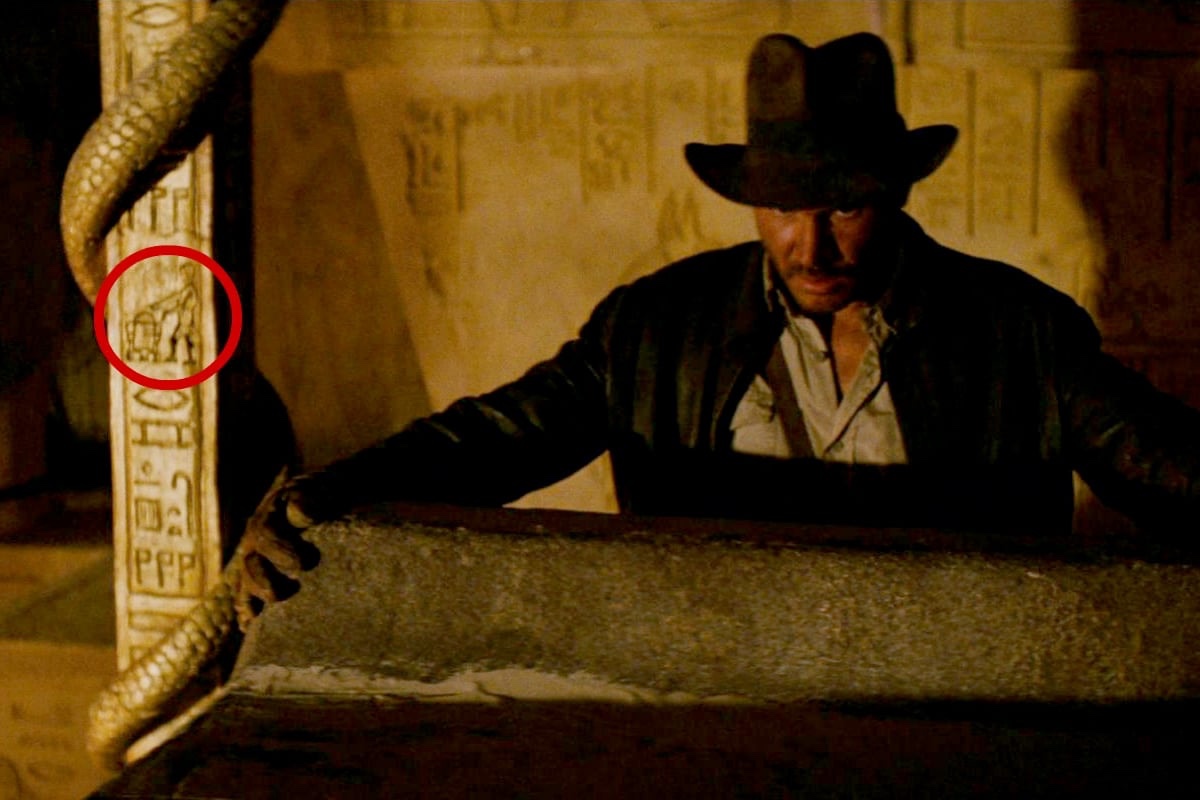
I’m not going to explain why the ‘Easter Egg’ is there. I could, but it would only prove that I am a nerd. All you need know is that it’s there for a reason, a way of showing that Star Wars and Raiders of the Lost Ark are connected in some way.
‘Easter eggs’—hidden references—occur in many shapes and sizes. And although some people think they are a modern thing, ‘Easter Eggs’ have been around for a long long time.
We have started calling them ‘Easter Eggs’, but the original term for them was ‘an allusion’.[i] The expression refers to bringing something to mind without explicitly mentioning it, hoping you will connect the dots.
They’re not just in modern movies. Our classic novels are filled with ‘Easter Eggs’. Medieval paintings nearly always contain ‘Easter Eggs’. Even our sacred writings drop references and leave us to connect the dots. And John, the writer of the forth gospel, is an absolute expert this.
JOHN’S EASTER EGG
Throughout his writing, John constantly leaves Easter Eggs—references to the stories of the Old Testament. They are his way of telling his audience, and us, that these stories are deeply connected to Jesus’ story, that these stories foreshadow who Jesus was and what he had come to do.
In the passage we’ve read, in the famous Easter story of the resurrection, there is an Easter Egg (or two, or three) to a famous episode (or two, or three) in the Old Testament.
Can you find it (or them)?
Yes, there are hints to the creation texts, with the ‘first day’, darkness, chaos and confusion, all moving toward light and hope as this chaos is spoken into by Jesus’ voice. All of this hinting that this is the launching of a new day of creation, that creation’s own renewal and restoration (as well as our own) is unfurled in the resurrection.
Yes, there are nods towards the garden, with the man and the woman. The resurrection (and Jesus’ commissioning of Mary, and his later breathing on his disciples in verse 22), is a recommissioning of humanity to their Divine-given vocation be God’s images bearers. Mary has the first privilege to carry the juicy life-giving news of Christ’s resurrection.
But there’s more …
If it helps, the Egg I want to focus on can be found in verses 11-13:
‘Mary was standing outside the tomb crying, and as she wept, she stooped and looked in. She saw two white-robed angels, one sitting at the head and the other at the foot of the place where the body of Jesus had been lying. “Dear woman, why are you crying?” the angels asked her.’
You may not see it, but this is a nod to the conclusion of the Exodus story. By the way, all the Gospels (Matthew, Mark, Luke and John) drop ‘Easter Eggs’ to the Exodus story, but John does it with some special pizazz.
I’m not going to retell the Exodus story, here. But, in short, God liberates Israel from their bondage in Egypt. He rescues them from the slavery and tyranny of darkness and death. God does it by defeating the powers that hold Israel captive.
Following this, God then sets up a tent among them—the Tabernacle, a way of symbolising that he dwells with them and that he would show them the way. Within the Tabernacle, there is a chest; the Ark of the Covenant (famously discovered years later by Indiana Jones years—only kidding). This chest had a lid, called the ‘mercy seat’. And on that lid, at either end of it—one at the foot and one at the head, we could say—were angelic statues. As Exodus 25:22 describes it, it was from the empty space between these angels where God’s life-giving voice would be heard, where grace, mercy and glory would be encountered.
Do you see it now?
It’s from the empty tomb that God brings life. The resurrection says ‘this is the way.’
A NEW HOPE
There’s a lot that can be said about the Resurrection, it’s importance and centrality to our faith. There’s a lot the writers of the New Testament say about it, too. But here, John plants an Easter Egg reminding us of the Exodus.
John wants us to understand that Jesus is the leader of the great Exodus, the great rescue. Like the Exodus, the life, death and resurrection of Jesus is seen as an act of divine invasion, the smashing of gates and bonds, and the setting free of those bound to death, those made to worship God.
The writer of Hebrews, like John, also uses this same Exodus imagery: ‘Because God’s children are human beings—made of flesh and blood—the Son also became flesh and blood. For only as a human being could he die, and only by dying could he break the power of the devil, who had the power of death. Only in this way could he set free all who have lived their lives as slaves to the fear of death.’ (Hebrews 2:14-15, NLT).
Paul uses Exodus-like language, too. In Colossians, Paul says, ‘We have been transferred from a kingdom of darkness into the kingdom of the Son.’ (Col. 1:14). In 2 Timothy, we are told that our Saviour broke the power of death and showed us the way of everlasting life (2 Tim. 1:10).
One of the earliest Easter sermons outside the New Testament, by Melito of Sardis (c. AD 175), portrays Jesus as a conquer boasting of his victory:
‘”I am the one who destroyed death, and triumphed over the enemy, and trampled Hades under foot, and bound the strong one, and carried off man to the heights of heaven, I,” he says, “am the Christ.”’[ii]
If we wanted, I suppose we could say that Death was mortally wounded when Jesus rose, with no chance of it striking back.
Jesus has conquered the grave and shattered death’s cruel empire. Death has been arrested. Jesus has taken the captor captive (Eph. 4:4), taken the captor’s keys (Rev. 1:18), flung open the prison doors and, like he did with Lazarus, has shouted to entombed humanity to ‘come out’ (John 11: 33).
Jesus himself referenced Jonah’s experienced when talking about what he would do (Matt. 12:39-40). But, unlike the one who was swallowed by a fish, Jesus, who allowed himself to be swallowed by the tomb, ends up swallowing up death itself. Therefore, fulfilling Isaiah’s words that God would swallow up death (Is. 25:8) and proving that death is not the bigger fish.
I’m saying all this, because Christianity is not about reconciliation with death. Jesus did not approach death with romantic sentiments of death as natural and normal. Death is an enemy he came to destroy, not strike a deal with it.
The hope Christianity declares is not death, nor a luxury version of it. It is death’s defeat we sing about as we look forward to our eventual bodily resurrection.
Yes, it’s something we wait for, as Paul describes in 1 Corinthians 15. But, as Paul also reminds us, and as John does with his ‘Easter Egg’, if we look closely into the empty tomb we will see a picture assuring us that Jesus has indeed kicked death in the teeth!
To use the words of someone else, this means ‘that the worst thing that can happen to us is not the last thing!.’
The resurrection of Christ is more than a happy ending to a tragic Easter weekend. In a world marked by sin, suffering, and death, it is the hope, promise, and guarantee of a new beginning. We could even say that Jesus’ resurrection is the start of that new beginning in the midst of the old story. God’s dream for creation and humanity has been unveiled in Jesus Christ and you’re invited to belong to it.
‘But in fact, Christ has been raised from the dead. He is the first of a great harvest of all who have died. So you see, just as death came into the world through a man, now the resurrection from the dead has begun through another man. Just as everyone dies because we all belong to Adam, everyone who belongs to Christ will be given new life. But there is an order to this resurrection: Christ was raised as the first of the harvest; then all who belong to Christ will be raised when he comes back.’
1 Corinthians 15:20-23
[i] Apparently, ‘Easter Egg’ was coined around 1979 by Steve Wright, Director of Software Development in the Atari Consumer Division, to describe a hidden message in the Atari video game Adventure, in reference to an Easter egg hunt.
[ii] Melito of Sardis, On Pascha, (St Vladimir’s Seminary Press, Popular Patristics Series, No. 20), (St Vladimir’s Seminary Press, Crestwood, NY, 2001), p. 65.

 TRISTAN SHERWIN
Leave a comment