
THEME: The Exclusively Sufficient Work of Jesus
Here’s my longer notes from this morning’s @mccbury service (6th July, 2025), continuing our FREE TO GOD series which explores Paul’s letter to the Galatians.
You can also catch up with this via MCC’s YouTube channel (just give us time to get the video uploaded).
‘Do or do not. There is no “try”.’
—Yoda[i]
READ: GALATIANS 2:1-10 (NIV)
MERCH’
The other day, I was listening to the late American pastor and teacher, Tim Keller talking about this passage.
He described what we have just read as a very important passage, but noted that, despite its importance, you’ll never hear it read aloud at a funeral or a wedding. He added that, in all the visits he’d ever made as a minister to people’s homes, not once had he seen this passage embroidered on cushions or cross-stitched and framed on someone’s wall.
Now I think about it, I haven’t, either.
There are lots of popular Bible verses that do turn up all over the place, such as:
‘For God so loved the world, that he gave his only Son …’ (John 3:16)
‘“For I know the plans I have for you,” says the Lord. “Plans for good and not for disaster …”’ (Jeremiah 29:11)
‘Be still and know that I am God.’ (Psalm 46:10)
I have seen these, and others, over and over again: on bookmarks; mugs; car stickers; t-shirts; within people’s social media bios. I have the last one artistically written out and framed at home. But I can honestly state for the record that I have never seen a social media bio’ or t-shirt reading:

Personally, I think this is a good look.
As a quick show of hands, if I got some of these t-shirts printed, who would be interested?
If you’re not interested in a t-shirt, I would offer the option of having it as a vest—but having the sleeves removed would seem to go against the message.
But seriously now, as Tim Keller said it, ‘[this verse] just doesn’t seem very inspiring’ enough to have branded on a t-shirt or the side of a coffee mug, ‘but actually it’s every bit as important a passage as you’re going to read.’[ii]
ASSASSINS AND SPIES
As a bit of catch up, Paul is in the middle of sharing his own backstory of faith, of how the news about Jesus turned his world upside down.
Paul has been talking about how, as a passionate Jewish man, eager to protect the boundaries of his religion, he violently persecuted other Jewish people because of what they were saying about a Jewish man called Jesus. This Jesus had been crucified—a God-forsaken way to die—by the Roman authorities, and yet they were claiming that God had raised him from the dead. They were claiming this Jesus was the long-awaited-for Messiah—his resurrection had proved it—and that through this Jesus, God, the Creator of all there is, had come of his own loving and voluntary action to rescue us and give us new life. They were talking about Jesus the way you should only talk about God.
For Paul, this was blasphemous, and so he went on the hunt.[iii]
Paul has mentioned how, in the midst of this same violent pursuit, in the middle of mistakenly thinking that he was serving God, protecting God’s name, and doing God a favour, he encountered the revelation of God in the risen Jesus and realised that he was acting against the very God he claimed to be whole-heartedly devoted to.
Paul has spoken of how, within this revelation, echoing words originally used by the Hebrew prophet Jeremiah, God had then called him to announce this good news about Jesus, not only to his fellow Jews, but to all the nations and peoples of the world.[iv]
Because of God’s kindness and grace, Paul was now preaching the very message he had originally tried to silence and destroy.[v]
It’s an amazing story of transformation.
And yet, Paul’s not writing this autobiography in the hopes of making it on to the ancient equivalent of the New York Times’ bestseller list.
He’s sharing his story because the message he has been preaching has come under attack.
Paul’s letter is addressed to early Christian believers living in Galatia (part of modern-day Turkey), somewhere between the mid-40s to mid-50s AD.[vi] They are non-Jewish people; a mixture of Roman, Greek, Gaul, plus others, who came to hear this Jesus story because two Jewish men— Paul, the same Paul writing this letter, and Barnabas, who Paul mentions in the first verse of what we have read —set out on an epic journey, that you can read about in Acts 13 and 14, to announce this good news to them.
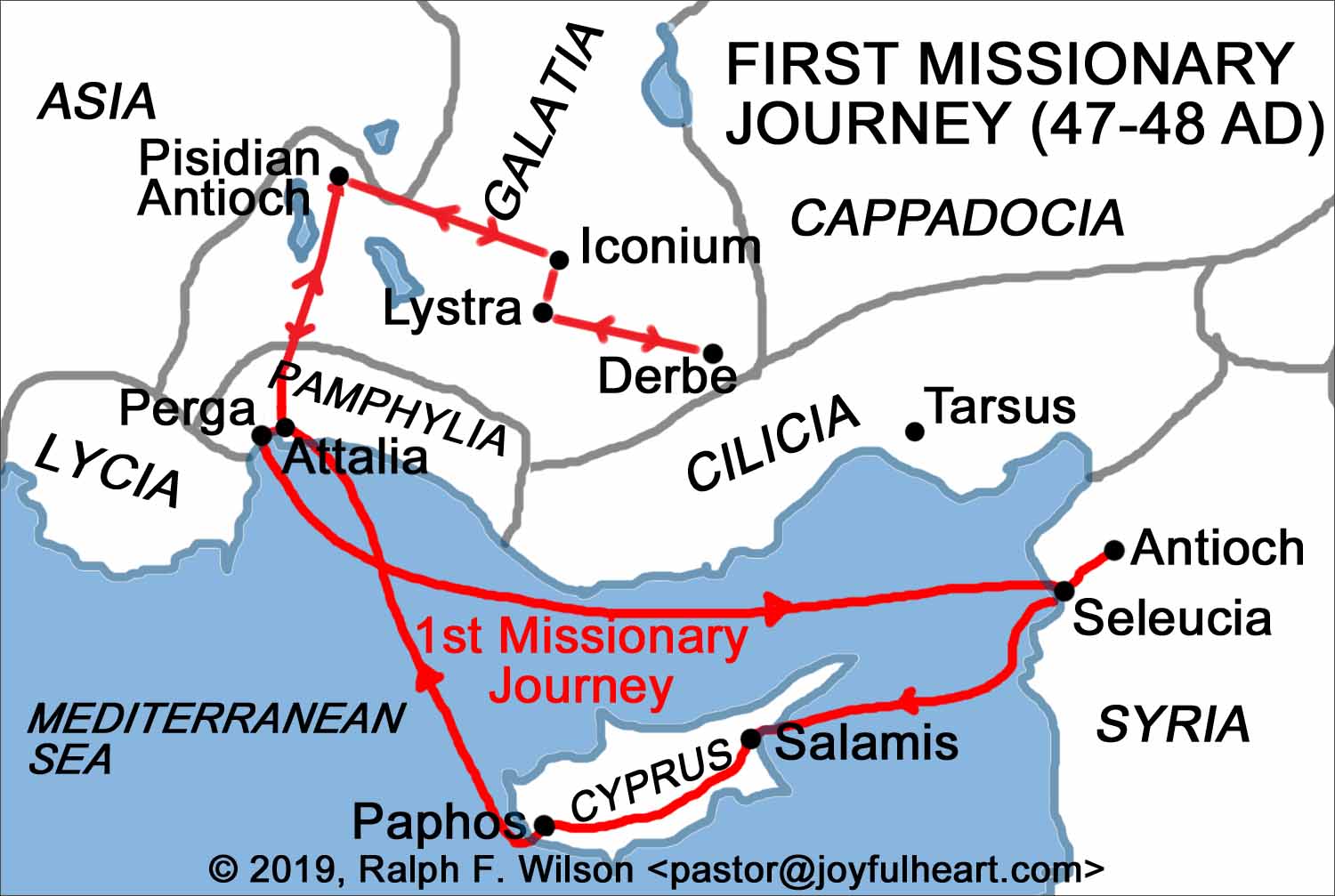
When Paul and Barnabas were travelling around Galatia, they were telling people of all nationalities, backgrounds and social classes that they could be in on this Jesus thing, they could have this new life and forgiveness God was offering and be part of his Kingdom, and that they didn’t have to become Jewish to do so. Before their travels across Galatia, they had already been doing the same thing in Antioch, Syria for more than a decade.
But after Paul and Barnabas left Galatia, to return to Syria, other Jewish Christians had turned up, preaching something different.
They’ve come from Jerusalem, in Israel, likely claiming that what they are saying is totally legit’, in that it matches up with what they’re teaching in the place that is the very source of this Jesus story, where there are people who walked and talked and were taught by Jesus personally.
And they’ve been telling these Galatian churches that Paul and ‘Barny’ hadn’t been telling the truth: you do have to become Jewish if you want to be a part of this new thing God has done. And that means food regulations, clothing restrictions, calendar and, for the men, circumcision. Basically, they are undermining Paul’s message.
As with modern times, the most popular way to undermine someone’s message is to launch a smear campaign. They have been hurling muck at Paul’s reputation in a full-blown character assassination.
We cannot know for certain what this smear campaign consisted of. But, with what Paul is having to say about himself—a lot more than he feels he has to say in any of his other letters—we’re given the impression that these character assassinators had given their spin on Paul’s story, and that Paul is under tremendous pressure to give his version of events; having to say, ‘no, this is how it was.’
Based on what Paul is saying, I don’t think I would be far off in suggesting that the smear campaign went something like this:
‘You can’t trust Paul. He was an enemy of this message about Jesus right from the start. He used to have people locked up, you know. He even handed people over to be executed: Stephen, a Greek-speaking Jew was stoned to death on his watch! He then went around dragging men and women out of their homes and having them thrown in jail. But, because that wasn’t ultimately working, and the church kept growing, Paul’s now changed his tactics. Instead of trying to destroy this from the outside, he’s now trying to sabotage it from the inside, teaching you something that sounds like the truth but is keeping you away from the truth.
‘He didn’t even get his message from the original followers of Jesus.
‘Oh! And while we’re at it; did you know that he was once dragged before the church leaders in Jerusalem for disciplinary reasons over what he was teaching in Syria! They told him there and then that his message was wrong—that he should be telling non-Jewish people to become Jewish. James (Jesus’ own brother), along with Peter and John (two of Jesus’ closest friends), even gave Paul a verbal caution and put him on probation! And what did he do in response: he broke his probation and took off with Barnabas around Galatia—to you—spreading his lies.
‘You’ve been scammed by someone on the run.
‘You should have known better. After all, this Paul had never even met Jesus, and he was never licensed by the church leaders in Jerusalem. He’s a charlatan.
‘It’s a good job we got here when we did.’
This is a serious issue. Slander always is.
If you have ever been lied about, or had someone twist the truth of some events, you can begin to imagine how Paul feels.
But there is more at stake here than a reputation. Paul, I believe, doesn’t care at all about his reputation. He’s dead to all that, as he goes on to say in this letter. But he does care about the gospel of Jesus. And so, like a man in the dock of a courthouse, he contends for the truth and gives his witness statement.
To use some extra details from the book of Acts, Paul, in Galatians 1-2, is basically responding to the slander like this:
‘Firstly,’ Paul says, ‘it’s true: I was a violent man! I don’t deny it. I’m guilty. I did try and wipe out the message about Jesus and anyone who was spreading it. I was good at it, too! I certainly wasn’t failing at it. But I have already told you all about this, if you care to remember. And trust me when I say this, no matter how bad these people say I was, they’ve barely scratched the surface. I remember Stephen, and his face is not the only face I see at night when I close my eyes. And here’s the kicker, I did it all thinking I was doing good, that I was being a “godly” Jew. My circumcision did not stop me misunderstanding or misrepresenting God.
‘But then God stepped in and knocked me off my high horse. Literally. Jesus showed me the truth of who he was—the truth of who God was! Again, I’ve told you all this. But in case you have forgotten, you need to know that I wasn’t seeking Jesus, I wasn’t searching for some divine revelation or mystical experience. God’s salvation found me, and did so in the midst of my biggest failings and grossest errors. I’d done nothing to earn it—God’s kindness knocked me sideways. And I finally understood, like Jeremiah before me, that God had called me to shout about Jesus’ lordship to all the nations of the world because God has always cared for all the nations of the world.
‘So that’s what I did. I took a little time out in Arabia, beforehand—I went back to the ancestral beginning of this story to get my bearings, rethinking all that I thought I understood about this story of God’s encounters with my ancestors. After that, I paid a brief visit to Jerusalem—Barnabas helped to introduce me to Peter and James. Some people were suspicious that I was a double agent, at first. Who can blame them, I had been giving them hell (again, wrongly thinking I was following Heaven).[vii]
‘But after this, at Barnabas’ invite, I went to Antioch in Syria, where I stayed for years, teaching with Barnaba’s encouragement and just enjoying being part of a church family made up of Greek-speaking Jews, Hebrew-speaking Jews, and full-blown Greeks. Because we were such a mixture of different peoples, the locals didn’t know what to call us—they couldn’t call us people belonging to the Greeks or the Hebrews, or any other ethnicity for that matter. So, they nicknamed us ‘Christians’; meaning, ‘people belonging to Christ’. [viii]
‘I’m not lying about any of this. I declare before God that I am, and I have told you the truth.
‘With regards to my second trip to Jerusalem, fourteen years later, what these slanderers are saying is a load of old tosh. I was not summoned to Jerusalem on disciplinary charges! I went in response to Divine revelation: the Holy Spirit had spoken to a man called Agabus, a prophet who had come to Antioch from Jerusalem, telling us a great famine was about to sweep the Roman Empire and have a huge impact on our Jewish Christian brothers and sisters in Judea. In hearing this, we, at Antioch, felt led to start a relief fund for them. After all, they may be in a different part of the world, but we’re still one family. It just so happened that the other believers in Antioch picked me and Barnabas to personally deliver this money and make the journey to Jerusalem.[ix]
‘But with such a golden opportunity, I just had to take Titus along with us as a living testimony of the amazing and wonderful things God had been up to in Syria. Unlike Barnabas and I—who have a rich and wonderful Jewish heritage (‘Old Barny’ is even a Levite, btw, so he’s something extra special!)[x]—but unlike the pair of us, Titus is a flesh-and-blood, uncircumcised, Greek Christian. There’s not a trace of Jew in him. Still, I’m not in the least way embarrassed to say that he’s like a son to me—I’m proud to share the faith with him.[xi]
‘As I was saying, I took Titus along because I wanted to show the Jerusalem leaders the fruit of a decade’s long work. I wanted them to understand what we had been teaching. Not because I for one minute doubted the message we were preaching. But because, if the Jewish leaders refused to except Titus, it would mean that I had wasted my time working for the unity of Jew and non-Jew. If James and Peter had not accepted Titus, instead of one family in Jesus, we’d have two, or three, or four—and where would it end!
‘But here’s the rub: The leaders in Jerusalem agreed with everything we were saying and doing. They embraced Titus as a brother. They offered us their right-hand, recognising that our work wasn’t a splinter group but an equal partner in God’s mission, and they blessed us and encouraged us to keep up the good work.
‘To be sure, not everyone was happy. There were some uninvited guests at this meeting, spying on the freedoms Jesus had won for us. They tried to sabotage what God was doing: they wanted to force Gentiles to adopt all the Jewish regulations, they wanted to enslave non-Jews to the Torah customs.
‘But we (myself, Barnabas, James, Peter, John—all of us Jews), told them where to go! That wasn’t what God was up to. Think about it: if this is what the Jesus-movement had been teaching from the start, compelling Greeks and Romans to be Jews, every ounce of violent compulsion within me would have been on their side from the beginning!
‘Maybe these gatecrashers are the very same people who have now come whispering in your ears? They’re the saboteurs. They are the ones twisting the message, masquerading as family, and acting without authority—both human and Divine.
‘Know this, Jerusalem added nothing to our message! Non-Jews can become full members of the people of God without becoming Jewish in custom or culture. It’s faith in Christ alone that matters! If you want that another way: Jesus plus nothing equals everything! I’m not saying this because I am anti-Jewish, or anti-circumcision. I am Jewish. I am circumcised. Duh! I’m saying this because this good news is not about turning Gentiles into Jews, neither is it about turning Jews into Gentiles. While we’re at it, it’s not even about turning ‘bad people’ into ‘good people’, either (though, that inevitably begins).
‘It’s about making spiritually dead people alive, and about setting enslaved people free!
‘Again, James, Peter and John—people who knew Jesus best—had nothing to add. There is no performance or ritual that is necessary for salvation. Jesus has done it all. All they asked us to do is remember the poor, which, again, is why we went to Jerusalem in the first place.
‘Regardless of what they say about me, remember this and hold fast to it—make it a motto, get it printed on t-shirts: Even Titus wasn’t circumcised!’[xii]
THE FUTILITY OF TRYING
I don’t always preach by retelling the story in this way, but I hope doing so helps us grasp the sense of what Paul is saying and why he is saying it.
Paul’s on the defensive because he wants to preserve the truth of the gospel. And, for those who have ever preserved anything, such as fruit or vegetables in a jar, you will know that means closing the lid, sealing the jar. That it means there are no more ingredients or additives to go in.
There’s plenty in this passage that we could pull out—most of which we’ll revisit again at some point as we travel through the rest of this letter. But if I could say one thing only, it would be this: There’s nothing to add to the finished and victorious work of Jesus. The jar is sealed; it is finished.
To echo how the great Victorian preacher Charles Haddon Spurgeon put it years ago:
‘I wish I could get this thought out of my own mouth, and get it into your heads, that when God saves you, it is not because of anything in you, it is because of something in himself. God’s love has no reason except in his own bowels; God’s reason for pardoning a sinner is found in his own heart, and not in the sinner. And there is as much reason in you why you should be saved as why another should be saved, namely, no reason at all. There is no reason in you why he should have mercy on you, but there is no reason wanted, for the reason lies in God and in God alone.’[xiii]
It’s worth spelling this out, because so often we can get this the wrong way around.
Sometimes, we have this maddening idea that God loves us, but on condition. And so, our religion crumbles into this ridiculous parody of true religion; that if we can meet those conditions, we will gain God’s love, favour, forgiveness, acceptance, favour … call it what you will.
Think about what such an idea says about God. It’s like being in love with a person who has no interest in you. He loves your advances, but only because they make him feel self-important. It’s all one-sided.
In a nutshell, as I put it many years ago, we end up thinking of God as a vending machine. If I insert the right currency, out comes God’s affection.
And I find the idea that God withholds his love and that you must submit to some sort of performative system in order to earn or extract that love, to be the worst of corruptions.[xiv]
That’s not the good news of Jesus Christ. It’s not good news at all—it’s the same old news that the false religions of the ancient world pumped out and that the present world’s value systems still regurgitate in its shallow ideas that if you only do ‘this’ or ‘that’ you’ll find ‘peace’, ‘meaning’, ‘success’, or ‘acceptance.’ But it’s the world’s longest con’.
Back in the sixteenth century, when the reformer Martin Luther read Galatians and challenged the structure of the church, this is what annoyed him. It wasn’t so much about ‘faith’ versus ‘works’; he was repelled by any idea that we, as humans, could have any sort of mastery over God—that we could somehow do something to pull God’s strings and make God act.
As Paul has already said in the opening of this letter, this rescue plan of God’s was all God’s. It’s not that we asked God to do this; that we did something to “woo” God or coerce God to descend toward us. It was God’s initiative. It was what God wanted.
It’s always been God’s unchanging plan to bring us forgiveness and to adopt us into His family; a plan God has enacted, not through external pressure or with a ‘I-suppose-I-have-to’ attitude of resignation. Not at all. As Paul writes in another letter of his, it was God’s great pleasure to enact this plan of forgiveness and freedom, of rescue and reconciliation.[xv]
As Jesus himself said it, ‘For God so loved the world…’, not, ‘For the world so loved God…’
And if we get this, it’s powerful.
It releases us from our slavish attempts of trying to get God to love us.
Because, at one end, the problem with trying is that there will always be this lingering sense that we haven’t quiet done enough, this looming feeling that we are constantly on shaky ground and that at any moment, with just one wrong step, we will lose all the affection we have worked so hard to attain.
At the other end, the problem with ‘trying’ is that we can wrongly believe we have somehow succeeded! And, in our delusion of thinking that we have won God’s love, we end up hugging ourselves instead of embracing the unconditional love of God. We get enthralled by our apparent “goodness” and cease to be humbled and amazed by the extraordinary greatness of God’s grace.
It reminds me of the story of a king who invited all his people to come and dine with him and to talk with him, face to face.
But the people could not bear the idea of coming before so great a king without some sort of gift.
Some people, thinking they had nothing of worth to bring, refused to take up the invitation. But there were many who came with their best and their brightest of trinkets to lay before the king.
The king continued to tell them that he did not want their presents, but their presence. He didn’t want their attendance, but their attention.
Yet still, day after day, after day, the people continued to come and place their gifts before the king.
In time, the king was completely lost behind a wall of gifts. The people would come and stand amazed at all they had given, enthralled by its beauty and scale, adoring the greatness of their goodness.
Meanwhile, the king, behind this enthralling wall, would continue to call out to them, inviting them to simply come and sit with him . . .
Martin Luther had the sense to see that it was not solely our ‘bad deeds’, or sin, that affected our perception and conception of God, but also, and more so, our good deeds.
We can be so impressed with ourselves that we fail to see how impressive God’s love is, barricading this outreaching love from invading our lives and finding expression through us.
God has come down to us, and we just struggle to accept that and attempt to clamber up to God. Why? Because God’s humility cuts right across our pride.
We cannot admit that there is nothing we can do to make someone as great as God come and meet with us. And so, foolishly, we cannot recognise and refuse to acknowledge how great it is that God would come and do so anyway.
Again, as Spurgeon put it,
‘There is no reason in you why [God] should have mercy on you,
but there is no reason wanted,
for the reason lies in God …’
As Paul would describe our condition in many other places, we were dead.[xvi] And the thing about being dead is that you cannot perform, you cannot ‘try’; you can’t act upon anything or move at all. You can only be acted upon. But, as Paul goes on to remind us, ‘God was so rich in mercy, and he loved us so very much, that even while we were dead because of sin, [God] gave us life when he raised Christ from the dead.’[xvii]
This is good news! The best of all news. News that you can either trust, or news you can ignore as you carry on building your flimsy wall of goodness.
I’m not suggesting that morality and ethics are unimportant or that we can do whatever we like, and neither is Paul, and he’ll get into that later in this letter. Paul, though stating that we are not under ‘the law’ is certainly not handing out hall passes to be lawless.
But we need to get this the correct way around.
So, to be clear: As a Christian, I am not trying to win God’s affection, I’m living out of it.
As Tim Keller once wrote, ‘We do not live God’s way in order to become His children, but out of gratitude that we are already God’s children.’[xviii]
I do not know who you are, I cannot know what you think about God, either.
But know this, God loves you and in his Son, Jesus, he came to save you and give you life.
You can trust the truth of this statement, and I would encourage you to do so and to build your life upon it.
As another posed it, ‘The real question, then, is: What are you going to do now that you don’t have to do anything? What will your life look like lived under the banner that reads, “It is finished”?’[xix]
How will you live in the light of this?
Will you stand amazed at the greatness of God?
‘Our surrender doesn’t produce God’s favour; God’s favour produces our surrender.’
— Tullian Tchividjian[xx]
‘For by grace you are saved through faith, and this is not from yourselves, it is the gift of God; it is not from works, so that no one can boast. For we are his workmanship, having been created in Christ Jesus for good works that God prepared beforehand so we may do them.’
— Paul, Ephesians 2:8-10
ENDNOTES AND REFERENCES
[i] From the film The Empire Strikes Back (LucasFilm, 20th Century Fox, 1980)
[ii] Timothy Keller, sermon titled The Fellowship of the Gospel, from his teaching series, Galatians: New Freedom, New Family (preached October 19th, 1997): https://gospelinlife.com/sermon/the-fellowship-of-the-gospel/
[iii] Acts 8:1-3
[iv] Galatians 1:15-16 is Paul’s reworking of Jeremiah 1:5. Jeremiah was called to be a voice to the nations. Paul sees this now as his own vocation, especially in the light of Jesus being the fulfilment of all God had promised.
[v] Galatians 1:23
[vi] I’m not going to get into date debates. You can pick up a commentary or two. But if you’re asking, I’m in favour of Galatians being writing sometime between the mid-to-late 40s AD.
[vii] Acts 9:26-28
[viii] Acts 11:19-26
[ix] Acts 11:27-30
[x] Acts 4:36-37
[xi] Titus 1:4
[xii] I’ve not got into the great debate of whether Galatians was written pre-Acts 15 or whether the scene Paul describes in Galatians 2 is the same council as Acts 15. However, as evidenced in this narrative, I’m more convinced by the argument that the visit Paul is describing in Galatians 2 is his second visit noted in Acts 11. My primary reason for this, simply put, is if the letter written by the Jewish leaders, in Acts 15, had been available to Paul at the time of writing Galatians, he would have quoted from it.
I’m more than happy to be wrong, though.
For arguments for, see N. T. Wright, Commentaries for Christian Formation: Galatians (Eerdmans, Grand Rapids, Michigan, 2021), pp. 21-22, 92, and Paul: A Biography (SPCK, London, 2018).
For arguments against, see Craig S. Keener, Galatians: A Commentary (Baker Academic, Grand Rapids, Michigan, 2019), pp. 7-13, 108.
[xiii] C. H. Spurgeon, Faith: What it is and What it Leads to (Christian Focus Publications, Christian Heritage Imprint, Ross-Shire, 2017), p. 36
[xiv] To borrow some words from Erwin Raphael McManus, Soul Cravings (Thomas Nelson, Nashville, 2006), pp. 9-10
[xv] Ephesians 1:4-5
[xvi] Ephesians 2:1, for example.
[xvii] Ephesians 2:4-5 (NLT)
[xviii] Timothy Keller, Galatians For You (God’s Word For You) (The Good Book Company, Kindle Edition), p. 33
[xix] Tullian Tchividjian, Jesus + Nothing = Everything (Crossway, Wheaton, Illinois, 2011), p. 175
[xx] Tullian Tchividjian, as quoted in Tristan Sherwin, Love: Expressed (WestBow Press, Kindle Edition, 2015), locations 357-358
 TRISTAN SHERWIN
Leave a comment