
Here’s my longer notes from this morning’s Metro Christian Centre, Bury service (8th March, 2026).
You can also catch up with this via MCC’s YouTube channel (just give us time to get the video uploaded).
‘Mos Eisley spaceport. You will never find a more wretched hive of scum and villainy. We must be cautious.’
― Obi-Wan Kenobi[i]
‘God is not moved by words. We often pray best when we stammer and stutter.’
— Charles Spurgeon[ii]
THE PRAYER THAT NEVER HAPPENED
We’re continuing our UTTER series, listening to the prayers of Scripture so that our own prayer lives might be de-mystified, I suppose.
Don’t misunderstand me: the fact that we humans — breath and dust, finite creatures contained within creation — can commune with God — the eternal Creator, who stands above it all — is simply miraculous. Beyond explanation. And should forever fill us with the “wow factor” of awe. There’s always this sort of mystery to prayer.
But often, we overcomplicate prayer, making it a mystical process: thinking it requires a correct ritual-based approach or some intense training before we can do it “properly” … if at all. As if it’s on the same technical level as operating a spaceship or, for some generations, using WhatsApp.
Prayer sounds daunting, so we don’t try.
Or “we give it go” but, because we make it a mystical endeavour of human effort, we are left with these nagging feelings of awkwardness and clumsiness.
I’ve lost count of how many conversations I have had where people had said things like, ‘I don’t know how to pray’, or the more popular, ‘I’m not good at prayer.’
And then there’s the opposite extreme — where some people feel they are experts in the mystic arts. Professional pray-ers. As if they’ve cracked the code and nailed it.
Strangely — whether we consider ourselves to be clumsy or absolute legends – so much of what prayer is, and what happens in prayer, hangs on us, we feel.
Yet the opposite is true: All of prayer hangs on God — His grace, His mercy, His humility, His sympathy; His deep inclination toward us.
As the Psalmist said,
‘Because [God] bends down to listen, I will pray as long as I have breath!’[iii]
Prayer is not a human art.
It is the open ear of the Father; the interceding heart of the Son; and the indwelling help of the Holy Spirit.[iv]
Again, we’re doing this series is to show how uncomplex prayer is. That, when people (or you) say, ‘I don’t know how to pray’, it’s simply not true.
As we’ve listened in on the prayers of the past weeks, I hope there have been moments when you’ve been, ‘Oh, I’ve said stuff just like that to God!’ And I hope you’ve been encouraged in the knowledge that regardless of how clumsy you may feel in prayer, God hears, nonetheless.
In a way, you can’t really get a word wrong.
Having said that …
The prayer(s) we’re looking at this week is strange in comparison to the others.
Firstly, it’s strange because, pulling the rug from under what I have just said, it is more of a ‘Don’t do it like that.’
Secondly, and stranger still; unlike the other prayers we’ve listened in on, this prayer never actually happened.
It’s a prayer lodged inside a story (a parable) told by Jesus.
READ: LUKE 18:1, 9-14 (NLT)
MANDELA AND THE PHARISEE
They say that every day is a school day.
This Tuesday was certainly a school day for me, as one of our Trust House visitors rocked my world with a stunning revelation: The ‘Monopoly Man’ does not wear a monocle and, more to the point, has never worn a monocle.

You may gasp loudly – it’s more than appropriate! Because many of us—vast hordes of us, in fact—are convinced he does.
Even now, some of you are looking at the right-hand image and are thinking that it just doesn’t look correct. You may even be wondering if Tristan has created a deepfake. The picture doesn’t convince you; you’ll be ‘googling’ it later on (or even right now).
And for those of us who now realise he doesn’t, but who are now thinking we must have confused Mr Monopoly with some other mascot who wears a monocle, and who are now trying to rack our brains thinking of who it is we have confused him with: The Pringles man doesn’t wear one, either.
It’s an example of what has been dubbed as The Mandela Effect. I won’t explain where the name comes from (you can explore that as you ‘google’ the Monopoly man). But in essence, a Mandela Effect describes a widespread and strongly held misconception.
As a few more examples:
‘Play it again, Sam’, is not the famous line from Casablanca.
‘Mirror, mirror on the wall’, is never said by the evil queen in Snow White.
Arthur Conan-Doyle’s famous detective, Sherlock Holmes, has never uttered the words, ‘Elementary, my dear Watson.’[v]
The famous Scottish soft drink, Irn-Bru hasn’t been spelt with a letter ‘O’, ‘E’ and ‘W’ since 1946.[vi]
The Mona Lisa, despite popular opinion,is smiling (smirking, in fact).[vii]
More famously, this is not Frankenstein:

Finally, and in connection to what we have just read, being a Pharisee does not equate to being the bad guy.
It’s odd thing to say, but I have to say it.
We have these widespread ideas, that automatically kick in when we hear mention of or see a Pharisee enter the scenes of the Gospels that makes us ‘boo’ and ‘hiss’ like they are the Pantomime Villain.
It’s even been, for many years, something of a slur to label someone a ‘Pharisee’, and to warn people, in Pantomime style, ‘he’s behind you’, if we see one lurking about. When we describe people as a being like a Pharisee, it’s shorthand for thinking of them as legalistic, hard-hearted, greedy and corrupt snitches, obsessed with law more than compassion.
And so, when Jesus begins his story, ‘Two men went up to the Temple to pray. One was a Pharisee, the other was a tax collector…’, we modern people, under our Mandela Effect, automatically loathe the Pharisee, and all our sympathies are with the tax collector.
Our hearts go out to the tax collector like he’s Disney’s Aladdin, a misunderstood outcast who needs a break, and we scowl at the Pharisee like he is Aladdin’s arch-nemesis, Jafar.

I know, within the Gospels—even in Luke alone—the Pharisees don’t always come across well: Jesus certainly has his clashes with some of them, questioning their motivations and observance of the Torah (Lk. 11:37-44); Jesus tells some of his most famous stories to combat their separatism, I suppose (Lk. 15); and some of them are accused of loving money and honour (Lk. 11:43; 16:14).
But the gospels—even Luke—are not out to get the Pharisees; they have good things to say, too. It’s some Pharisees who warn Jesus about Herod Antipas (Lk. 19:41); Jesus, in Luke alone, is described as eating at the home of a Pharisee at least three times (he obviously didn’t mind being with them and they didn’t mind being with him) (Lk. 7:36; 11:37; 14:1).[viii] In John’s gospel, Nicodemus, a Pharisee is always shown in a good light (Jn. 3:1; 19:38-39); and in Matthew’s gospel, though Jesus has some strong words against the non-compassion and rigid practice of some Pharisees (and other religious authorities), he does encourage his disciples to listen and practice what they teach (Matt. 23).[ix]
Like many groups of people, the Pharisees could get it right, and some of them could get it wrong. But such problems can arise in any given group of people—religious people are not immune.[x]
There’s a famous Jewish historian, who lived when Luke was writing his gospel, called Josephus. He also had some criticisms towards a certain group of Pharisees who were manipulative and power-hungry.[xi]
But Josephus also tells us that they were extremely popular—especially with the non-ruling classes.[xii]
The Pharisees were the people’s choice. They were the good guys and highly admired.
If they had lived in a democracy, the people of Jesus’ day would have voted for them to lead. And they would have got the vote for all the same reasons that the Pharisee in this story gives thanks for: they were not extortionists, they had moral integrity, and they respected and protected the heritage of their people. They would do better than the Sadducees, the Herodians, and the foreign Roman regime—all of which were an oppressive foot on the neck of the people.
Without getting too political, the things we bemoan as lacking in our own global leadership, this guy has by the bucket full.
He’s right to be thankful! Just like we are thankful whenever we meet people like Him.
He’s the kind of guy you want to bump into on a dark night.
He’s the kind of guy you want managing your personal savings.
He is the kind of guy who, if he walked into this church right now, you would understandably want as pastor—and he would do a far better job than the scouser stood before you!
So, Jesus has chosen this guy, not to take aim at the Pharisees, but because he is the best in the eyes of his culture. When Jesus introduces him in this story, no one is booing, they’re cheering.
He’s Aladdin. He’s Ned Flanders. He’s Luke Skywalker. In the view of some people in the north of the UK, he’s Andy Burnham. He’s the best role model you could possibly ask for and want for your children.
If there was ever someone who should be allowed to stand before God …
If there was ever someone who should represent the people …
If there was ever someone who could enter the Temple—the centre of ancient Israel’s religion and politics …
There’s a famous Psalm that asks,
‘Who may ascend the hill of the Lord?’[xiii]
Well, it’s this man—this man with cleans hands and zero idols—he may ascend. He’s a good man!
THE BAD AND UGLY
But he’s not the only one ascending the hill.
This creepy Tax Collector scuttles up, too. And he’s a rat if ever there was one.
In first-century Palestine, he’s more than a fly in the ointment; he’s a festering wound whose stink and decay oozes all that is wrong with the nation, and the world. ‘It’s people like him,’ we would say, ‘that make the world a harder place to survive.’
Like the Pharisee, he’s Jewish. But ‘[tax collectors] sold out their own people in the interest of pleasing the Romans and making a profit.’[xiv] They worked for the foreign tyrants. Don’t imagine him as a poor, oppressed outsider; he’s likely to have overcharged the population while collecting his levies for Rome—skimming a little of the top of all the tolls he collects. He’s probably rich, and can afford to live in a fine home and host some pretty lavish parties.[xv]
Don’t pity him. Don’t show him any mercy, because, as a Roman tax collector, he ‘has likely shown no mercy to others.’[xvi] Many people within Jesus’ audience had felt the pinch of a tax collector, or two, or three.
He’s Jafar; Homer Simpson; Darth Vadar … all rolled into one and much worse.
To borrow the words of the great Obi-Wan Kenobi, when he described the Mos Eisley spaceport in StarWars,
‘You will never find a more wretched hive of scum and villainy.’
And to think; this home-grown agent of Rome—Rome that uses and abuses the Temple system for its own aims[xvii] – has the barefaced cheek to come to the Temple to pray.
I’ve tried to think of a modern analogy, but it’s not easy.
And so, imagine the person who steals the milk off your doorstep coming around to your house for a brew? And imagine that, when you place the milk-strapped coffee before them, they say something like, ‘is the cow on strike?’
This still doesn’t come close. But you’re part way there, at least.
Several commentators state how odd it is that this tax collector shows up at all. They were that hated—and they knew it—that they probably avoided the place, especially at the main offerings and gatherings for prayer.[xviii]
As one commentator puts it, ‘The presence of the tax collector in the Temple is [unexpected]’ and, to Jesus’ audience, very, very, unsettling.[xix]
How dare this ‘law breaker’, this ‘traitor’, ascend the hill of the Lord.
He stands at a distance, Jesus tells us. And his audience are probably thinking, ‘good job, too.’ More than a few would be thinking that’s still not far enough.
He begins to pray.
But his prayer is nothing like the Pharisee’s. It’s tiny. Muttered. He beats his chest, showing sorrow, but all he can say is, ‘Have mercy of me, a sinner.’
This may sound beautifully simple to us. But, to say what is undoubtedly running through the minds of Jesus’ crowd—and what would certainly be running though our minds if this was the vilest person we can imagine praying this prayer: That isn’t enough.
Some people, when exploring this parable, talk forever about how long the Pharisee’s prayer is. But it’s honestly not that long at all. It’s less than a minute long, and such obsession is missing the elephant in the room. It’s the brevity of the tax collector’s prayer that is the scandal.
As we saw a number of weeks ago: When Kind David messed up big time, he penned words that were raw with regret and full of devotional language to God.[xx] Psalm 51, as we now know it, is a long prayer of remorse and a tear-drenched cry for renewal.
David didn’t just say, ‘have mercy.’
We’d want the Tax Collector to sound a little more like David – with many extra lines appended.
‘Sorry’ doesn’t cut it, pal.
Tell God everything you have done.
If you are really sorry, then tell us what it is, exactly, that you are sorry for, in all its details. Articulate it accurately, don’t leave anything out.
Sadly, and wrongly, this is how we can be, at times, when attempting to dredge a confession out of someone. As parents, looming over our kids, we want them to tell us what it is they’re saying sorry for. As grownups, dealing with each other can be much the same, but crueller.
‘Spill it all.’
Much to our annoyance, however, the Tax Collector doesn’t say anything further.
And the crowd, hanging on Jesus’ words, awaiting the punchline, are expecting Jesus to say what they are thinking, and what you and I would be thinking, too. In his failure to craft a testimony riddled with guilt, we’re vindictively hoping that the punchline will be something along the lines of, ‘he went away unheeded.’
But no. Jesus turns around and says that this man—the hive of scum and villainy, the traitor, the Jafar-type character—returned home right with God, while our hero does not.
Luke doesn’t tell us the crowd’s reaction.
But don’t imagine a cheer.
COMPARATIVELY HIDDEN
It’s a powerful and disorientating story.
All good stories are.
But what are we meant to do with it?
Well, for starters, it is worth saying that this story is not really about Pharisees or Tax Collectors as historical groups. It is not Jesus taking a swipe at ancient Judaism, nor is it simply a morality tale contrasting good people with bad people.
Again, Jesus is teaching about prayer. Plus, we need to notice who Jesus is addressing.
As verse one tells us: his own disciples.[xxi]
In verses 2-8, Jesus has told them a story about the importance of being both persistent in praying for justice and patient as they wait on God to justify them. With this second story, he’s warning the same group against justifying ourselves, aiming this story specifically at those ‘who were confident of their own righteousness and looked down on everyone else.’
I’m saying this because, the temptation Jesus is exposing is not uniquely Jewish, not uniquely ancient, not uniquely Pharisaic. It is profoundly human: The disciples liked to argue among themselves over who was the greatest.[xxii] We still do, today.
It is the instinct to compare ourselves with others and then quietly judge where we and they land on this ladder we imagine there is (a further example of a Mandela Effect).
And once you start noticing that instinct, you see it everywhere. As a British society, comparison is our favourite pastime. It used to be limited to peering over garden fences, while others weren’t looking. But these days, social media has only helped solidify it as a day-long habit. We peruse and scrutinise one another’s lives when we first wake up in the morning and it is the last thing we do before we go to sleep at night. We compare IQ’s, parenting, salaries, home décor (how sad) … even ministries and churches!
And the ‘good man’s’ prayer runs on that same fuel.
His thankfulness is not the problem. It’s the under-lying comparison:
On the one side, there’s boasting, self-advertisement, self-commendation.
On the other side, there is a negative judgement of someone else.
As the golden-tongued, John Chrysostom pointed out in the fifth century, the real problem in the prayer is that the Pharisee separates himself from the other man.[xxiii] He creates distance. He draws a line, establishing himself on one side and places the tax collector on the other.
As does Jesus’ audience.
As do we.
The Pharisee, the ‘good man’, like most of us, may believe he has all the information he needs to speak of his own status. But he cannot, in any way, know what is going on in the heart of the Tax Collector, and therefore, he has no basis for his harsh judgement, other than his own prejudice.
Who many ascend the hill of the Lord? I can. They cannot.
The Pharisee’s prayer, by the way, is not loud or aggressively directed toward the Tax Collector. Please don’t read this as if he’s shouting insults across the temple courts. He’s not hurling abuse or dropping ‘truth bombs’ in his public prayers, like I’ve seen some Christians wrongly do—pretending to address God, when we’re actually attacking someone a few chairs away.
Luke tells us he is standing by himself. In other words, the conversation is just between him and God only.
But this is where the comparison becomes insidious, because, in having this private one-on-one with God, he assumes that God shares his assessment. It’s a prayer that invites God to agree with his hierarchy, to ratify the line he has drawn.
But, as Jesus tells it in the story, God doesn’t.
Funnily enough, if we read this wrongly, we do the same thing. One of the most common reactions to this parable is a kind of self-congratulatory relief, in which we see ourselves as the Tax Collector, and then look at the Pharisee and say, ‘Thank God I’m not like that guy!’
And so, we end up drawing a line, inviting God to sign it off.
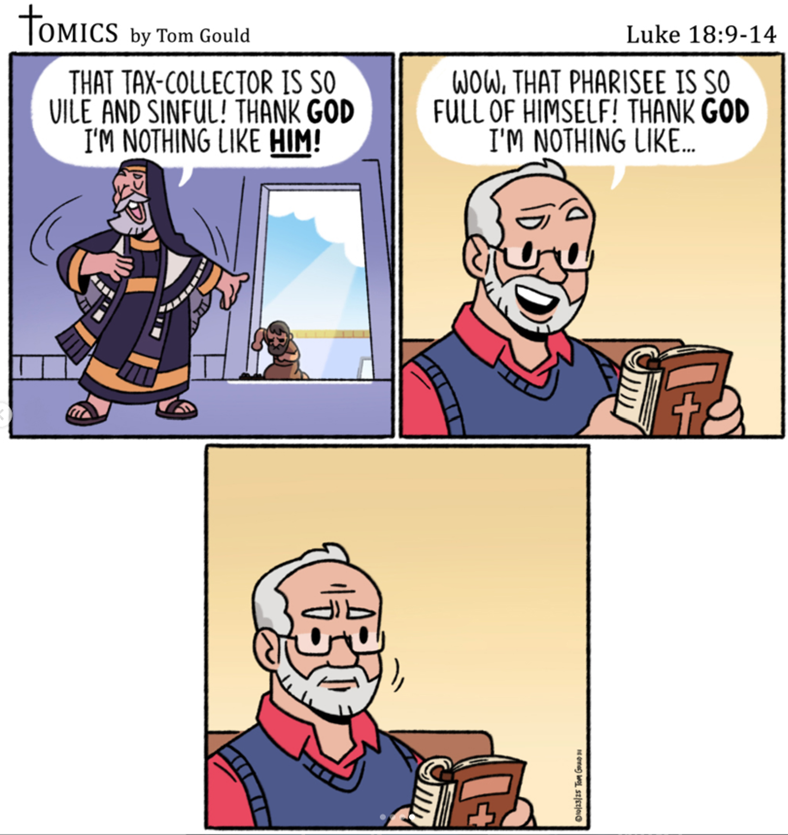
If we are honest, all of us— maybe it’s just me — from time to time, find ourselves, in prayer, bringing the best of ourselves to God while we simultaneously bring the worst of others. Boasting and backbiting fall out of the same mouth, twisting prayer away from what it’s supposed to be.
The historian (not the Spider-man actor), Tom Holland, in his book Dominion, notes that in Homeric Greek the word euchomai — “to pray” (a tense of which Luke uses in this passage)— often meant to boast. To declare your excellence before the gods in order to get their gratitude and applause. In the famous story of the Trojan war, The Iliad, the legendary warrior, Achilles, stands in the midst of battle and does just that; calling on the divine by rehearsing and retelling his greatness to them.[xxiv] It’s the standard formula of, ‘This is why I deserve honour, because I have done X, Y and Z…’
But, in contrast to that very Greek idea of prayer, as Rabbi Jonathan Sacks noted, the Hebrew root idea for prayer, lehitpalel, means to judge oneself. It is neither boast or backbite. Rather, prayer is the place where the relentless ‘I’ falls silent. It is the moment we stop measuring ourselves against others or against our own achievements and face the truth of who we are before God.[xxv]
And this is where the second man, the ugly man, is crucial.
He doesn’t presume to lift his eyes toward heaven. He just beats his chest and prays a very short prayer. No résumé. No comparison. No argument. Just a plea; a plea for mercy.
The Greek word translated “be merciful” is strange, because it’s not the usual word for mercy. The Tax Collector picks a word that is inextricably tied to the language of atonement, of sacrifice, of reconciliation. In other words, the Tax Collector is not offering God anything. He is asking God to do something for him that he cannot do for himself; for God to do the offering because he comes empty handed with nothing to offer.
In a way, the Tax Collector’s prayer is the only honest prayer in the room.
Not because he is morally superior to the Pharisee. That would miss the point entirely. If we turn this story into “bad Pharisee, good tax collector,” we have simply repeated the Pharisee’s mistake with different characters.
But it’s honest because he simply acknowledges the truth of his situation before God: He has nothing to give, and everything to receive.
He is lifeless, but God is life.
I like what the preacher and chef, Robert Farrar Capon said about this parable. He pointed out that the lesson of this parable is not the virtue of humility. It’s about recognising that we are lifeless and putting your faith in the God who raises the dead.
As Capon bluntly indicates, spiritually speaking, both men are dead. Sadly, only one of them knows it.
The Pharisee is sincere, disciplined, religious, morally serious—and yet he still believes he is fundamentally alive enough to present something to God. Whereas, the Tax Collector has abandoned that illusion. He has reached the point where he knows he has nothing to bring except the need for mercy.[xxvi]
Prayer was never meant to be a place where we bring our comparisons to God. Prayer is where our comparisons are meant to die.
Prayer, as Jesus is showing us, is about receiving mercy and life from the God who sees us clearly.
TWO BECOME ONE
With this parable, Jesus is not teaching us to craft better prayers. He is teaching us to come honestly.
And, in the end, this story is not about two different kinds of people, as such, but two different voices that exist within each of us whenever we enter prayer.
Sometimes, there is the voice of the ‘good man’, in us all …
The voice that quietly rehearses our strengths. The voice that draws subtle lines between ourselves and others. The voice that would quite like God to notice that, all things considered, we’re doing reasonably well and that we’ve got plenty to offer Him.
And if we are honest, that voice can slip into our prayers surprisingly easily. Our prayers can become crowded with other people: people we measure ourselves against, people whose failures reassure us, people whose faults we quietly hold up beside our own virtues. Because, when all is said and done, comparison is one of the easiest ways to avoid honesty.
But Jesus dismantles that instinct completely. In the presence of God, there is no ladder. No hierarchy. No spiritual scoreboard. There are simply people who need mercy and divine life.
So put down the measuring tape.
No one is so good that they do not need grace.
And then, at other times, there is the voice of the ‘ugly man’…
When the comparisons no longer work and collapse. When we arrive before God without any impressive story to tell. Moments when we come to prayer carrying guilt. Or shame. Or regret.
When we come painfully aware of our failures, aware of the ways we have hurt others, aware of the gulf between who we are and who we were meant to be. And in those moments, we can begin to wonder whether we even belong in prayer at all, as we wrongly imagine that prayer is for the put-together people, for the spiritually successful, assuming God deals in clean things and tidy lives only.
We may even ask ourselves, ‘what right do I have to approach God at all?’
But the gospel, strangely and beautifully tells us a very different story. God deals with the dead.
So come, bring your emptiness—it’s easier to fill something that is empty.
Grace and life do not meet us where we pretend to be alive. Grace and life meet us where we finally admit we are not.
No one is so bad that they cannot receive grace.
Dead is dead, as Capon says, and God raises the dead.
‘If we claim to be without sin, we deceive ourselves and the truth is not in us. If we confess our sins, he is faithful and just and will forgive us our sins and purify us from all unrighteousness’
– 1 John 1:8-9
‘I acknowledge, Lord, and I give thanks that You have created Your image in me, so that I may remember You, think of You, love You. But this image is so effaced and worn away by vice, so darkened by the smoke of sin, that it cannot do what it was made to do unless You renew it and reform it.’
— Anselm of Canterbury[xxvii]
END NOTES AND REFERENCES:
[i] Spoken by Obi-Wan Kenobi (Alec Guinness) to Luke Skywalker (Mark Hamill) while overlooking the spaceport, as they seek for a way—more importantly, a pilot—to help them leave Luke’s home-planet of Tatooine, in Star Wars: Episode IV – A New Hope (Lucasfilm, 1977)
[ii] Charles Haddon Spurgeon, Comfort For Those Whose Prayers Are Feeble (March 12, 1906, Metropolitan Tabernacle Pulpit Volume 54)
[iii] Psalm 116:2 (NLT), emphasis mine
[iv] I reflected on some of this in the first session of this series: UTTER …
[v] To be clearer: in none of the original books. Modern adaptations placed these words on Sherlock’s lips.
[vi] This caught me out a few weeks ago, in a board game I was playing with Corban. He reminds me of it weekly.
[vii] The famous songwriting duo, Ray Evans (lyrics) and Jay Livingston (music), got it right when they penned the 1950’s hit Mona Lisa, famously performed by the great Nat King Cole.
[viii] As an aside, it’s telling that we never hear about Jesus eating with the Sadducees, who were the official priests at the time. He never receives any invite to eat with them.
[ix] I could also add, as one further example from Luke’s writing in Acts, that it was Gamaliel, a highly respected teacher and Pharisee, who speaks on behalf of Peter and John after they are arrested by the Sanhedrin (Acts 5:34-39)
[x] Rabbinical thought—which traces its movement back to the Pharisees (who were able to preserve Judaism despite the disasters of the war against Rome in the middle of the first century, the destruction of the temple, and the increasing numbers of Jews taken into diaspora as slaves)—also acknowledged that there could be both arrogant and humble approaches to religion, as the Talmud itself later admitted (see, b. Sot. 22b). This concept is not new to the Hebrew scriptures as a whole.
[xi] Flavius Josephus, Jewish Wars, 1.110, where he speaks of the agreement of some Pharisees with Alexandra, the widow of King Alexander Jannaeus who inherited the kingdom of Judea upon his death in 76 BCE. She was a Hasmonean queen who ruled for nine years (76–67 BCE). I don’t personally see Josephus aiming this critique at all Pharisees, though he uses the term as a collective party. As a modern analogy, when we speak of the Labour government, for example, and levy any critiques against it, we (for the most part) know we are not describing every individual within it, nor the span of its history.
[xii] Ibid, Antiquities, 13.297-298
[xiii] Psalm 24:3
[xiv] Amy-Jill Levine and Ben Witherington III, The Gospel of Luke, New Cambridge Bible Commentary (Cambridge University Press, UK, 2019), p. 491
[xv] He wouldn’t be the only tax collector who could: Levi (Lk. 5:29) certainly could afford to do so.
[xvi] Amy-Jill Levine, Short Stories by Jesus: The Enigmatic Parables of a Controversial Rabbi (HarperOne, an imprint of HarperCollinsPublishers, NY, 2015), p. 188
[xvii] Amy-Jill Levine, Ibid, pp. 188-189
[xviii] Craig L. Bloomberg, Interpreting the Parables (IVP Academic, Downers Grove, IL, 2012), p. 342. Diane G. Chen, Gospel of Luke, The New Testament in Color: A Multiethnic Bible Commentary (InterVarsity Press, Downers Grove, IL, 2024), p. 160-161
[xix] Amy-Jill Levine, Ibid, pp. 188-189
[xx] Listen to, UTTER … FAILURE, by Helen Jenkinson.
[xxi] Equally, when Luke writes this down and “posts” it as a letter, he, too, is addressing this lesson to the early church.
[xxii] See Luke 9:46, for one example.
[xxiii] Or, in Chrysostom’s words, ‘To despise the whole race of man was not enough for him; he must yet attack the tax collector.’ (As quoted in Luke chapter 18 of the Catena Aurea by Thomas Aquinas). I can’t find the reference anywhere else, so I am uncertain of where Aquinas sources this comment. The closest I can come to is in Chrysostom’s Homily on Matthew 6 (his 19th Homily on Matthew), where he writes, ‘And he was vainglorious too in his very prayer, making it for display. For since there was no one else present, he pointed himself out to the publican, saying, “I am not as the rest of men, nor even as this publican.”’
As an additional voice, Augustine of Hippo also pointed out that the vice of the Pharisee was not his good works—such as fasting, or giving a tenth of his possessions to the poor (a tithe), or that he was neither an adulterer or extortioner; all this is commendable. The issue, in Augustine’s words, is that he was ‘proudly vaunting himself above the publican.’ (Letter 36, chp 4, circa A.D. 396). Augustine also adds the important reminder, that, ‘the Scripture does not say that the Pharisee was condemned, but only that the publican was “justified rather than the other. “’
[xxiv] Tom Holland, Dominion: The Making of the Western Mind (Abacus, UK, 2020), p. 14.
[xxv] Rabbi Jonathan Sacks, Covenant and Conversation: Genesis, The Book of Beginnings (Maggid Books, 2009), p.192.
As an additional thought, it could be that Luke, who is the only gospel writer to include this parable, felt that his Greek audience (considering the book is addressed to Theophilus) needed to understand this important distinction.
[xxvi] Robert Farrar Capon, Kingdom, Grace, Judgement: Paradox, Outrage, and Vindication in the Parables of Jesus (Eerdmans, Grand Rapids, Michigan, combined edition, 2002), pp. 337-344
[xxvii] Anselm of Canterbury (c. 1033-1109), Proslogian, The Major Works, Oxford University Press (Oxford, 2008), p. 87
 TRISTAN SHERWIN
Leave a comment