Here’s my longer notes from this morning’s Metro Christian Centre, Bury service (5th April, 2026), as we gathered to celebrated the birth of our hope with the resurrection of Jesus Christ.
You can also catch up with this via MCC’s YouTube channel (just give us time to get the video uploaded).
‘“[W]e had hoped that he was the one …”’
— Cleopas, Luke 24:21a (NIV)
‘The Birth of Christ is the eucatastrophe of Man’s history. The Resurrection is the eucatastrophe of the story of the Incarnation.’
— J. R. R. Tolkien[i]
READ: LUKE 24:13-41 (NIV)
PICASSO-LIKE PERCEPTION
A long, long, long time ago, in a galaxy very near to us …
… our galaxy, actually, and in 1969, human beings travelled nearly 240,000 miles across the vacuum of space and placed their earthy feet on the dusty surface of the moon.
This remarkable moment, at a rough guess, had 650 million people sat in front of their televisions around the globe (not counting those who listened to it on radio).
Up to that moment, for all of human history, people had merely looked up at that same moon—poets, lovers, kings, children—and suddenly, for the first time, we were touching it, bouncing along it, playing golf on it.
It was, in Neil Armstrong’s words as he took that small step onto the lunar surface, ‘a giant leap for mankind’, one that forged an entirely new perspective about our world and what it means to be human. In just 4 days, 6 hours, and 45 minutes—the time it took the Apollo 11 crew to reach the moon—the horizon of what had seemed possible for tens of thousands of years suddenly expanded.
Sure, for decades before this, people had imagined if it could be possible—science fiction writers chief among them. But now we had done it; fiction became fact.
An amazing and extraordinary fact, to be sure.
And yet, not everyone was amazed.
The New York Times ran some interviews, asking famous people to comment on this milestone in history. One of those was the renowned artist Pablo Picasso, who reportedly responded to the moon landing with a shrug, saying:
“It means nothing to me. I have no opinion about it, and I don’t care.”
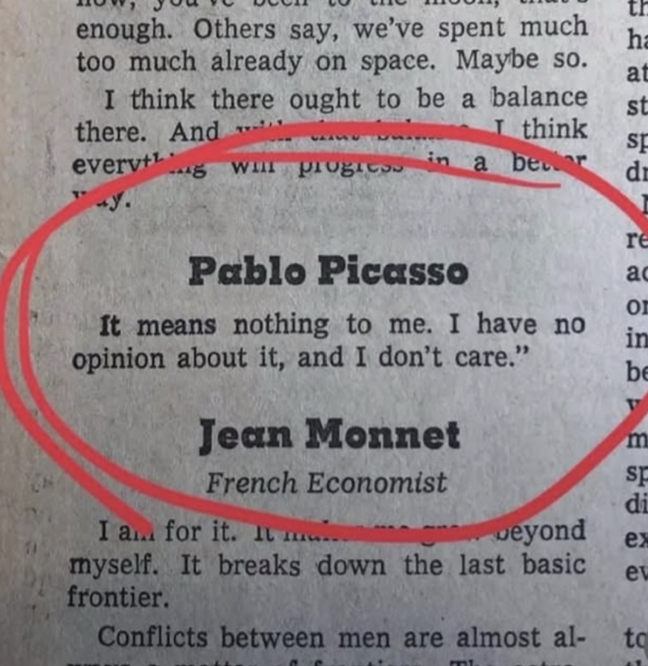
Picasso had a way with words.
If we’re honest, though, we get it where he’s coming from, because regardless of how monumental the moment was, and remains to be, most people still had to get up the next morning, go to work, and deal with grief, anxiety, relationships, bills, and all the questions that sit in the back of our minds.
Humanity had placed its feet on another world. Yet we still had to wander along the roads of this one, and the roads we wander haven’t really changed all that much since.
It is incredible and amazing! But, so what?
Picasso hit the nail on the head.
This question—so what?—isn’t new.
When it comes to Easter, Christians make an even bigger claim than walking on the moon.
That Jesus of Nazareth, who was executed publicly and brutally, killed conclusively, was then, three days later, raised from the dead.
Now, if you wished, you could explore the historical side of this claim. I’ve heard lots of people remark that, ‘Jesus didn’t even exist’ and we have no evidence that he ever did.[ii] As such, there’s no need to even think about it at all.
But there’s famous historian, called Bart Ehrman, who slams that idea completely. In one of his books, he writes:
‘I am not a Christian, and I have no interest in promoting a Christian cause or a Christian agenda. I am an agnostic with atheist leanings … But as a historian, I think evidence matters. And the past matters. And for anyone to whom both evidence and the past matter, a dispassionate consideration of the case makes it quite plain: Jesus did exist.’[iii]
Another historian, Tom Holland, who’s been speaking a lot about this in recent years, said something similar in a debate from February this year. Holland was making that point that, considering this is a guy (Jesus) who gets crucified, who is put to death by the Roman authorities in an obscure corner of the Roman Empire, it is astonishing how many extrabiblical references we have of him.
He goes on to add,
‘The fact that we have mentions of Jesus in a large number of classical texts, relatively speaking, is remarkable.
Essentially, it’s often said that we know very little about Jesus and that this is therefore evidence that he may not even have existed. That is absolutely not the case.’[iv]
Many, if not all (with the exception of the odd radical here and there) non-Christian historians like Bart Ehrman and Tom Holland agree on key facts: that Jesus lived, that he was crucified, and that very quickly, his followers came to believe he had risen from the dead and staked everything on announcing this.
It’s not that the claim came along centuries afterwards, or after a few generations either. The claim was made by the very people who knew Jesus, most of whom died because of that claim.
The whole emergence within history and spread of Christianity rests on this single announcement that Jesus had risen from the dead.
And the spread was so effective—despite all the cultural odds against it[v]—that, by the time we get to 182AD, within 150 years of his death and resurrection, the message had spread all the way from Judea and there was a Christian community down the road of here, in Roman Manchester, a street away from where the Beetham Tower now stands.[vi]
I know this doesn’t say it all, and more could be said. But it’s amazing non-the-less. And I want to be of some help to anyone who’s asking those questions.
But, even if you satisfy your intellectual itch and resolve all your questions about the events at Easter, you still have to ask:
So what?
DIVINE MAGNETISM
So let me explain it another way.
Have you seen people doing magnet fishing?[vii]
It’s exactly as it sounds: A powerful magnet is tied to a rope that is then thrown into dark, murky water—rivers, canals, docks. Places where things are accidentally lost or where things are purposely cast away to be buried in the silt and sediment at the bottom. And they just, slowly and patiently, drag this magnet along the bed of the water.
Often, the magnet connects and they pull up things that have been lost for years.
And not just shopping trolleys.
A bike that was stolen. A safe someone tried to get rid of. Coins. Tools. Engines. Long forgotten things. Things people assumed were unsalvageable and gone for good.
To say the obvious—those objects don’t find their own way back up. They’re found by something that has plunged down in search of them and then pulled up by something stronger than the water and miry clay that anchors them down.
Hold that image, because this is what God has done in The Incarnation—this plummeting search that commenced in the events we celebrate at Christmas and concludes in the events we remember at Easter.
God has gone down into the depths of our world—down into our mess; down into our pain; down into our sin; down into death itself. Not skimming the surface with whatever floats, but right into the seabed with everything that has sunk, everything that is wrecked.
And God has done this not just to visit, or to observe, but with the purpose of bringing things back up with Him. And God certainly hasn’t come back up empty-handed. In the resurrection of Jesus, God brings life up with him. Hope up with him. A future up with him.
C. S. Lewis described the Jesus story like this:
‘In the Christian story God descends to reascend. He comes down; down from the heights of absolute being into time and space, down into humanity … down to the very roots and seabed of the Nature He has created. But He goes down to come up again and bring the whole ruined world up with Him.’[viii]
In the resurrection, Jesus does so much more than escape death. It’s Jesus pulling life out of death, defeating death. It’s not just that He rises, it’s that He brings resurrection with Him. It’s not that Jesus saves his own skin—he’s come to save you and me from the sin and death and evil that anchors us to the seafloor, so to speak.
To use the words of one Old Testament writer, God lifts us out of the slimy pit, out of the mud and mire, to set our feet on solid rock.[ix]
Or, in the words of a New Testament writer, God came to rescue us from the Kingdom of Darkness and bring us into the Kingdom of his Son.[x] Dredging us out of the murky depths and bringing us into the light.[xi] And he has done this through his death on the cross and through his resurrection from the dead.
This is what Easter is all about.
SAME ROAD, NEW WORLD
But, so what?
As I said before, the Christian claim from its very beginning, is that Jesus is alive! It all rested on this.
That’s not to say the earliest believers had no problems swallowing this. When you read the gospel accounts, no one was expecting Jesus’ resurrection, and everyone’s surprised and confused:
The women who went to the tomb early Sunday, went expecting to embalm a corpse.
The disciples are hiding because they fear what the authorities will do them because they followed Jesus. They’re certainly not eagerly desiring to say anything about Jesus; they know he’s dead, and they could be, too, if they say something publicly. And when the women turn up saying that Jesus is alive, it understandably sounds like total nonsense.
And the two individuals travelling toward Emmaus are genuinely downcast as they walk away from Jerusalem, certain it’s all other.
Like all of us, they knew that no one comes back from the dead. They had no doubts about this.
In fact, the only time they are said to have expressed any doubts is when they encounter the risen Jesus (Lk. 24:41). It would be easier and much safer, let alone saner, to affirm that he was still dead.[xii]
And yet, they encounter this living, breathing, walking, talking and eating, physical Jesus.
Not a resuscitated man. Not some bodiless phantom, either. And certainly not some sort of zombie. Jesus wasn’t just back from the dead, but back and better. There is no taint of death upon Jesus and no claim death has over him. He is gloriously alive in a way that you and I, even in our own living physicality, are merely shadows of.
He had risen!
No one had ever done this before. No one has done so since.
If Jesus was really raised from the dead, it’s more than a milestone of history, like the moon landing is. It is the pinnacle of all history, the turning point of the entire universe. It is the one event that really changes everything.
The two travelling to Emmaus that day, certainly thought so.
They had once walked into Jerusalem full of expectation. But when we meet them in this scene, they are walking away from Jerusalem, tired and shattered, heading toward the small village of Emmaus, trying to make sense of what has just happened as they play with the shards of their dreams.
In their conversation with this “stranger” who comes alongside them, they use three words that say it all, really:
‘We had hoped … ’
They had hoped the world would be different. They had hoped Jesus would restore Israel, defeat the Romans, and usher in the kingdom of God. They had hoped that everything they had seen in Jesus—the authority, the compassion, the strange sense that God himself was present—was pointing toward a new future.
But instead, Jesus had been crucified. And now, as far as they could see, nothing had changed. Rome still ruled. The world was still broken. The same fears and injustices remained. Whatever promise they thought they had glimpsed in Jesus seemed to have a died a shameful death like he had and disappeared with him into the tomb.[xiii]
. . .
‘We had hoped’ carries enormous weight. It’s not simply an expression of grief. It’s the humiliating, discrediting defeat of a specific expectation.
Most of us, I think, have a ‘we had hoped’ of our own. Most of us know that road.
Like that road to Emmaus, it’s a road we’ve walked — or are currently walking — where something we hoped for ran headlong into what actually happened, and what actually happened won.
We had hoped that the relationship would have lasted.
We had hoped that the diagnosis would have been different.
We had hoped the treatment would work.
We had hoped that peace would have reigned, and war would not have prevailed.
We had hoped that if we did everything right, things would go right. And then they didn’t — and the hope doesn’t just fade; it collapses under the weight of what actually happened.
There are many roads like the road to Emmaus, even if the details differ.
If we were reaching for language, we would call these moments catastrophes.
It’s a Greek word meaning disaster.[xiv] When we say something a catastrophe, we’re not describing a mess that can be tidied up, like spilt milk. We are describing a total shipwreck—the destruction and the sinking of our world. What’s gone is unrestorable and the world will never be the same again.
When we meet these two travellers, they are feeling the crushing weight of catastrophe.
And yet, by the end of the story, something has dramatically shifted. They’re back on the road—the same road—walking it once more.
The same road they had walked in sorrow, was the very same road they now hot footed back down with hope.
It was not that the road had changed. It hadn’t—and neither had the scenery. Their dreams where still smashed. Their circumstances hadn’t changed in the slightest. The world, from the outside looked exactly as it had when they were on their way to Emmaus: Rome was still in charge. The cross had still happened. The same violence, the same grief.
Nothing had changed in any of this.
But they now knew something that reframed every step of it: Jesus is alive—and had been walking with them.
It’s a bit like reading a book where everything is falling apart. The kind of story where you get halfway through and think, ‘There’s no way this ends well.’ The protagonist is losing. Everything is collapsing. And based on everything you can see on the page in front of you, there is no way back from this.
But then, you do that thing some readers do, and you take a sneaky peek at the last page, and discover that somehow it has all worked out.
You still don’t know how it can work out, but you now know, without doubt, that it will.
And once you know this, you go back to the middle of the story, and everything is different. You’re still in the same chapter. The darkness on the page is still dark. The circumstances haven’t changed in the slightest, but your confidence has, your reading of the story has, because you’ve seen the end.
That’s what the Resurrection of Jesus does. (At least, one of the things it does!)
Christ’s resurrection doesn’t erase the hard chapters. It doesn’t pretend the cross wasn’t the cross, or that the grief wasn’t grief. The present the darkness doesn’t disappear. But it reveals that what looked like the final word — wasn’t.
My favourite author, J. R. R. Tolkien coined a word to describe this sort of turning point in a story, this sudden upward thrust and change of circumstance. He came up with the word eucatastrophe.[xv] Basically, he took the Greek word disaster and stuck the Greek word for good at the beginning of it. Ergo, a ‘good disaster.’ Genius! Like a world-ending event that cannot be undone, something good has now happened that means the world will never be the same again.
When Tolkien applied this word to Jesus’ resurrection, he pointed out that the eucatastrophe Christ has brought about is not a turning point that we wait for, but, in the same way we preview the end of a story, it becomes an event that reaches backward and forward across all of history —into the middle of our own stories —saying to us: the darkness does not have the last word.
If Christ is risen — and he is — then the darkness you’re in is not the final chapter. And the God who pulled life out of death is not finished yet.
SO WHAT?
The Emmaus road was walked in sorrow and then ran back with hope because of one thing only: these travellers had met the risen Jesus. That meeting is still available. And it still changes everything.
Not all of us will get to walk on the moon, but we can all encounter the risen Jesus.
And here’s what makes it all the more remarkable.
Jesus doesn’t wait for these two to find their faith again before he shows up. He doesn’t appear to the people who’ve got it all figured out intellectually. He walks toward two people heading in the wrong direction with their hopes in ruins, and he falls into step beside them. He meets them in the middle of their catastrophe, on the very road of their despair.
The God who went all the way down into death and pulled life back up with him has a long history of meeting people on their Emmaus roads. Like a magnet dredging the bottom of a canal, he comes to find you where you are. On your road. In your chapter. In the middle of your ‘we had hoped.’
Wherever you are — the same road walked in sorrow can become a road walked with hope. Not because the road changes. But because of who is on it with you.
You might be someone who’s never really done this before; never asked Jesus to be part of your story —never considered that he might already be walking your road and you’ve just not recognised him yet.
But my prayer for you today is that, like those travellers, your eyes would be opened, your heart would be warmed, and that you would encounter the risen Jesus for yourself.
More than this, that you leave here today, by the same road that brought you, but never quite the same again.
‘Living, He loved me; dying, He saved me;
Buried, He carried my sins far away;
Rising, He justified freely forever:
One day He’s coming—O glorious day! [xvi]
ENDNOTES AND REFERENCES:
[i] Tolkien, On Fairy Stories
[ii] Contrary to this: ‘We have as much reason to believe that Jesus was a historical figure as we do to believe that Caesar Tiberius existed. There are ten sources documenting Tiberius’s existence recorded within 150 years of his life (one of which is a Christian source) whereas for Jesus of Nazareth, we have 42 sources documenting Jesus’s existence in the same time-frame (nine of which are non-Christian sources).’ – David Nixon, Have You Ever Wondered? Finding the Everyday Clues to Meaning, Purpose & Spirituality, ed. Andy Bannister and Gavin Matthews (10Publishing, a division of 10ofthose.com, 2024), p. 116
[iii] Bart D. Ehrman, Did Jesus Exist? The Historical Argument for Jesus of Nazareth (HarperCollins, London, 2012), p. 5, emphasis mine
[iv] Tom Holland, in conversation with Justin Brierly and Dr Peter J. Williams, February 2026: https://pillarandstep.com/history
Holland goes on to add, ‘Considering who he is, and considering the range and variety of sources we have for the entire history of the empire, the number of allusions to him is, I think, really considerable.’
There is also a introductory booklet that can be downloaded from the event, here: https://pillarandstep.com/docs/His_Story_Booklet.pdf
[v] For some further reading on these ‘cultural odds’, I’d recommend: Religions of Rome, Vol 1. A History, by Mary Beard, Simon Price and John North; The Patient Ferment of the Early Church, by Alan Kreider; and Destroyer of the Gods, Larry W. Hurtado.
[vi] For Britain’s earliest Christian relic found thus far, see: https://ilovemanchester.com/christianity-roman-relic; and https://museumcollections.manchester.ac.uk/collections/narrative/abaf7819-93f9-3c1b-ad9a-b84ef5b112c5/?s%3Dword%2Bsquare&pos=1
[vii] If you’re curious, the best of these is the very enthusiastic and extremely watchable Bondi Treasure Hunter: https://www.facebook.com/bonditreasurehunter
[viii] C.S. Lewis, Miracles, Chapter 14
[ix] Psalm 40:2
[x] Colossians 1:13
[xi] 1 Peter 2:9; Ephesians 5:8; John 8:12
[xii] To say something extremely obvious, but which is often overlooked by sceptical examinations of their claim that Jesus had rose from the dead: They did not have to say such things, other alternatives existed, there was no social or psychological pressures which required them to respond with such an announcement, and no one would have expected them to do so.
To reduce some points that professor N. T. Wright makes at length, in his excellent tome The Resurrection of the Son of God (great book!), there were lots of people who had made claims about being a Messiah or something akin to this, who then perished. And when they did, their followers had a choice: disband and scatter or continue with the cause.
Jesus’ disciples could have said, ‘Oh! That’s a shame, turns out Jesus wasn’t it,’ and then, if they fancied, followed or chosen another successor of the cause. Alternatively, they could have responded with, ‘Sure, Jesus is dead, but we still feel connected to him and his teaching in some way, in a spiritual sense.’
Many movements—socially, politically, religious-based or even hobby-centred—have done these two things. These responses are so “normal” that we never bat an eyelid when they continue to be done. What no one had ever done, like the first Christians did, was to say: ‘Jesus really died’ and then, within three days, be risking their lives saying, ‘He is risen—Jesus is alive! I’ve seen him.’
This was both unique and extraordinary, and remains so. In Wright’s view, the weight of this cannot be ignored in the conversation over the historicity of the resurrection.
[xiii] As a fuller statement, Luke records there hope more fully as, ‘We had hoped that he was the one to redeem Israel.’ (Luke 24:21). To our modern ears, this might sound like a vague spiritual hope. But ‘redeem Israel’ was loaded political language—the same political hopes flavouring the shouts of ‘Hosanna’ and the waving of palm branches as Jesus rode a donkey’s colt into Jerusalem seven days earlier.
Almost a century and a half before Jesus, a man called Judas Maccabeus led a revolt against the Seleucid Empire, freeing Israel from foreign regimes and to national independence for the first time in, well, lets just say the time of the books of Kings (a long, long time ago)— events that are now marked by the celebration of Hanukkah. After gaining victorious independence, the crowds celebrated by taking palm branches and waving them in the air. Judas got nicknamed, like we nick name wrestlers, ‘the hammer’, to mark his crushing-oppression crushing abilities. And, taken with the imagery, in the decades that followed, the coinage of Irael’s new independence (known as the Hasmonean period) was stamped with palm branches.
The independence didn’t last long, though. Just shy of century after Juda’s cleansing of the temple, in 63 BC, the Roman general Pompey seized Jerusalem, ending independent Hasmonean rule and turning Judea into a client kingdom of the Roman Republic.
Roughly ninety years after this, when the crowds of Palm Sunday shout ‘Hosanna’ (which literally means ‘save now’) and wave their palm branches again, they are doing so filled with the hope and expectation that Jesus will rescue them from Roman oppression just like they were rescued before from Seleucid rule. They want Jesus to be a ‘hammer.’
The Messiah, in their understanding, was the one who would win — overthrow Rome, restore the nation’s independence, and reign as conquering king. That’s what the category meant. That’s what the two walking the road to Emmaus (along with the disciples, as their numerous conversations with Jesus on the way to Jerusalem reveal) had staked everything on—despite Jesus’ constant rebuttal of these ideologies.
They had expected him to redeem Israel. To break Rome’s grip. To be the kind of messiah their history had been groaning toward for centuries — a king who would win. Publicly. Visibly. Decisively.
And instead, he was crucified (by the Romans, I should add). Which, in their world, wasn’t just a tragedy.
The crucifixion of Jesus didn’t just kill that hope. In their world, it discredited it entirely. Jewish understanding was unambiguous: a man executed on a Roman cross, hung on a tree, was under the curse of God. A crucified messiah wasn’t merely a failed messiah — he was a contradiction in terms. The cross seemed to disprove the very claim Jesus had been making in the most public, humiliating way imaginable.
In reality, I will add, the cross wasn’t a failure. To use Frederick Buechner’s wording, it was the Magnificent Defeat. It was God’s means of defeating and delivering us from the powers that enslaved us: sin, death and Satan. The cross didn’t disprove Jesus’ claims, it challenged and overturned the miliary expectations of Jesus’ generation.
[xiv] To be more precise, cata means ‘down, against, back’, and strophe means ‘turn’. A literal translation, then, would be downturn. But this doesn’t really capture the suddenness, weight, or rate of descent. So, maybe ‘drastic downturn’ gets us closer. But disaster says it best.
[xv] Tolkien discusses this in what is catalogued as his Letter 89. In his book, On Fairy Stories, he also writes, ‘[Eucatastrophe] does not deny the existence of dyscatastrophe, of sorrow and failure: the possibility of these is necessary to the joy of deliverance; it denies (in the face of much evidence, if you will) universal final defeat and in so far is evangelium [good news], giving a fleeting glimpse of Joy, Joy beyond the walls of the world, poignant as grief.’
[xvi] ‘One day when heaven was filled with His praises’, written by, John Wilbur Chapman (1859-1918)
 TRISTAN SHERWIN
Leave a comment