Here’s my longer sermon notes from this morning’s Metro Christian Centre, Bury & Whitefield service (dated 13th March 2022), continuing our series on the Apostles’ Creed. You can also catch up with this via MCC’s YouTube channel.
‘I believe in the Holy Spirit, The Holy catholic church, The communion of the saints, The forgiveness of sins.’
SINGLE BEDS
There were five in a bed and the little one said, ‘roll over, roll over.’ They all rolled over and one fell out, and he hit the ground and gave a shout, saying, ‘please remember, to tie a knot in your pyjamas, single beds are only made for 1, 2, 3, 4 …
There were four in a bed . . .
If you are familiar with this song, then you’ll know how it ends. Everyone keeps rolling over until only the ‘little one’ is left, enjoying the bed’s comfort and space all to his or her self, whilst everyone else is left scrabbling about on the floor.
It is a silly song. Yet, it does get me thinking: We are not very good at sharing our bed—metaphorically speaking, of course!
I’ll explain what I mean.
Over the past eight weeks, we’ve journeyed through the creed. And it would be easy to stop, I suppose, after the statements about Jesus’ ascension and his return. We could draw a line in it, there, and each one of us could walk away holding on to those truths, leading our separate lives. But the Creed takes us further: it doesn’t leave us as individuals, it pulls us into the truth that the consequence of all this—one may even say the purpose of all this—is community.
The story of Jesus doesn’t end with Jesus, it continues in this community of people who believe in him and follow him.
God does not call people to live in isolation. We cannot embody God without community. If we are truly people who are listening to, believing in and following the Holy Spirit, then the Spirit does lead us and fit us into this marvellous, yet messy, beautiful, yet complex organism of community.
We call it church. It’s not a building, an institution, or a social network with a mission statement and a website. It’s a community. Not a community of perfect people—definitely not! But humbled people, gathered around the story and life of Jesus, stumbling in his footsteps, allowing his resurrection life reform them, through the indwelling of the Holy Spirit.
In the words of the creed, it’s described as ‘the Holy Catholic church, the communion of the Saints.’
I noticed the drop in volume when we read the first part of that line together! But the word Catholic simply means universal. The church is a body of people spanning across different times in history, across different tribes, languages, cultures, nationalities, age groups, denominations, branches, streams … etc.
A diverse community spread out across our world and history, meeting in different places, with differing styles and ways; yet they are all mysteriously united in one Spirit.
However, we often have reservations about that. Maybe it’s the size that scares us? Maybe we want something that just reflects our preferences. And so, sadly, as Christians, we want to define that Christian community and scale it down, maybe reducing it back to a particular people, a particular colour, style or denomination. Maybe even to a particular cluster of people we like and who agree with our preference for a particular Bible translation.
Again, the drop in volume when we spoke the words, Holy catholic church, really does speak of our discomfort with the idea of a universal body of Christ.
Like the ‘little one’, we are often asking people to roll over…
We are going to read a wonderful passage that the Apostle wrote in the letter called, Ephesians—which is Paul’s great letter on what makes the church, church.
As we read this passage, we will jump over a section of verses (3:1-13). Only because, as most commentators will note, Paul breaks off mid-sentence, and takes a detour talking about his call to the gentiles, and then picks up what he was about to say at verse 14.
READ: EPHESIANS 2:14-22, 3:14–4:6 (NLT)
ME-SIZED PROBLEMS
Throughout this passage, Paul is in awe of this thing called church—this universal Holy-Spirit brought-together, Holy-Spirit-held-together community.
Paul thinks it is great! Maybe we would disagree? But Paul sees it all as part of the wisdom and scope of God’s plan—a dwelling of God (2:22); when different people come together in Jesus, God’s wisdom and greatness, in all its rich variety, is shown to the world (3:10-11).
This doesn’t mean Paul thinks the church is perfect, or problem free. Paul is not blinded by sentimentalism or led by idealism. We may struggle with this, though. We may believe that if God is truly involved then the church would be an idyllic place populated with idyllic, irresistible people. But the church is not like that—it’s got people like you and me; people with foibles and problems and preferences; people in process.
Paul is realistic. He understands, as Eugene Peterson worded it, that ‘Getting saved is easy; building a community is difficult.’[i]
Community has always been difficult. Paul not only acknowledges this, but, as Paul highlights in chapter 2, our lack of community—our ‘walls of hostility’ (2:14)—have always been a problem; a problem that, somehow, the cross of Christ has come to put an end to.
As I mentioned the other week (CREED // BURIED, RAISED), humanity was made to reflect God, to symbolise God. One of the main avenues this was to be seen was in our relationships with one another. Our love for God was to be shown forth in our love for our neighbour.
But getting along, loving one another, resisting greed, selfishness, envy, strife… doesn’t come easy, especially when differences are involved. And so, God’s Spirit has being trying to shape the reflection of God within human community ever since the beginning.
However, we are resistant.
If you think about it, the Bible is, in one light, a whole treaty on our inability to get along.
In the testimony of the scriptures, we are often found redefining, distorting and shrinking neighbour to someone who is like me, or reducing the idea of ‘community to conditions congenial [agreeable] to the imperial self [me]’—a theme that Jesus challenges in his famous story about a Samaritan.[ii]
In the Scriptures, the human community gets tribal and fractured. Walls of hostility are built. Not only between nations, but, as one of the very earliest stories tells us, even a brother turns against his brother.
Again and again, we see this pattern of the ‘little one’ saying ‘roll over…’, and the mirror of God in humanity gets reduced to a single bed with a sole inhabitant.
I’m reminded of something that the late Rabbi Jonathan Sacks wrote, in his book, Not in God’s Name: Confronting Religious Violence. He takes a look at all the sibling rivalry stories in Genesis: Cain and Abel; Ishmael and Isaac; Jacob and Esau, Leah and Rachel, Joseph and his brothers—most of the book is taken up with them in some form. As Rabbi Sacks states , Genesis is attempting to show us how hostile we are to being the human society that reflects God.
He writes, ‘This is the crucial point, the core problem Genesis is intent of exploring. To create a universe, Genesis implies, is easy. It takes up no more that a single chapter (Gen. 1:1—2:3). To create a human relationship [however] is difficult.’[iii]
We could look at the salvation story of Jesus through the same lens that Rabbi Sacks views Genesis: Jesus defeating the dominions of Sin, Death and Satan, though costly, took relatively little time. The trick now is getting us to behave like a community without walls of hostility, without the abuse of power, without tiers of elitism, and favouritism.
ONE?
Paul is picking up this theme, in Ephesians.
Again, Paul is in awe of this idea of the church, this wisdom of God—that God’s plan has always been to create one people under the headship of Jesus (Eph. 1—2). It’s not a forced together community, but one that is brought together and carefully joined together under the direction of the Holy Spirit as people respond to the grace and love of God.
As Paul writes in 3:14, when he thinks about what God is doing in this carefully joined together community, he falls to his knees and … praises God?
No. Paul prays.
It is a beautiful, powerful prayer. But that Paul prays is fascinating and revealing.
Paul is in awe, but also keenly aware of how fragile this all is.
Not because God is fragile or God’s plans are fragile, but because we, people, are involved in this. Unless we, as the individuals making up this community, get a real grasp of God and allow Jesus to be more at home in our hearts; unless we truly get our roots deep into the soil of God’s marvellous love; without the inner strength of the Holy Spirit, the church will not (and cannot) embody the communal life Jesus called it to. It will again corrode into fractions and sects, with humans dividing other anything and everything instead uniting over the one Lord Jesus, by the power of the one Spirit.
Paul knows this practically. In this letter (like most of his letters), he is addressing a church that contains both Jewish and non-Jewish (Gentile) believers. Two totally different cultures. And Paul is eager that they would understand that there are not two churches.
As he spells out in Ephesians 2, there may be Jewish congregations and Gentile congregations, there may be, preferably, congregations with a mixture of both, but there is NOT a Jewish church and a Gentile church and a mixed church. The is only ONE Church. ONE Body, as he says in chapter 4:4-7: One body with; One Lord; One faith; One baptism, and ‘only one God and Father who is over us all and in us all and living through us all.’
They may be diverse. These communities may meet at different times, in different places, with different people all across Ephesus—but they are all outcrops of God’s one church.
Paul’s emphasis on One and All is fundamental. There’s obviously something going on behind the scenes, where certain communities are suggesting that this one God isn’t with all of us. There are some narrowly believing that their little cluster is the one true church.
It is telling that Paul has to tell the Gentiles (in Eph. 2:19-22) that they are not strangers and foreigners; they are citizens, members of the family, part of the house. Paul is saying this, because some people are saying the opposite, attempting to put tiers into the church, attempting to rebuild the walls that Jesus has torn down.
To go back to my analogy of the bed, Paul’s having to deal ‘little people’, ‘small-minded people’ who are saying ‘roll over, roll over… there isn’t room for you and us’.
KING-SIZED DIMENSIONS
It’s no surprise then, that at the centre of this prayer of Paul’s, in order to expand the thinking of these little people, is this wonderful petition that they may know the King-sized dimensions of God’s Kingdom:
‘May you have the power to understand, as all God’s people should, how wide, how long, how high, and how deep his love really is.’ (Eph. 3:18)
I have often read this verse as if this was about me; about me understanding how deep God’s love is for me. But it’s about the universal scale of the church. It is about understanding how broad and deep, how long and high, and diverse, the community of God’s people really is.
Two thousand years after Paul wrote this, there is still only one church—and it is vast in its scope and variety. But that oneness, like in Paul’s day, is still under threat from people saying, ‘roll over, roll over…’
Eugene Peterson, in his book, Christ Plays in Ten Thousand Places, says that the biggest threat to the church today, as in previous eras, is Sectarianism: Sects. ‘Sectarianism is to the community what heresy is to theology, a willful removal of a part from the whole. … Sects are composed of men and women who reinforce their basic selfism by banding together with others who are pursuing similar brands of selfism.’ Peterson goes on to say that this impulse is strong in the church ‘because it provides a convenient appearance of community without the difficulties of loving people we don’t approve of, or letting Jesus pray us into relationship with the very men and women we’ve invested a good bit of time avoiding. … Sects are termites in the Father’s House.’[iv]
They are termites because the church without diversity in unity stops looking like Jesus and looks more like me.
One of the reasons I wanted to do this series on the Creed, the main reason, is because I want us to understand that there is only one church, and that this group of people, known as Christians, is very diverse. But we can be so tribal and narrow.
As we’ve gone through the creed, we’ve explored the things that Christians hold in common. That was, primarily, the purpose of creedal statements. For some of us, though, it may not have said enough, and it makes us uncomfortable about who we’re sharing a bed with (again, metaphorically speaking!).
For example, we’ve spoken about God being the maker of Heaven and Earth. All Christians hold to that. But for some of us, it is not enough. For some of us, we’re only willing to share a bed with those who are also willing to embrace Young Earth Creationism, or, if you hold a different view, Old Earth Creationism, or Intelligent Design, or Theistic Evolution. But there’s only one church, and it includes all those people.
Some of us are only willing to share a bed with those who hold the same view as us on the atonement. We wish that the creed would say much more than Jesus suffered, was crucified, buried, and resurrected—we want atonement theories. But the one church, throughout its long ages, has always had differing views on how all this has overcome sin.
Some of us want more definition on the second coming; we’re only happy to share the name Christian with those who believe in the rapture. Further than that, we’re only willing to except people as being Christian if they subscribe to a particular version of the rapture (because there are at least five different versions of it). And then there are those of us who don’t believe in a rapture, but we do believe in the Second coming of Jesus, but we’re not happy to call Christian those who believe in a rapture. But the one church contains a diversity of opinion on this.
The main thing is that Jesus is coming back!
And then there’s this thing called Judgement; what it looks like, how long it is, where it all takes place, when it takes place …
With all these things, there is this constant temptation to push people out of the bed. And I get it; I want to push some people out of the bed, too. But that’s not church; it is a club.
Does that mean that anything goes, theologically or practically? Of course it doesn’t.
The creed itself, as we’ve mentioned in previous weeks, developed as a means of defending the faith against sects, against distortions to and deletions of parts of this story of faith. We need good theology. For example, I wouldn’t entertain theologies that permit abuse, or theology that deletes the resurrection. But in its formation, the creed embraced and was faithful to the king-sized dimension of God’s people by defining what was most important.
Does that mean we all agree, or that we are all right and no one is wrong? No.
The church is full of different opinions, and we all should earnestly grapple with the biblical texts in our earnest desire to understand them correctly and contextually.
Does that mean denominations, ‘movements’ and streams are wrong? Not necessarily, no.
The problems begin when a particular denomination thinks that it is the true church, and everyone else is wrong.
We Pentecostals are not the church—it’s bigger than us. For years, our church has been affiliated with the Evangelical Alliance—but the church is bigger than Evangelicals.
The problem doesn’t only pervade denominations, though. Worse, is when individual churches, within those denominations, believe that they are the one true church. I’ve heard it myself, when local churches declare themselves to be the one true church in a particular town. That’s just arrogance. To be clear, Metro Christian Centre is not the church of Bury—the church of Bury is made up of various congregations across various denominations. And it is beautiful precisely because of this!
Worse still, is when clusters of individuals within a particular local congregation feel that they are the one true group of believers within that congregation, and that everyone else is a either a heretic or being led astray. Again, that’s arrogance.
May we have the power to understand, as all God’s people should, how long, how wide, how high, and how deep God’s love really is.
We need to grasp it, otherwise we ruin it. Or as Dietrich Bonhoeffer said it, ‘Those who love their dream of a Christian community more than the Christian community itself become destroyers of that Christian community even though their personal intentions may be ever so honest, earnest, and sacrificial.’[v]
FORGIVENESS
This is why forgiveness is so essential to this community (as Paul himself points out in Ephesians 2:1-8).
It’s telling that the confession about forgiveness is located here in the creed and not within the ‘Jesus part’ of the statement. There are many reasons for this, and for why we believe in the forgiveness of sins. But it is embedded within the confession regarding church because it is forgiveness—understanding the basis of our own membership in this community—that prevents elitism and sects.
None of us entered this community because we passed an entrance exam, proving all our ideas and theology were right. We embraced the forgiveness of God. And it is clinging to forgiveness that enables us to follow Paul’s advice in Eph. 4:2-3: be humble and gentle, patient and loving towards one another when we fail.
Forgiveness is what unites us in the Holy Spirit. The practice of forgiveness is what binds us together in peace, because each of us acknowledges that the Spirit is the one putting all of us together, and that we have nothing to boast of except the cross of Christ.
As Ben Myers, in his book on the creed, says, ‘ A church that takes its stand on forgiveness of sins can never be the church of the pure. It will always be a community that is patient and understanding toward the timid and the imperfect. Whenever a judgemental, elitist spirit enters into the Christian community, we need to hear again the confession: ‘I believe in the forgiveness of sins.’ We believe that we stand not by our own achievements but by the achievement of Jesus’ death and resurrection.’[vi]
Amen.
‘May God be given glory in the church and in Christ Jesus forever and ever through endless ages. Amen. – Ephesians 3:21 (NLT)
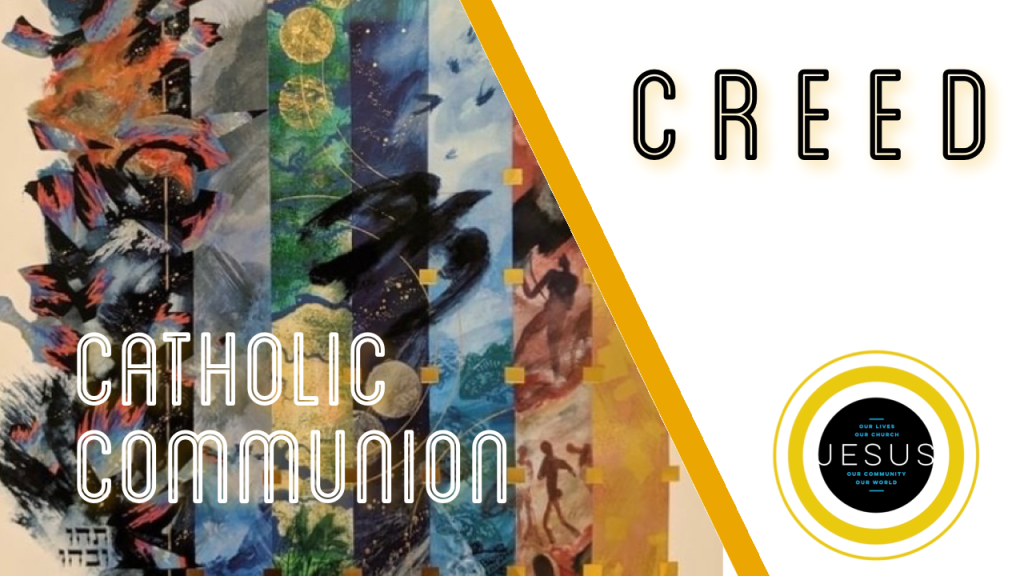
The header image for this series comes from the The Saint John’s Bible (saintjohnsbible.org), illustration taken from the book of Genesis.
[i] Eugene Peterson, Christ Plays in Ten Thousand Places, p. 250.
[ii] ‘to conditions congenial to the imperial self’ is from Eugene Peterson, Ibid, p. 244
[iii] Rabbi Lord Jonathan Sacks, Not In God’s Name: Confronting Religious Violence (London: Hodder & Stoughton, An Hachette UK Company, 2015), p. 147.
[iv] Eugene Peterson, Christ Plays in Ten Thousand Places, pp. 240, 242, 244.
[v] Dietrich Bonhoeffer, Life Together
[vi] Ben Myers, The Apostles’ Creed: A Guide to the Ancient Catechism, pp. 115-116

 TRISTAN SHERWIN
Leave a reply to ONE ANOTHER // INTRODUCTION | TRISTAN SHERWIN Cancel reply