Here’s my longer notes from this morning’s Metro Christian Centre, Bury service (13th September, 2026), as I introduce our new series, Christ in the Margins, in which we’ll be seeking the Cross of Jesus in the marginal characters of the Bible.
You can also catch up with this via MCC’s YouTube channel (just give us time to get the video uploaded).
‘The words of the prophets are written on the subway walls.’
— Simon and Garfunkel[i]
‘The Christian good news is all about God dying on a rubbish-heap at the wrong end of the Empire …’
— Tom Wright[ii]
READ: LUKE 24:25-27 (NLT)
PHYSICAL GRAFFITTI
There’s a band called Pink Floyd—you’ve more than likely heard of them or heard something by them. They’ve written several now-famous, familiar songs.
Personally, I’ve been aware of Pink Floyd since … well, for as long as I can remember. They’re the first band name I ever learnt.
Strangely, though, my first encounter with Pink Floyd wasn’t through their music. That would come much later, as a teenager. My first encounter with them was through some graffiti.
There was a route we’d walk with my mum to primary school every day. This route took us past a block of flats, and on the black creosote-coated wood fencing outside those flats someone had sprayed Pink Floyd in neon pink paint. You couldn’t miss it, even if you tried.
I was only a kid, but I somehow knew this was more than words and something of a statement. Whoever wrote it meant it as a homage to their favourite band— a public declaration to every passer-by that said, ‘I love Pink Floyd.’
But I also got the impression that some people didn’t love Pink Floyd.
Underneath those words of devotion, was another set of words. Different colour paint, different style of writing. Someone had taken the first artist’s start point of a mere band name and developed it (creatively, I’ll admit) into a full-blown sentence: a sentence that now told every passer-by their not-so-loving opinion of Pink Floyd, using words I shan’t repeat.

I remember asking my mum what the words meant.
I can still feel her handprint on the back of my head.
Graffiti is fascinating. It’s one of the oldest ways human beings have found to say what they think. Something political, maybe, or funny, or derisive. Sprayed onto walls, scratched into school desks, doodled in a toilet cubicle— we leave a message somewhere we know other people must encounter it. A message we want others to notice.
The thing is, I don’t notice. Not really. Not any more. I’ve grown up around it and become desensitised by it, and because it’s so prolific I have naturally assumed that 99.9% of the time, graffiti has nothing more valuable to say than ‘someone woz ‘ere.’
Occasionally, though, I do notice. Especially when it’s big, bold and beautiful. If you walk through Manchester, for example, there are entire walls covered with it. Bland brickwork and dull doorways have been turned into eye-popping portals.
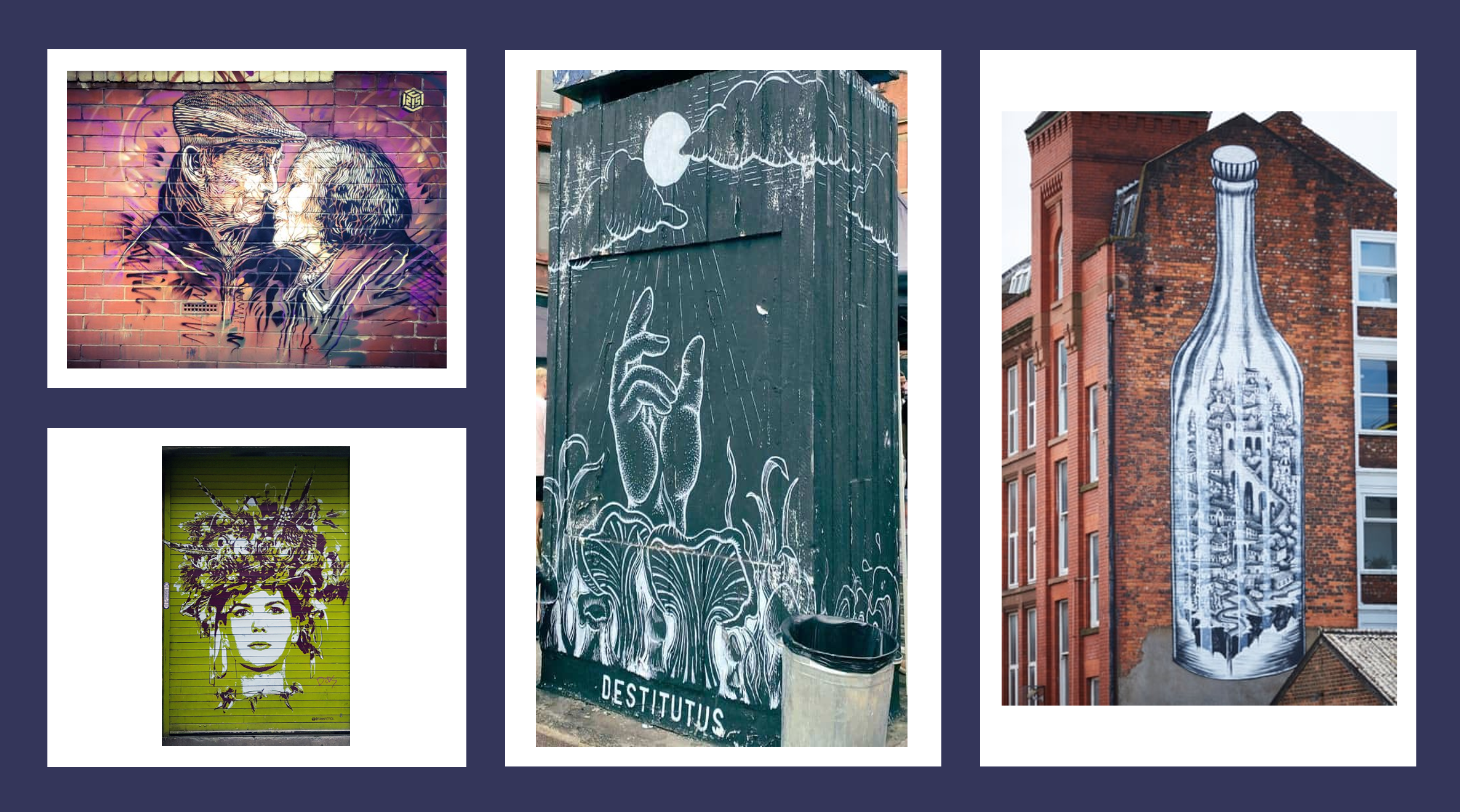
Interestingly, when we see things that look like this, we stop calling it graffiti—that word seems like an insult. Instead, we dub it street art or, to give a more proper name, a mural.[iii] We understand that things like this have normally been commissioned and they’re intentionally decorative—worthy of our admiration—and so, we assume, they must be communicating something of importance. And they often are.
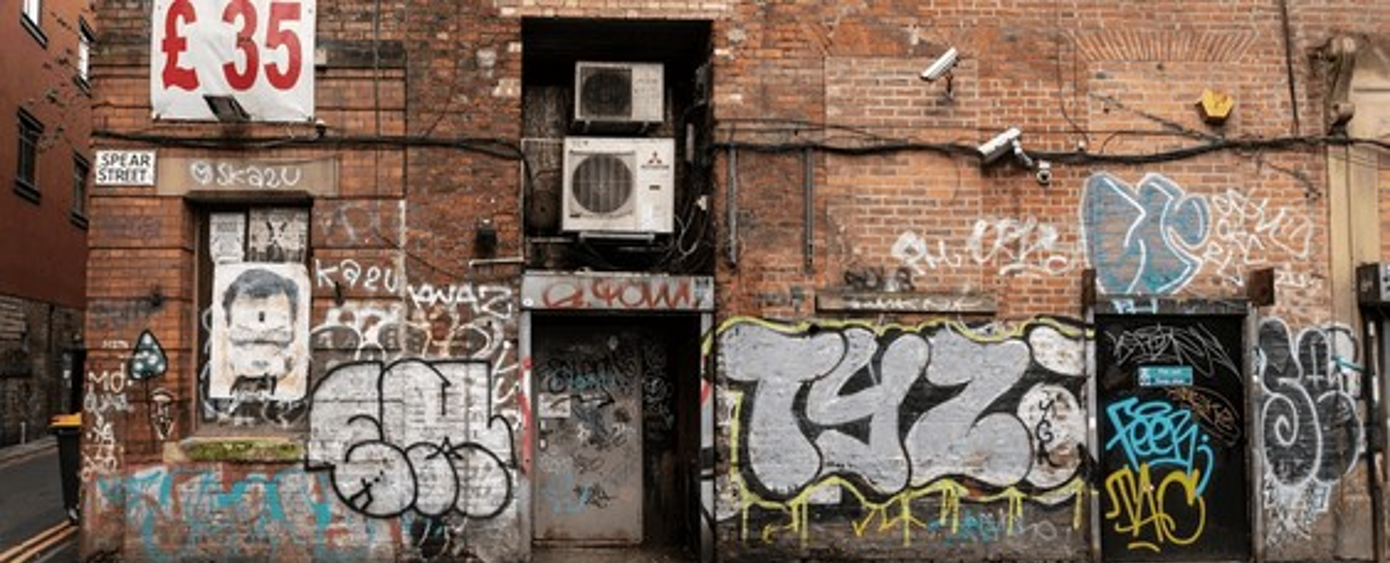
But the other stuff—graffiti proper, the unauthorised scrawl on subway walls and unlikely places—well, our normal reaction is to dismiss that stuff as vandalism. Trash. Filth. Mess. Something to be scrubbed off rather than admired. Surely, we think, nothing important can be found there.
TRASH TALK
There’s a piece of graffiti from ancient Rome which is now rather famous.
It’s known as the Alexamenos Graffito, and it was scratched into the plaster of a building on the Palatine Hill—the centre of Rome’s power, the place where every decision of the Empire was made—sometime in the second century AD.
The wall it was scratched into was likely part of a training school or servant quarters for those who worked in the imperial household. Whoever made it most likely served Caesar. Not someone famous like Caesar—not a name the history books have honoured, but someone strewn in the margins of antiquity. We don’t know whether they were a child or an adult, but they weren’t trying to make art: it’s a very trashy scribble (as we’ll see). They’d likely be shocked to know that, all these years later, their graffiti now hangs in a museum, treated as a priceless piece of history.
One man’s trash really is another man’s treasure.
It’s famous because it is widely regarded as one of, if not the earliest surviving images we have of the crucifixion of Jesus.[iv] It looks like this:
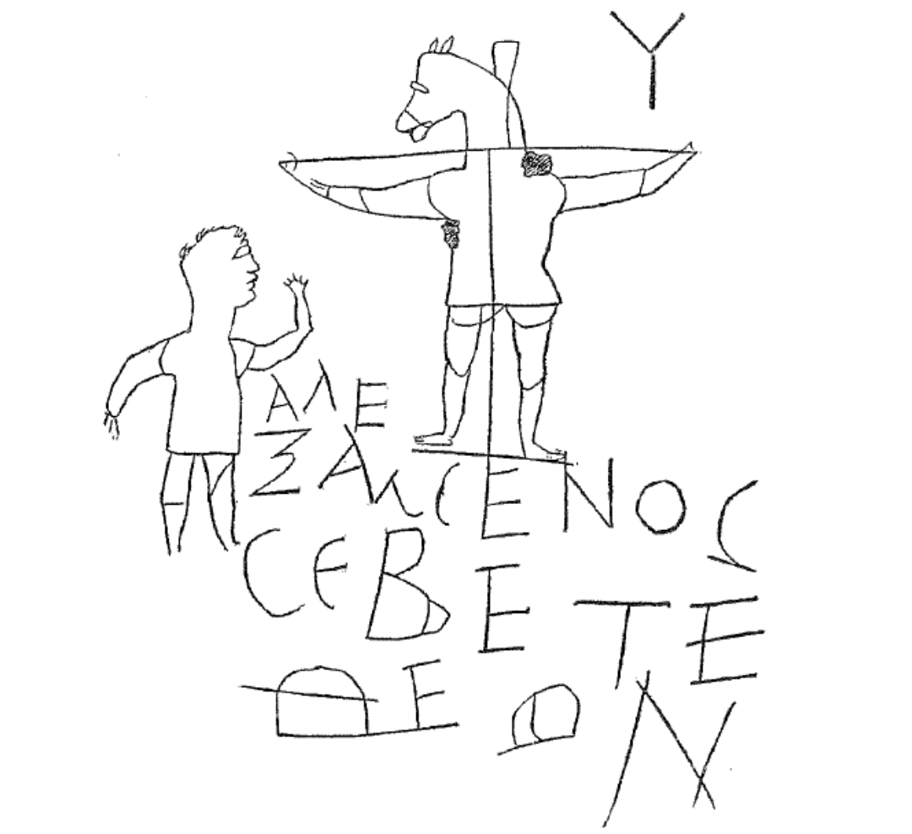
It shows, on the left, a young man, arm raised, in the classic Roman posture of worship—throwing a kiss of adoration. And the one being adored is a crucified figure, with the head of a donkey. Underneath, scratched in Greek, are the words:
Alexamenos worships [his] God.
We can infer two things from this graffiti. First, that Alexamenos—like whoever carved this “portrait”—was likely also a slave in the imperial household. Rather like when people write about you on the toilet door at school: they do it knowing you’ll see it, because you share the same space.
Second, that Alexamenos is a Christian, and that this was meant as an insult— mockery of the ridiculous, foolish, irrational business of worshipping a crucified man as a god.[v]
This is what Roman society made of the early Christian faith and its shockingly strange claim.
Two thousand years on, we probably don’t get the joke. Familiarity has worn the edges off the cross. Nowadays, crosses hang from our necks and sit on our walls—even non-Christians have it as jewellery! And when we honour the graves of the dead, as a mark of respect—especially of those who have made great sacrifices—it’s a token of respect and reverence. But in the first century, the cross was not religious symbolism or a marker of altruistic virtue.
It was how Rome terrorised the conquered and silenced political rebels— designed to humiliate, degrade and destroy a human being publicly. To be crucified was the absolute opposite of sacred. It was associated with trash, filth, mess … Something you would rather scrub away, something treated with disgust and never admiration.
Cicero, the Roman writer, said that because crucifixion was so cruel and disgusting that the very word— crucifixion (Latin, crux)— ought to be kept far away from any decent person’s body, thoughts, eyes and ears.[vi] Speaking about it was on a par with the words scrawled beneath that Pink Floyd graffiti I saw as a kid: people used crucifixion language as foul language. If you wanted to insult a person you would tell them to go and ‘get crucified’ (in cruce figarus).[vii]
All the references we have to crucifixion in Roman writing are almost always jokes or vulgar language, because it was scandalous.
So when Christians began worshipping One who had been crucified as God, it was genuinely strange. They weren’t taking something that already looked beautiful, mural-like and turning it into a religious symbol. They were taking something appalling, profane, graffiti-like, and saying: this is where we see the glory and power of God.
Paul knew exactly how strange that sounded. He writes to the Corinthians, ‘We preach Christ crucified, ’ and immediately admits that for some this was a scandal, and for others sheer foolishness.[viii]
The Alexamenos Graffito gives us a unique glimpse of that reaction. It’s trash talk: You worship someone who was crucified? You think that person is God? You’re an idiot.
Whoever scratched that insult into plaster helps remind that there’s a ridiculous tension, a scandal, at the heart of what we proclaim. A scandal that remains.
I remember a work mate once asking me, genuinely puzzled, why some Christians wear an instrument of torture around their necks as jewellery. ‘It’s very strange,’ they said, ‘if not disturbing.’ They were right. It is. There’s no getting around that.
Except, of course, for Christians it isn’t only that. Christians have always claimed that the cross of Christ, the humiliation and suffering of Jesus is ‘the power of God for salvation’, and ‘the wisdom of God’, and even the ‘love’ of God displayed.[ix]
To be clear, we’re not saying there’s anything beautiful or glorious about torture, or anything holy and loving about the abuse of a human being. There isn’t. Crucifixion remains a brutal instrument of Roman torture and public shame. Through it, humanity did something terrible to Jesus.
The strangeness is that, knowing all of that, we still look upon the crucified Jesus and say, with the hymn writer, ‘Here is love, vast as the ocean … ‘[x]
It’s a strange thing to proclaim. But we do so because the glory isn’t in the violence. The glory is in the love of the One who willingly entered it.
Jesus didn’t simply happen to end up on a cross because things went wrong. His plans didn’t take an unexpected, disastrous turn. He knew where he was going: Though he was God, he made himself nothing … taking the very nature of a servant … humbling himself … even to death on a cross.[xi]
He enters victimhood. Rejection. Humiliation. Suffering. Death.
God goes where most of us wouldn’t go looking for God—into the places where we would least expect to find him.
It reminds me of a photograph Pete Greig, the founder of 24-7 Prayer, shared on social media earlier this year: the crucified Christ among the garbage.[xii]
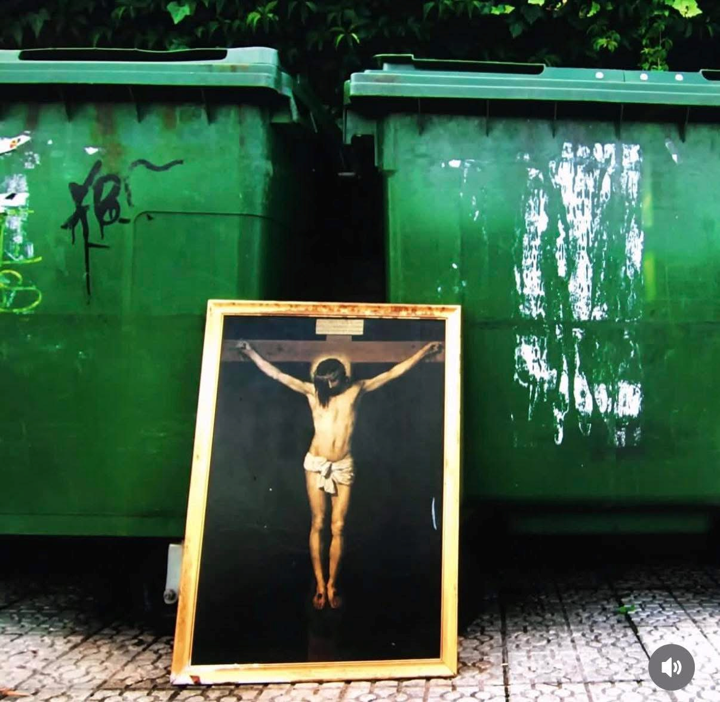
Alongside the image, he shared these words from Isaiah:
‘He was despised and rejected by mankind, a man of suffering, and familiar with pain. Like one from whom people hide their faces he was despised, and we held him in low esteem.’[xiii]
We treated him as trash.
If Jesus had appeared more like a mural, like street art—something commissioned, celebrated, worth stopping to look at—we might have found it easier to see his beauty. But Jesus appears among the garbage.
Would we have thought of rummaging for God there? When we think of the ‘holy places’ of God, what do we picture: the litter-filled, graffiti-walled back streets of our town? Most likely not.
How fitting then, that the first portrait we know of the crucified Jesus appears the same way: not in some commissioned work of religious art, but scratched into the wall of a slave’s quarters as graffiti. It’s poetic—the crucified God, appearing in a medium associated with the unofficial, the messy and the easily overlooked, in a place that is also overlooked and considered not of worth by those seeking the great and the mighty.
It seems foolish to find God here. It is foolish! The fact that we discover God in such places confuses and confounds all of our expectations.
It’s the same confusion two disciples are walking through, on the road to Emmaus.
CLEAR AS MUD
Two devastated disciples are walking home, trying to make sense of the worst weekend of their lives. As they do, a stranger falls in step beside them—it’s Jesus, though they don’t recognise him yet—and he asks what’s got them so upset.
They him everything: of how Jesus of Nazareth, a prophet powerful in word and deed, was handed over by the religious leaders to be cruelly executed; of how they’d firmly hoped he was the Messiah, ‘the one who was going to redeem Israel.’ But all of it is shipwrecked now. They’re devasted. This wasn’t the weekend they were expecting.
Jesus, hearing all of this, seeking to “comfort” them, calls them foolish, and then asks them something remarkable:
‘Wasn’t it clearly predicted that the Messiah would have to suffer all these things before entering his glory?’[xiv]
Wasn’t it clear that God would be treated like trash?
If I’d been walking that road, my honest answer would have been: no.
The two walking this road have already made it plain that they didn’t expect the Messiah to suffer at all, let alone be mocked, flogged, and executed in the most degrading way the Empire knew how to devise.
Even Jesus’ closest disciples, who’d heard him predict his death more than once, hadn’t expected it. Peter once took Jesus aside and rebuked him for even suggesting it.[xv]
And in John’s gospel, when Jesus talks to a crowd about being “lifted up” —his own veiled way of describing how he’d die— the crowd is baffled. As far as they understood the Scriptures, the Messiah was supposed to reign forever.[xvi]
Nobody expected this. Not the two on the Emmaus road; not Peter and the rest of the Twelve; not the crowds who followed him; not even the other Jewish groups with their own expectations of a Messiah.
They’d all read the Scriptures. They just hadn’t seen the cross in the story they thought those Scriptures were telling.
The closest thing to a clear reference might be Isaiah’s Suffering Servant— a man despised and rejected, familiar with suffering and pain (words we have just seen). But Isaiah’s words weren’t understood in Jesus’ day as a straightforward prediction of a suffering Messiah, and certainly not as a revelation of God himself suffering.
And yet Jesus insists that the suffering was there all along. There, but unseen. Not hidden. But, I suppose, a little like graffiti on a wall: the message can be right in front of you, but if you’ve learned to stop looking, as you chase the bright and beautiful, you’ll walk straight past it.
So, Jesus helps them to see.
He does more than point them towards one obscure prophecy they had missed. He shows them that the whole story must be read differently in the light of the cross. He begins with Moses and moves through all the writings of the Prophets—front cover to back cover of what we now call the Old Testament—explaining what was said throughout concerning himself and his suffering.[xvii]
I often wonder exactly which stories he used, which narratives did he lead them through and which walls did he stop them in front of and say, ‘Can you not see me written there?’
I wouldn’t be the first to wonder. Because of this passage, and others[xviii], Christians throughout history —even the the New Testament writers themselves—have gone looking for Jesus in the Old Testament.
Theologians even have a name for it: typology.
You may have heard of people talking about “types” of Jesus in the Old Testament –not that someone is Jesus, but that there’ s a pattern, a kind of Jesus-shape, to certain stories and certain characters.
Back in the fourth century, Basil the Great (not a name he gave himself, by the way) described types as giving us ‘rough and shadowy outlines’ of the divine — an ‘imitative anticipation of the future.’[xix] His rather fancy, rather beautiful way of saying that some things in the Old Testament foreshadow Jesus. Like a shadow cast by an object, giving us an outline of something that only becomes fully clear when we meet the thing itself.
So, unsurprisingly, people have seen a shadow of Jesus in Joseph’s story, for example— sold by his brothers, imprisoned unjustly, eventually “raised up” and exalted.
We see it in the Exodus story, too, in the Passover lamb, whose blood on the doorposts turns death away.
These are all good.[xx]
But I wonder whether they were the only writing Jesus pointed to. Because there is a problem with how we sometimes do typology. Depending how comfortable we are with the cross, typology can gravitate towards the victorious and the beautiful—the murals of the Old Testament.[xxi]
So we go flicking through Scripture asking: Who looks like Jesus because they win? As we do, we naturally look for Jesus in people who are visible, named, powerful, victorious. Joseph rising from the pit to the palace is everyone’s favourite.
But if the cross and suffering of Jesus are our interpretative key—if we’re to look for graffiti, not just murals—then there is another question we could and should be asking: Who looks like Jesus because they suffer?
Who bears something of the shape of the cross?
Who is pushed aside, denied dignity, silenced, and regarded by the people around them as foolish, shameful, and insignificant?
If we ask that question, then there’s more writing on the wall that we must stop at and see.
There’s a second problem, too. Whenever we go looking for human “outlines” of Jesus in the Old Testament, our typology has a habit of looking for men.
The Bible itself gives us male figures who are important to its unfolding story, of course. But if the cross teaches us to look differently, then perhaps we need to look beyond the people who hold cultural esteem and to pay attention to those who are pushed towards culture’s edges.
CHRIST IN THE MARGINS
So, over the coming weeks, we’re going to go looking for Jesus in the Old Testament—not among the kings or the conquerors, but among people who have often, sadly, been treated as footnotes or supporting cast. People who are easy to miss, easy to walk past. People whose stories have sometimes been mishandled by readers and preachers as embarrassing, foolish, or sadly disfigured and labelled the opposite of Christlike.
All the figures we’ll meet are women. That’s deliberate –there are male figures we could have chosen, but I’m trying, in a small way, to address a historic imbalance in how we’ve often gone looking for Christ in Scripture.
None of these women is Jesus—just as none of the men traditionally offered as “types” of Jesus are Jesus either. But they are all women who, long before Golgotha, found themselves caught up in something of the same cruciform pattern that Jesus would later embody completely.
Because of that, like Christ’s crucifixion, many of their stories are horrific: there is abuse, violence, exploitation and death. I don’t want us to tidy any of that up, or make it sentimental.
The point of this series isn’t to look at suffering and call it good because we can trace a connection to the cross. Abuse and violence do not become virtuous because we can find Jesus standing somewhere in the story. The cross doesn’t teach us to call horror beautiful. It teaches us that God doesn’t stand at a safe distance from human horror. He enters it – the place of rejection, humiliation, injustice, suffering—and in Jesus, takes his place among those the world has discarded.
Admittedly, we’re stepping into unknown territory here. Everyone’s done a series on Ephesians, or a series on prayer. But in all my reading (because this has been on my mind for near ten years), I haven’t found anyone who’s done a series looking at the Cross in women of the Old Testament.[xxii] So please bear with us as we journey through this; we are breaking some ground.
But, at the end of it all, there are two things I hope we will do together in this series.
First, I want us to see these women differently—to stop treating them as footnotes, or villains, or embarrassing stories to be hurried past, and instead slow down and discover that they are not scribbles at the edge of Scripture at all. They are murals. Beautiful, significant, worthy of our attention.
Second— because if we learn to see the shape of the cross in their stories, then perhaps their stories can also help us see the cross more clearly, too.
Through the shape of their own suffering, perhaps we can better understand what God is doing for us, and saying to us through his own cross.
So this series is about learning to look again. At the women whose stories we might otherwise walk past. At the places where Scripture is messy and painful and difficult. And at the cross of Christ itself.
And perhaps, if we can better learn to see Christ in the margins of scripture, then we will be better equipped to see that the margins of our own world are not where Christ is absent, but where Christ has been waiting for us to look.
As a teaser: Next week Helen will be starting us off with Bathsheba; a lady who has sadly been maligned by many a preacher as being something of a ‘cougar’. However, Scripture bestow a great honour upon her: she is the only person in all the scriptures, aside from Jesus himself, who is described by God as a lamb.
‘Then, turning toward the woman, [Jesus] said to Simon, “Do you see this woman?” … ’
— Luke 7:44 (NET)
ENDNOTES AND REFERENCES:
[i] Paul Simon and Art Garfunkel, The Sound of Silence, from the album Wednesday Morning, 3AM (1964)
[ii] Tom Wright, Paul for Everyone: 1 Corinthians, (SPCK, London, 2012), p.13
[iii] Even legally speaking, there is a difference. Murals are legal, planned paintings commissioned to tell a story or decorate a space, while graffiti is typically unauthorized, done quickly in public places.
[iv] A fantastic, and up to date treatment of this Graffito, can be found in Felicity Harley-McGowan’s essay, The Alexamenos Graffito, in The Reception of Jesus in the First Three Centuries, Vol. 3: From Celsus to the Catacombs: Visual, Liturgical, and Non-Christian Receptions of Jesus in the Second and Third Centuries CE (t&tclark, Bloomsbury Publishing, London, 2025), pp. 105-140
[v] I use the lowercase god to denote the artists’ viewpoint. With regards to the identity of this donkey-headed figure with Jesus, this is the general consensus of most historians. As Felicity Harley-McGowan states, considering other options: ‘The dominant and most plausible interpretation of the grafitto, proposed by the Italian archaeologist who discovered and first published it, Raffaele Garrucci, is that it caricatures Christian belief in a crucified deity, furnishing a remarkable visual counterpart to the accusation, well documented in literary sources in the first centuries CE, that like the Jews with whom they were often associated and confused, Christians worshipped the head of an ass. … The crucified figure, as the object of this gesture, is the “god.” It is possible, as various scholars have noted, that the horse/donkey head may have prompted some Roman viewers to see the Egyptian god Seth, or a demon depicted on the cross. While there existed in antiquity a range of precedents for the death of a prominent person, given that Jesus was the only divinity to be crucified and worshipped, there are stronger grounds for arguing that the figure is Jesus.’ (Ibid, pp. 105, 112-113).
[vi] Cicero, Pro Rabirio Perduellionis Reo, 5.16.
[vii] Felicity Harley-McGowan, Ibid, p. 135. Harley-McGowan also notes, ‘The use of such abusive terms are well documented in literature, and an example was found scratched on a wall of the Stabian baths in nearby Pompeii. (For the inscription [see] (CIL rv, 2082, table VI, 3): Cook, Crucifixion, 122, and figure 4.), p. 121 +fn. 66
[viii] 1 Cor. 1:23. The Greek we often translate stumbling block is skandalon (σκάνδαλον), where are word scandal comes from. Personally, I have no issue with stumbling block, but knowing the Greek helps us appreciate why it is a stumbling block. Paul also uses this same Greek word, in relation to the message of the cross, in Galatians 5:11.
[ix] Rom. 1:16; 1 Cor. 1:24-25; 1 John 4:9-10 (Italics mine)
[x] Here is Love, Vast as the Ocean, originally written in Welsh by the poet and minister William Rees (1802–1883), and the English translation used today was made by William Edwards (1848–1929)
[xi] Phil. 2:6-8
[xii] I saw this on Pete Greig’s Facebook feed, dated 3rd April 2026.
[xiii] Isaiah 53:3
[xiv] Luke 24:26, NLT
[xv] Matthew 16:21–23
[xvi] John 12:32–34
[xvii] Jesus not only carries out this study on the dusty road to Emmaus, but also later, back in Jerusalem to all his disciples (Lk. 24:44-46)
[xviii] Such as John 6:39-40, for example, along with the New Testament writer’s own use of the texts of the Hebrew bible.
[xix] St Basil the Great (c. 329-379 AD), On the Holy Spirit, ch. 14.
[xx] The New Testament writers themselves frequently echo the Exodus story.
[xxi] Fleming Rutledge has observed that it’s typical of Western Christianity, as of Western culture generally, to push the cross out to the margins, because we prefer our faith upbeat and triumphant. [See Fleming Rutledge, The Crucifixion: Understanding the Death of Jesus Christ (Eerdmans, 2015), p.37]
[xxii] If you do know of any, please let me know.


Leave a Reply