
Here’s my longer notes from yesterday morning’s Metro Christian Centre, Bury service (11th October, 2026), as we continued our series, Christ in the Margins, in which we’ll be seeking the Cross of Jesus in the marginal characters of the Bible.
You can also catch up with this via MCC’s YouTube channel (just give us time to get the video uploaded).
‘But there’s no proof in the paper today | Tales of war and of waste | but you turn right over to the TV page.’
— Crowded House[i]
‘How full of pitiful traits is this story!’
— St. Ambrose[ii]
DRIVING TO DISTRACTION
Most of us, I suspect, have a well-practised reflex when it comes to avoiding horrifying things.
When I was a child, I used to reach for the sofa cushion whenever something scary or violent appeared on TV, using it as a refuge, closing off my eyes and ears. But as I’ve grown older, I have, admittedly, bought into some of the coping strategies our culture offers.
On the one hand, our culture has turned violence into something of a spectacle. I’ve lost count of the cities I’ve seen destroyed in films and the inhumane violations I’ve witnessed in TV crime dramas. The visual effects are often very realistic, rendering violence in hideous, brutalising high-definition technicolour. But I know it isn’t real. It’s “fantasy”, it’s acting, and that psychological distance allows me to consume violence as entertainment. I no longer stretch for the cushion anymore; instead, I reach for the popcorn or tuck into a takeaway.
When the acting stops and the horror is real, however, my culture offers me, on the other hand, the ability to change the channel or to turn the page. As a teenager, I learnt to flick through the newspaper, past the scenes of Darfur to the comic strips at the back. Today, it’s all too easy to swipe from a social media reel about Nepal or Gaza to the latest movie trailer or a make-up video.
(I’m not sure why my algorithm keeps suggesting those…)
Whether we consume suffering as spectacle or simply look away, the result can be much the same: a society that struggles to connect genuinely with human suffering. We become desensitised, numb. There is something troubling about a world in which true crime is a multi-billion-dollar media industry, and where, in the digital age, the impulse to record a violent event on a smartphone often replaces the impulse to intervene.[iii]
I mention this because the passage we’re about to read, Judges 19, is one of the darkest and most disturbing scenes in the Bible. But we’re not going to be reaching for lurid detail, and we shall not be reaching for the remote either.
As many critics (and devoted readers) have noted, the Bible contains some deeply disturbing scenes of violence. But depicting violence is not the same as delighting in it. And to assume that a text which tells us about violence must therefore be celebrating it is to overlook the possibility that it is doing something rather different: exposing evil, bearing witness to suffering, and forcing us to confront what we might otherwise prefer not to see.
Sometimes a story tells of terrible things because we need to face what human beings are capable of doing to one another.
At the centre of this story is a woman whose whose voice is never heard, and whose body is treated as though it belongs to everyone except herself.
But, as the theologian Helen Paynter points out, the narrator handles this woman’s suffering with tremendous restraint. We are told enough to understand the horror of what happens to her, but we are not given a narration in “bloody technicolour” that lingers over the gruesome details and turns her suffering into a spectacle.
Paynter encourages us to take our cue, as readers, from the narrator’s restraint. Adding that:
‘[If] we would not stand at the foot of the cross [of Christ] and gaze at it with indifference or delight, then it is inappropriate for us to have those attitudes as we read or retell its Old Testament precursors.’[iv]
The danger of voyeurism is that we become so absorbed in the violence that we lose sight of the person who suffers it. The danger of looking away is the same, even if it appears to be its opposite: in avoiding the discomfort, we turn the page and leave the victim behind.
So why is this story in our Bibles? Because it matters. Because this woman matters. Because victims like her matter. As Paynter writes elsewhere, because ‘the atrocity she endured was not shrugged off as just one of those things.’ The narrator—and the Divine Narrator who guided him—noticed, cared and memorialised her suffering.[v] That Divine Narrator wants us to see, and care, too.
The text wants to re-sensitise us. It is provocative, not to leave us more fascinated by violence, but to make us more sensitive to the suffering of others. Until, to quote St. Augustine, the reign of love (the love of God for others) is established in our hearts.[vi]
And that is what I want us to do with this passage.
READ: JUDGES 19 (NLT)
FOR WHOM THE BELL TOLLS
One thing I have come to admire about the writer of Judges is that, while sparing us the lurid details, he still manages to make us sense the danger gathering through the way he unfolds the story, letting us hear what I’ll call the alarm bells.
Think of the soundtrack in Jaws. Long before the shark appears, those ominous notes from John Williams tell us that danger is approaching, even when we cannot see it yet.
There are several alarm bells ringing through Judges 19. The first sounds in the very opening verse:
‘In those days Israel had no king.’
If you’ve never read Judges before, don’t hear this as the beginning of a fairy tale, as though we’re about to be told what happened once upon a time. This is half of a sentence, and the other half is crucial. We find the full version at the end of this story, the very end of the book, in chapter 21, where it serves as the final word on everything we’ve been reading:
‘In those days Israel had no king: everyone did what was right in his own eyes.’ [vii]
Using a modern idiom, we would say: every man for himself.
The same refrain appears earlier, in chapters 17 and 18.[viii] It’s the book’s way of saying that something has gone profoundly wrong. Judges charts ancient Israel’s descent from its high calling, echoing humanity’s wider descent from its God-given calling. This refrain captures that decline.
It’s not describing everyone having their own harmless preferences. It’s a picture of a society in which there is no longer any shared recognition of what is good, just or right; where individual desire has become its own authority.
So when the chapter begins this way, we know another, deeper and darker step downward step is coming.
The second bell is more subtle.
Despite the warning, the story seems almost promising. It’s the story of boy meets girl; girl leaves boy; boy chases girl to win her back.
I’ll admit, I have polished that up a little. But still.
I’m not going to wade into the debate over why she left him in the first place. Did she cheat, or was she angry at him? The Hebrew is disputed, and translations differ. Personally, I lean towards the view that she has not played around, but that leaving her marriage and returning to her father’s house is the act being described as unfaithful. The marriage has broken down, whatever the precise circumstances.[ix]
So, on the surface, we have an estranged woman and a husband who comes seeking her.
There’s a journey to Bethlehem. He even brings an extra donkey, presumably so she can travel home comfortably, with something of the honour due to her. There’s a warm reunion: she welcomes him into the house, so there’s no standing out in the cold like in Love Actually. Her father receives him warmly, there’s food and drink, and several days of hospitality.
The Levite is repeatedly encouraged to stay a little longer. But the delays accumulate.[x]
And these repeated false starts make us conscious of time passing. We’re getting anxious as we read, knowing that the longer they stay, the later they set out, the less time they have to find somewhere safe for the night.
The third bell rings as night approaches.
As the story progresses, the quality of light declines from the story, and darkness closes in.
Ignoring his father-in-law’s advice, the Levite leaves late in the day, with too little daylight remaining for the journey. Maybe it’s just me, but if this were a TV show, even without knowing the rest of the story, I’d be shouting at the screen: Bad idea! Stay. Go in the morning!
The day is almost gone when they reach Jebus (Jerusalem). But the Levite, ignoring his servant’s advice now, refuses to stop because it’s a foreign city. He would rather press on to Gibeah or Ramah, Israelite towns.[xi] Surely, among his own people, he will find safety and hospitality?
Again, I’m shouting at the screen: You should stay at Jebus! To be honest, I’m also ranting at the Levite, calling him a xenophobe. Why assume that foreigners are less trustworthy?
But perhaps I’m judging him too harshly. Maybe he’s not negatively judging others so much as doing what we all do: positively assuming the best about our own. We all tend to believe that the safest place we could be is among those we know, people like us.
And that’s part of the shock of this story. The danger isn’t simply that the Levite has misjudged a foreign city. It’s that the safety he expects among his own people proves illusory. In a culture where everyone does what is right in their own eyes, where it’s ‘every man for himself’, even home is no longer what it should be.
Home should be safe, welcoming, loving. And yet, even today, some of the most disturbing acts of inhumanity take place, not in back streets, or when a person falls in among strangers, but in the place where we should expect refuge.
There’s a lot we could say about that.
By the time they reach Gibeah, the sun is setting. The light is exhausted, the city is cloaked in darkness, and we begin to feel the gloom closing, dreading what the dark will bring.
With no one initially offering hospitality, they have to sit in the town square, exposed and vulnerable, until an old man finally takes them in (after urging them not to stay in the square). There may be a moment of relief: at last, they have shelter.
But, for the discerning reader, there is also a terrible sense of déjà vu.
The fourth bell begins to ring.
We’ve been here before. We’ve read this story before. We don’t need the wolves to gather around the house; we now anticipate it because the parallels with Genesis 19, the story of Sodom, are unmistakable.[xii]
The echo is deliberate, and it is deeply disturbing. The narrator invites us to draw a conclusion that would have been shocking to his first readers: the people of God have become Sodom. Here, too, the obligations of hospitality collapse, vulnerable people are exposed to the violence of a crowd, and inhumanity runs free.
And what follows is horrifying. The men of the city demand that the visitor be handed over to them. The old man pleads with them not to commit such an outrage and then offers his own daughter and the Levite’s concubine in his place.
… ! (Again, horrifying. I wonder what his daughter thought hearing this.)
Our sense of déjà vu may have us expecting an intervention. In Genesis 19, the men being demanded are angels, messengers of God. They don’t sit idly by in the comfort of the home as their host tries to abate the tide of a violent mob. Instead, as messengers of God, they pull the vulnerable host back into the house, into safety.
But in this story, it’s the so-called Levite who takes hold of the woman he sought to bring home, and pushes her outside, feeding her to the wolves.
… !
Again, what happens here is horrifying, and sadly is not a unique event in history.
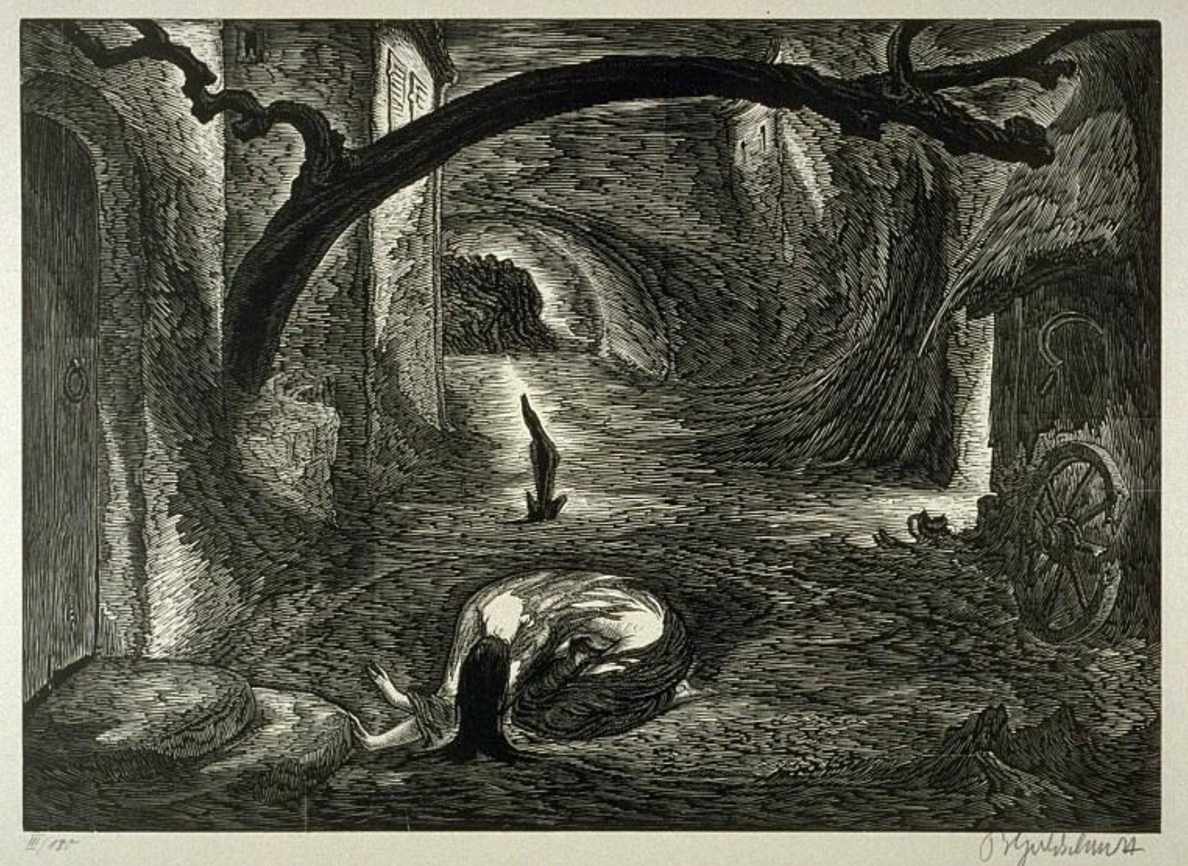
After the violence of the night, the woman makes her way back to the house. Why she seeks to go back there, I don’t know. She collapses at the entrance, her hands on the threshold (v.27); an echo of the innocent Passover lamb, maybe, but also a last desperate attempt to find a source of refuge.
A victim, inhumanely treated, seeking at least a trace of humanity.
THE UN-MAN
We’ll come back to the scene in a moment, because I want us to notice something else about the way this story has been told.
There’s been a clock ticking in the background of this story. It’s subtle, perhaps, but we’ve been (subliminally) counting.
The Levite arrives with one servant, and two donkeys. He stays three days. Is delayed for a fourth, and then then fifth.
They set off on the evening of the fifth day, and we might briefly hope that the party will make it safely through to the sixth day … a day which looms and is sought for in the text.
And I wonder whether we’re meant to hear an echo of the creation poem in Genesis 1.
The sixth day is when humanity appears in that story: people made in the image of God, created to reflect God’s likeness in the world. But the humanity we encounter here looks very different. Instead of people reflecting the character of their Creator, the moral world of the story has unravelled, and the dignity of human beings is trampled underfoot.
It is as though humanity is moving backwards, not towards the image of God but away from it; not becoming more fully human, but losing sight of what it means to be human at all.
I wonder whether Un-man might be the right word. It’s a term C. S. Lewis uses in Perelandra to describe a character whose humanity has been so thoroughly lost that something deeply inhuman has taken its place.[xiii] I don’t want to press the parallel too far, but it captures something of what we see here: people who still look human, who still occupy their familiar social and religious roles, yet whose actions have become a denial of their humanity.
Godless. There, I said it. But it’s an apt description of this passage. Because, apart from a passing reference to the Tabernacle, the whole scene is devoid of God. Which is odd, seeing as the previous eighteen chapters of Judges refer to God more than two-hundred times.[xiv]
What the chapter does have in abundance, though, is man, a word that turns up about seventy times, so that the whole account reads like a snapshot of the kingdom of man, and we are shown, with a good deal of grim precision, how far we fall when ‘everyone does what is right in his own eyes.’
In a world where everyone does what is right in their own eyes, you might expect the individual to become supremely important: my desires, my choices, my freedom, my right to do as I please. But the story exposes the terrible contradiction at the heart of that way of living. In a world where each person makes themselves the measure of everything, the individual can end up counting for nothing.[xv]
When I is king, you are paupers.
When each person acts within a world of self-interest, the person with the least power is the one who pays.
As Nelson Mandela put it, ‘A nation should not be judged by how it treats its highest citizens, but its lowest ones.’[xvi]
The woman who stands at the centre of this story, what happens to her, exposes all of this ‘Un-man-ish’ inclination. Others speak about her, make decisions for her, and ultimately decide what will happen to her body. She is surrounded by men, but no one truly sees her as a person whose life and dignity matter.
At the beginning of this text, she is dignified with the Hebrew term for woman (’iššâ, אִשָּׁה) but she is never treated with that dignity and instead is objectified, as her body becomes the focus of all this darkness, evil and inhumanity, bringing it all into the light, becoming a devasting illustration and indictment of humanity’s un-man state.[xvii]
Her flesh bears and testifies to their sin.
Even her husband is exposed, the man who came seeking her, whom she welcomed into her own home, the one who throws her to the wolves. We see him for what he really is.
Even to him, she is an object that can be handed over when convenient. And as the story moves one, he is shown to be a heartless, self-seeking and abusive man. When he rises the next morning to leave—not rising to go looking for her, rising after sleeping the night while she suffered—he spots her. The text gives us more of a sense of, he stumbled upon her. And he tells her, coldly, ‘Get Up!’
He then slings her over his donkey and carries her home. We may, if we didn’t know what happens next, expect him to give her the dignity of a burial. But no, he butchers her into twelve pieces—a further desecration of her body (especially in a culture that cared so deeply about proper burial), and mails her broken body, as a prop, to summon the tribes of Israel together.[xviii]
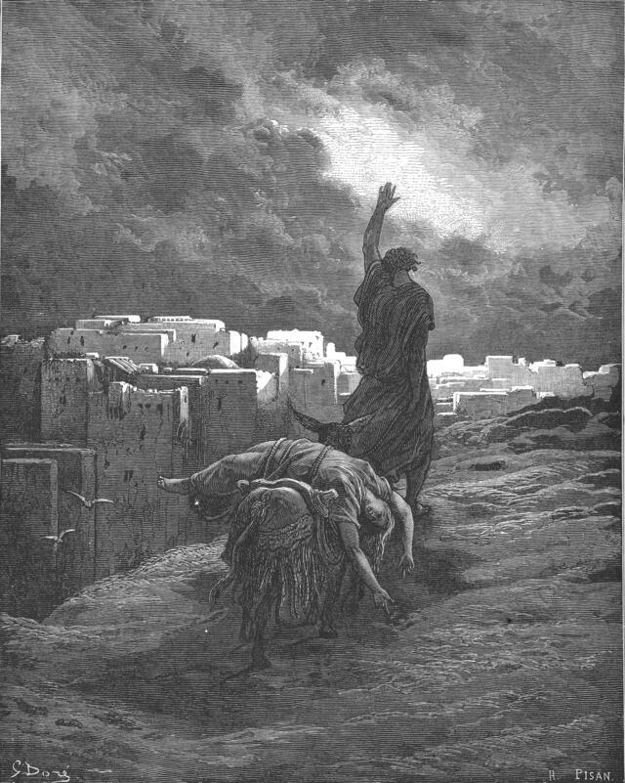
The tribes are outraged by this mutilated body. Notice this! They are disturbed by the mutilation of her flesh, they know nothing, at this point, of her night-time ordeal. And we end this chapter with a powerful question about justice: Who will do something and speak up about this?
With such a question, we may expect the dawn of humanity to be finally breaking in.
But what follows is not justice, but evil amplified. The violence is not healed; it spreads. A civil war breaks out, there’s the near genocide of a tribe of Israel, and at the end of it all, more women are violently abducted, and the first victim is all but lost in the noise of rage.
Toni Morrison was right when she observed that:
‘Rage has limited and serious flaws. It cuts of reason and displaces constructive action with mindless theater.’[xix]
All of this theatre is provoked by this Levite. A Levite who never once admits to his part in this tragedy.
Which is another thing: He’s a Levite! He’s supposed to be calling people to worship and repentance.
In such a Godless time, he, more than anyone, should be, as a Levite, as a priest of God, reflecting something of the character of God.
Husband …
Priest …
These are not incidental details. They matter because the Bible uses both images to speak about God’s relationship with his people. God is the faithful husband who pursues his estranged bride, refusing to abandon her to the consequences of her unfaithfulness.[xx] And the priest is called to represent God to the people, reflecting God’s character and covenant commitment. To play the part, I suppose, of the Divine husband.
The Levite should have embodied something of that faithfulness, something of that ‘safe refuge’, something of the sheltering wings of YHWH.[xxi] He should have protected the woman who had been entrusted to his care, being an ever-present help in times of trouble.[xxii] Instead, he sacrifices her to preserve himself. He should have represented the self-sacrificing character of God. Instead, as Everett Fox describes:
‘[We] are left with a descendant of Aharon (Aaron) who, in a parody of priestly sacrificial behavior, “sections” (see Lev. 1:6) the abused woman whose bed he shared.’[xxiii]
He is a terrible husband and a terrible priest. Another ‘Un-man’, like those around him.
And so, the story leaves us with two things:
The innocent body of a woman; a child from Bethlehem, pushed out into the darkness by a priest, and broken and dishonoured by ‘un-man’ inclinations.
And we are left hungry for something better: a King who will rule with justice, a Husband who will love faithfully, a Priest who will truly represent the heart of God.
BEHOLD THE MAN
Her story carries the shape of the cross.
When Jesus walked the Emmaus Road with his disciples, explaining how his suffering had been foreshadowed in the Scriptures, I wonder if he stopped at this story, and remembered this woman before them.
‘Like her, he was seized and held before a baying crowd before being given over to their bloodlust. Like her, he was [betrayed]. Like her, he took the place of another. Like her, he was stripped and beaten. Like hers, his body was broken. Like her, he died in dishonour and shame.’[xxiv]
We mustn’t lose sight of the difference between their stories, but we cannot miss what they reveal about the world in which we live: a world in which the vulnerable are sacrificed to protect the powerful, in which crowds can be stirred into cruelty, and in which people who should know better can participate in terrible injustice.
At the cross, Jesus is not spared the violence of the world. He is subjected to it. Darkness and evil surround him and assail him. His body becomes the focus and indictment of inhumanity. But there is one crucial difference in these stories: The Levite handed another person over to save himself. Jesus gave himself to save others.
That is the difference between the kingdom of man and the kingdom of God. God does not preserve himself at our expense, abandoning us to the powers of sin and death.
I need to clear, here, it is not that the Father pushes the Son out of the door. Let’s not divorce the Trinity or it’s passionate heart for creation. God the Son steps forward, commissioned by the Father, empowered by the Spirit. In Jesus, God comes among us and gives himself for us.
As Paul puts it in Ephesians, ‘Christ loved us and gave himself up for us’ (Ephesians 5:2). And later, using the very language of marriage, Paul writes that Christ loved his Bride and gave himself up for her (Ephesians 5:25).
The true King has come, but his kingship looks nothing like the self-serving power we see in Judges. The true Priest has come, not to sacrifice someone else, but to offer himself. The true Bridegroom has come, not to abandon his beloved to the wolves, but to give himself for her.
Unlike the Levite, Jesus doesn’t use his broken body as a summons to enact violent revenge or to amplify evil. Rather, his broken body becomes the site of reconciliation; reconciling us to God and each other; to bring us peace, forgiveness, light, and to lift us up from our ‘un-man’ state and to restore to us the dignity of the sixth day.
He comes to seek and save the lost. He loves us in our estrangement, meets us in our vulnerability, and enters the darkness we cannot overcome on our own. This is not because there is anything glorious about the suffering he endures, but because of the love with which he endures it. At the cross, we see just how far God is willing to go for us …
… for all victims …
… and also for all ‘un-men’.
I may be a long way from the sheer horror of the man in this story, but the same inclination to do what is right in my own eyes beats within me. That same reflex to put myself first, to place my own wants and needs above those of others, to make myself the centre of the story, to forsake the high calling of God-reflecting humanity.
God does not abandon us on the threshold or leave us abandoned to our un-man state. He’s come to bring us home.
God does not coldly command us to, ‘Get Up!’
‘This is my body, given, broken for you,’ Jesus says.[xxv]
‘This God—his way is perfect; the word of the LORD proves true; he is a shield for all those who take refuge in him ’
— Psalm 18:30 (ESV)
ENDNOTES AND REFERENCES:
[i] Don’t Dream it’s Over, written by Neil Finn, performed by Crowded House (Crowded House, 1986)
[ii] St. Ambrose (340-397 AD), On the Duties of the Clergy (Book III.IXX). As a caveat, although I quote this, I’m not convinced with what Ambrose then goes on to do with the story in his argument for virtue!
[iii] Of course, there can be good reasons for recording a crime, especially for evidence purposes. But I often wonder, echoing a joke about changing a light bulb, how many camera phones does it take to record a crime?
[iv] Helen Paynter, Dead and Buried? Attending to the voices of the victim in the Old Testament and today: Towards an ethical reading of the Old Testament texts of violence (Whitley Lecture, 2018), pp. 13-19
[v] To once again riff on Helen Paynter’s words, as per her article: Fearless Ones and Fallen Sparrows: A Meditation on Judges 19 (November 29, 2023)
[vi] St. Augustine (c. 354-430 AD), who was no stranger to the difficult parts of Scripture, writing about how Christians should handle and interpret them, offered a helpful:
‘… the following will be observed, to carefully turn over in our minds and meditate upon what we read till an interpretation be found that tends to establish the reign of love.’ (On Christian Doctrine, Book III.15.23)
Augustine is not asking us to pretend that this story is loving, because it is plainly not. He is asking us to linger over it until we find an interpretation that tends towards establishing the reign of love within each of us. That doesn’t mean forcing every passage into something comforting, nor pretending that the Bible’s darker corners aren’t really as dark as they appear. Sometimes love requires us to sit with something deeply uncomfortable, to name evil for what it is, and to refuse the easy consolation of looking away. To echo Paul in 1 Corinthians 13, love requires us to not delight in evil. To be stricken by it, shocked by it, and to feel compassion and empathy for those affected by it.
[vii] Judges 21:25
[viii] In Judges 17:6 and 18:1. Although, it’s worth noting that, in this previous setting, the sequence of the couplet is reversed, with the full sentence given first and the half sentence coming afterwards.
[ix] The Hebrew word in hot debate is זָנָה (zān⸠zanah), and translations vary (although, many modern translations will offer the variant of their textual preference within a footnote). The New King James (NKJV), for example, uses very strong language when it translated this as, ‘she played the harlot’, whereas other translations, like the New Revised Standard Version (NRSV) chose to go with anger being her motive.
The Hebrew word does have a primary meaning of committing fornication (and is utilized often when metaphorically describing Israel’s idolatry toward other gods and their abandoning of the covenant). However, according to Koehler-Baumgartner, Lexicon in Veteris Testamenti Libros (E. J. Brill, Leiden, 1958), p. 261, the word can also mean “to be angry, hateful” or to “feel repugnant against.” This second meaning shares an etymological root, developing from the first meaning. But it is distinct, and many commentators and modern English translations go with this view. Tellingly, ancient Greek translations (the Septuagint and the Greek trans’ of the Targum), all pre-dating our English ones (obviously), also tended to lean towards her becoming angry at her husband, rather than the claim of adultery. Neither of these ancient translations, nor Josephus, or even the Latin Vulgate for that matter, accused the woman of conjugal infidelity.
Beyond the Greek translations and popular preference among scholars, one reason I doubt the claim of adultery is because she leaves for her father’s house. Note, she does not run away with a lover or to her lover’s abode! Also, if adultery was her crime, she would have brought great cultural shame upon her father’s house. I won’t speculate as to what that would mean practically for her, but, had she committed adultery, her father’s house would not have been the obvious place to return to.
As such, I take the language of ‘unfaithful’ as not a referring to literal sexual infidelity, but as a metaphor, of sorts, for the fact she leaves her husband, breaking away from her marriage with him.
There are many places you could “google” for discussions on this. But I’d recommend Was the Levite’s Concubine Angry or an Adulterer? The Woman at the Center of Ancient Israel’s Darkest Story, by Marg Mowczko.
[x] Forgive my speculative mind, but I wonder if there is a Biblical echo here? The story of Exodus (as I’ve told elsewhere) is also, in its way, the story of a Divine Groom seeking his Bride. In that story too, there are delays, or rather, false starts; where the father of the Great House (the meaning of Pharoah) permits leave and then withdraws it. Of course, the stories are distinct in their threat and context. But I do wonder if we are to sense the echo here at the very beginning of this tale, especially when the very end of this section (v.30) also makes explicit reference to the leaving of Egypt.
[xi] As an aside: All the towns mentioned in this one chapter (Bethlehem, Jebus (which would become Jerusalem, and is so at the narrator’s time of relaying this story, v. 10), Gibeah, and Ramah) are all critical, nay, paramount, to Israel’s political story that is about to unfold after Judges, as described in the books of Samuel (NB: In the Hebrew Bible, Samuel follows immediately after Judges, as part of the collection called The Former Prophets). There’s a smorgasbord of theological morsels to mine from this, as the narrator of Judges, from their vantage point (further on in time from the account he is recording) is obviously setting us up for. I’ll leave it to you to delve in to the feast of study. Enjoy!
[xii] In the Hebrew, and I’m no expert at all (I’m leaning on commentary observation alone), the volume and specify of the grammatical resonances between the two stories is startlingly.
[xiii] C. S. Lewis, Perelandra (1943). The “Un-man” is Weston, the possessed scientist. I’ll leave you to read the story. Although, I’d highly recommend you read the first story in the trilogy first, Out of the Silent Planet.
[xiv] As Wilda C. Gafney notes, ‘No divine name, no form of “God” (el, Elohim, or any related form) occurs in the passage. The most holy name, YHWH, does not appear in the passage either; there is neither mention of [the] divine name nor articulation of divine presence.’ [Womanist Midrash, Vol 2: A Reintroduction to the Women of Joshua, Judges, Samuel, and Kings (Westminster John Knox Press, Louisville, Kentucky, 2024), p. 119]
[xv] Maybe, this is why none of the characters in this story bear any names? Every character is labelled, perhaps to demonstrate that in a world where people are deprived names (denoting character and identity) it’s easier, wrongly, to treat them as objects.
[xvi] Nelson Mandela, Long Walk to Freedom: The Autobiography of Nelson Mandela (Abacus, Little, Brown Book Group, London, 2013), p. 201
[xvii] It reminds of the following story, as relayed by Annabelle Hirsch, in her book, A History of Women in 101 Objects (Canongate Book Ltd, Edinburgh, 2023), pp. 368-369:
In 1974, twenty-three-year-old Marina Abramoić made herself into a living art installation; a six-hour-long performance entitled Rhythm O. ‘There are 72 objects on the table that one can use as desired,’ she stated in her instructions to visitors, ‘on me […] I am the object.’ The objects included water, bread, wine, roses, knives, shoes, handcuffs, razors, olive oil, grapes, a pistol loaded with a single bullet, and various scissors. At first, the audience were hesitant, and gentle, giving her water and roses. But after a short time, the mood shifted, and the participants flipped out. Some cut her; others pressed rose thorns into the flesh of her belly. One man sliced her throat with a razor and drank her blood; she was laid out on a table with a knife between her legs; one person even reached for the gun and aimed it at her, until the gallery owner ripped it out of his hand. When, after six hours of existing like a doll, the artist finally moved and tried to approach the audience, people simply fled. They ran away because they couldn’t bear her gaze, because they’d shown a side of themselves they possibly hadn’t known existed, or at least had never before revealed in front of other people.
[xviii] The reason, as Tim Keller notes, is not sudden concern for her. His cowardice and callousness have been plain all through, and he does this because he wants vengeance, and not for what was done to the woman, since he handed her over himself, but for the loss of his property. [Judges For You (The Good Book Company, 2014), p. 186]
[xix] Toni Morrison, Mouth Full of Blood: Essays, Speeches, Meditations (Vintage, London, 2019), p. 27.
[xx] As seen in the writings and prophetic actions of Hosea
[xxi] Psalm 91:2, 4; Deut. 32:10-11
[xxii] Psalm 46:1
[xxiii] Everett Fox, The Early Prophets: Joshua, Judges, Samuel, and Kings (Schocken Books, New York, 2014), on Judges 19:1-30, third paragraph.
[xxiv] Helen Paynter, Fearless Ones and Fallen Sparrows: A Meditation on Judges 19 (November 29, 2023)
[xxv] Luke 22:19 and 1 Cor. 11:24


Leave a Reply