Here’s my longer notes from this morning’s Metro Christian Centre, Bury service (15th November, 2026), as we continued our series, Christ in the Margins, seeking the Cross of Jesus in the marginal characters of the Bible.
As with the others in this series, this is not an easy story. But I trust this is helpful to you.
You can also catch up with this via MCC’s YouTube channel (just give us time to get the video uploaded).
‘Do you think … that God stays in Heaven because he, too, lives in fear of what he’s created … here on earth?’
— Romero (Steve Buscemi)[i]
PRIMAL SCREAM
They say a picture paints a thousand words.
So, let’s start with one of the most recognisable paintings in the world; one that has been parodied time and time again, and has even inspired a hit horror film franchise (which, in turn, has also been parodied by a comedy franchise):
Edvard Munch’s The Scream:
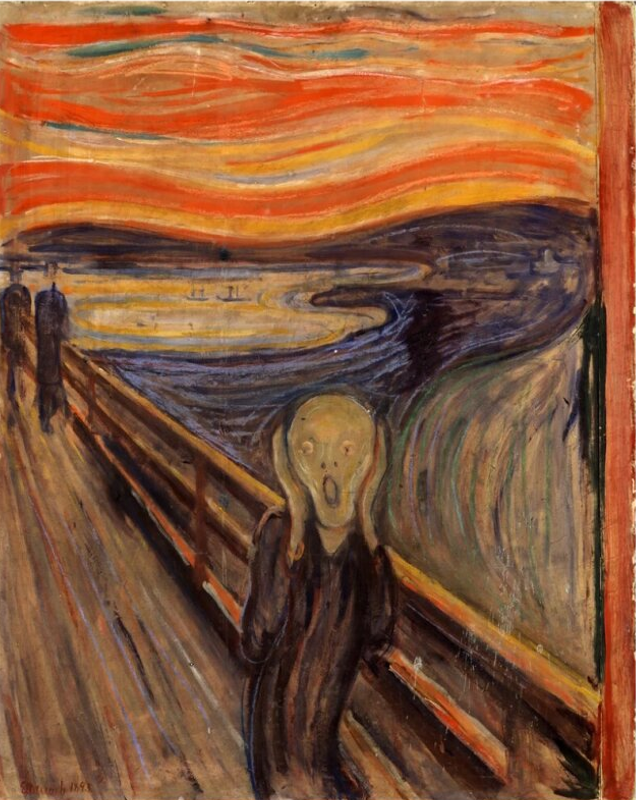
Forgive me—I know you can see the image, but allow me to point out the obvious. At the centre of the picture, grabbing our attention, there’s solitary figure, hands pressed to the sides of its face, mouth gaping open, displaying a sense of horror.
The figure is not the only figure in the image, and yet he is alone in this agony. Behind him, to the left, two figures are walking away into the distance, caught up in their own affairs, apparently oblivious to the world about them. A world in which, as portrayed by the painting, there’s churning dark waters, an intentionally distorted landscape, and a sky ablaze with colour, streaked with tendrils as red as blood.
To point out what may not be obvious: the central figure is not the one screaming.
I know, if you’re like me, you may look at the posture of the central figure and recall a famous scene from the film Home Alone, when Kevin lets out a scream after putting aftershave on his freshly shaven face.
But the figure in this painting is not letting out a scream. Rather, his hands are clamped over his ears, attempting to shut out a scream passing through the world.
In his own diary, Munch described the moment that inspired his painting:
‘I was walking along the road with two friends – the sun was setting – suddenly the sky turned blood red – I paused, feeling exhausted, and leaned on the fence – there was blood and tongues of fire above the blue-black fjord and the city – my friends walked on, and I stood there trembling with anxiety – and I sensed an infinite scream passing through nature.’[ii]
It’s an extraordinary description.
A few people think that Munch had experienced a panic attack. Maybe. But I think his description speaks beyond his own particular experience.
The Bible knows and documents that enormous, infinite scream.
In Romans, the Apostle Paul speaks of creation, as a whole, groaning against its bondage; incessantly crying out because of the suffering that transpires within it and that is afflicted upon it.[iii]
The voices of suffering people are also recorded within the Bible’s epic story. From the blood of Abel that cried out; through the story of the slaves in Egypt, whose cries for help ‘rose up to God’; to the cries of the saints in Revelation—cries that Heaven itself falls silent to acknowledge.[iv]
There are plenty of screams in our world, intensifying with the passing of each generation. The famous author, J. R. R. Tolkien, having witnessed the frontline horror of the Great War, writing to his son, who was serving during the second world war, lamented, ‘I sometimes feel appalled at the thought of the sum total of human misery all over the world at the present moment … If anguish were visible, almost the whole of the benighted planet would be enveloped in a dense dark vapour, shrouded from the amazing vision of the heavens! And the products of it all will be mainly evil …. ‘[v]
Even right now, if we could hear, we would hear the cries of people who are hurting, suffering, frightened, abandoned, abused, or simply exhausted by the circumstances in which they find themselves.
Sometimes those cries are heard and acknowledged by others. Often, they aren’t. Sometimes, like the two figures in Munch’s painting, the world simply carries on walking, because stopping means listening, and listening to the scream that rips through our reality is terrifying.
And what about God? Does God hear those cries? Or does God walk on?
It’s a question that sits at the heart of our next story in this series; a story about a woman called Hagar.
READ: GENESIS 16 (NIV)
A HANDMAID’S TALE
To understand Hagar’s story, we need a little background.
Hagar is an Egyptian servant in the household of Abram and Sarai. Abram has received God’s promise that he will become the father of a great nation; a people more numerous than the stars, and through whom the families of the earth would be blessed.[vi] But there’s a problem. Sarai is unable to have children, and as the years pass, the promise seems increasingly unlikely.
Just before what we have read, God has repeated his promise with Abram, making a covenant with him. But ten years on, there is still no child. Ten years of trying … Ten years of constant disappointment and heartache.
So Sarai takes matters into her own hands. Following a custom of her day—a form of ancient surrogacy—she “gives” Hagar to Abram, expecting that through her servant she might obtain the child she herself has been unable to have.[vii]
I need to say that, just because the text records this, doesn’t mean it’s giving it a thumbs up.
We need to recognise the profound imbalance of power involved. Hagar has very little say in what happens to her. She isn’t consulted. We don’t hear her opinion. Don’t, for one moment, presume that she was willing. Notice the verbs the text uses: Sarai takes Hagar and gives her to Abram. Nobody asks her anything. She is a woman of low social status, whose body becomes the means by which someone else’s hopes and ambitions might be fulfilled.
If that’s not troubling enough, and perhaps what makes this even more shocking, is that the people doing this are not outsiders to the faith.
Abram and Sarai are people who have encountered the one true God. They are the recipients of God’s promises, the very people through whom God intends to bless the nations. Of course, they are also people of their time and place, living at the beginning of this great redemptive story.[viii] That helps us understand some of the cultural assumptions shaping their actions, but it doesn’t excuse them. The text doesn’t offer them any such excuse, nor does it suggest that God approves of what they are doing.
One of the ways we can detect this, is in how the story offers an echo of the failing of Adam and Eve in the Garden. Sarai’s movements imitate the woman, who took something and gave it to her husband; Abram’s culpability is a mirror movement of Adam’s concession without protest; and in both stories we see the presence of ‘handwashing’ and the ‘blame game’. It’s a moment of historical déjà vu.
We aren’t told what they said to Hagar, or whether God’s name was invoked to persuade her. But that possibility is also worth considering, because religious language can be (and sadly, has been) used to legitimise some truly appalling things.
People can wrap their ambitions, prejudices and desire for control in the language of divine authority, sometimes without even recognising what they’re doing.
For those who have read the book or watched the TV adaptation, Margaret Atwood’s The Handmaid’s Tale is a chilling exploration of this; depicting a society, Gilead, that draws on biblical texts and twists them to justify the exploitation of women. Hagar is, in many respects, an ancient Offred (the central character of the book), if that helps[ix]: a woman whose body is appropriated to fulfil the ambitions of others, with religious conviction providing the backdrop.[x]

There’s a warning here for us. Just because someone invokes God, quotes Scripture or claims to be acting in God’s name does not mean that what they’re doing reflects God’s character or purposes. The same is true (maybe even more so), when governments and nations do this. We need to be discerning; we need to pay attention to what is actually happening to people, particularly those with the least power to speak for themselves.
As A. Rebecca Basdeo Hill observed:
‘[Hagar is] a pawn used by Sarah and Abraham for their own purposes. Nevertheless, the goal of Hagar’s forced sexual exploitation… is achieved as Hagar becomes pregnant with child.’[xi]
We would, then, expect some joy to come into the household. Yet, what follows is a household turning toxic.
The relationship between the two women deteriorates and rivalry erupts. Sarai feels slighted, Hagar despises her mistress, and Abram, not wishing to get involved (too late!), effectively washes his hands of the situation, telling Sarai that Hagar is hers to do with as she pleases.
To follow the Hebrew closer, Abram effectively says,
‘Do whatever is good in your eyes.’
We’ve seen language exactly like this already in this series. When we looked at the story of the Levite’s concubine the other week, the same language, of people doing ‘good/right’ in their ‘own eyes’, was present—with disastrous consequences.[xii] It’s as if Scripture keeps reminding us, subtly, that whenever people do what’s best for themselves, it seldom plays out well for others.
The same is true here. Sarai, we are told, goes on to treat Hagar harshly.[xiii]
I don’t imagine that means that Sarai snubbed her, or gossiped behind her back, or gave her some smellier chores around the homestead (‘You’re cleaning the latrine for the next month’). It’s a physical word that means to afflict.
In fact, the very same verb (עָנָה, ʿānâ) is used later on to characterise the afflictions the Israelites will suffer under Egypt.[xiv] It’s not the only echo to the Exodus in this story, by the way.[xv] But my point is that this affliction was such that it compelled the Israelites to cry out for deliverance.
The same verb is used in the story Ammon’s rape of Tamar (2 Sam. 13:22, that Olivier explored earlier in this series)[xvi], and the treatment of the Levite’s concubine (Jdg. 19:24).
It’s a graphic verb, describing deliberate and violent oppression.
No wonder Hagar decides to run away. The fact that she is willing to risk a perilous wilderness journey, whilst pregnant, rather than remain with Sarai, testifies to just how unbearable her situation must have become. Her life, and the life of her unborn child, may well be in danger.[xvii]
I don’t want to make this a simplistic story of one woman being wicked and another being good. It’s more complicated than that. Sarai has her own history of vulnerability and suffering. Back in Genesis 12, Abram, afraid for his own skin in Egypt—doing what was ‘good’ in his eyes—hands Sarai over to Pharaoh. She is taken, the text says, into Pharaoh’s house, placing her in an extraordinarily vulnerable situation. We never hear what she thought or felt, either.
Both women have experienced the consequences of a world in which the powerful make decisions and the vulnerable bear the cost.[xviii] That doesn’t excuse what Sarai does to Hagar, but it does help us understand the depth of the problem. Sarah was once voiceless and vulnerable, and now she finds herself in a position of power over someone even more vulnerable than herself.
She should know better. But Genesis, in its own way, is honest enough to show us how harm can ricochet through people’s lives, how suffering can be passed on rather than brought to an end.
Again, Margaret Atwood explores something similar in The Handmaid’s Tale; where women who have themselves been subjected to an oppressive system become, in different ways, its enforcers.[xix]
I’m also reminded of Holocaust survivor Primo Levi, who wrote about the terrible moral distortions within the concentration camps. The Nazi system deliberately created hierarchies among prisoners, granting some limited privileges and authority over others. In what Levi called the ‘grey zone’, people who were themselves victims could find themselves participating in the oppression of fellow prisoners.[xx]
None of this makes those individuals equivalent to their oppressors, nor does it diminish the coercion under which they lived. But it does expose something deeply disturbing about our world: how easily the patterns of power and cruelty that wound us can become the patterns we inflict on others.
Perhaps that’s part of the enormous scream running through human history, to go back to Munch’s painting. Suffering doesn’t always end with the person who first experiences it. It can be passed on, repeated, amplified. It’s remarkably difficult not to become a transmitter of that suffering ourselves, to shut it out and to break the chain.
And so, Hagar finds herself alone, pregnant, fleeing through the wilderness.
SEEING AND HEARING
But this is where the story takes a remarkable turn.
God finds her.
Hagar isn’t seeking God. When you think about it, if Sarai and Abram invoked God’s name in the process of exploiting Hagar, then God would be the last place she’d be looking for refuge.
She isn’t on some spiritual pilgrimage, searching for divine revelation. She’s simply running away from a situation she can no longer bear, trying to escape.
And yet, though she isn’t running to God, God meets her while she’s running.
God comes looking for her, seeking her, and finds her beside a spring, in the middle of nowhere, on the road back towards Egypt, and addresses her by name:
‘Hagar, Sarai’s servant, where have you come from, and where are you going?’
There is something deeply tender about that opening.
Up until this point, nobody in the household is recorded as addressing Hagar by name. Sarai refers to her as ‘my servant’ (vv.2, 5); Abram refers to her as ‘your servant’ (v.6). She’s spoken about, passed around, used and discussed, but never actually addressed as a person.
It’s like talking about someone only in terms of the pronoun ‘she.’ When I was a lad, referring to anyone as ‘she’ would earn me a rebuke from my mum: ‘Who’s ‘she’? The cat’s mother?’
At the tender age of forty-six, I still don’t know what that saying means. But I did learn that not referring to people by name was an undignifying thing to do.
But here, God addresses Hagar by name. God dignifies her, recognising that she is not an object, a tool to be used for somebody else’s purposes, but a human being with a life that matters.
Not only does God know her name, but God also knows her circumstances. The way God introduces her as ‘Sarai’s servant’ acknowledges the relationship from which she is fleeing. In verse 11 (which we’ll come back to in a moment) it’s even clearer: ‘The LORD has heard of your misery.’
God knows where she has come from. He knows what has happened to her. He knows her present physical condition. Don’t let the question, ‘Where have you come from, and where are you going?‘ fool you. God isn’t asking because he lacks information.
It’s another echo of an earlier Genesis story. Back in the Garden of Eden, when the man and woman hide among the trees, God comes looking for them and asks, ‘Where are you?‘[xxi]
Here again, God comes looking. And here, just as there, God isn’t seeking information. The question is an invitation to intimacy and trust. Tell me. Share your story. Share your scream with me. And I suspect nobody has asked Hagar that, or shown that sort of interest in her, for quite some time.
Abram and Sarai didn’t consult Hagar. They were oblivious to her misery, or at least indifferent to it. God, by contrast, has already heard her misery, and now invites her to speak of it.
The God of the Bible is not indifferent to the cries of those who suffer. He hears the cries that others ignore.
Perhaps there are people reading this who need to hear that. People whose circumstances feel unseen, whose pain is difficult to articulate, whose struggles are known to very few.
You may feel that the world has carried on walking while you have been left behind and swallowed up by the world’s scream. But you are not invisible to God. God is moved by our screams, and asks us to share them with him.
This may surprise you. Especially if you have encountered the indifference of those following God.
I wonder whether this was quite a revelation for Hagar, too.
She’s already suffered at the hands of people who might have claimed to be acting in accordance with God’s purposes. Perhaps she has even heard the familiar religious language: ‘This is God’s will. This is what God wants.’ And yet here is God himself, and he is nothing like those who have so horribly misrepresented him.
Good people—even Christians—can get things massively wrong. We can misrepresent God, sometimes quite spectacularly. I want you to know that God is better than the worst we see in humanity. In fact, God is even better than the very best we see in humanity.
I will get it wrong. You will get it wrong. The only person who has ever shown us God’s character and purposes perfectly, without distortion, is Jesus himself, God incarnate.
I’m flawed. Jesus is perfect. Let him be your point of reference.
Getting back to the story, notice, too, that Hagar can only answer the first part of the question: ‘I’m running away…’
She knows where she has come from. But she doesn’t have an answer to the second question. Where is she going? Geographically speaking, she’s on the road to Egypt. But even when she gets there, what then? There’s no obvious future, no prospects, no guarantees of anything better.
There is suffering in her past. A wilderness in her present. And obscurity ahead.
But not only does God see Hagar. God hears Hagar—even her unspoken uncertainty about the future. And God speaks to Hagar.
In verse 11, Hagar is told, ‘The LORD has heard of your misery.’
That language is significant. As I’ve mentioned, there is an echo of the Exodus story beginning to emerge here. [xxii] Hagar is Egyptian, and the Hebrew used to describe the misery God has heard is later used to describe Israel’s oppression in Egypt. [xxiii] The God who will hear the cries of an enslaved people in Egypt is already hearing the cry of an Egyptian woman in the wilderness.
I point this out, because, even before Israel has become a nation, we have this beautiful glimpse of the breadth of God’s compassion. God’s concern isn’t confined by nationality, ethnicity, social standing or religious pedigree.
I’m thankful that God is not racist, or xenophobic. Again, people using “God” language, through various portions of history, have wrongly used things like nationality and ethnicity to justify violence and hatred as “God ordained”, or to prop themselves up as divine favourites. But God’s love is for all people.
God’s approach to Hagar is a beautiful testimony to the heart of God.
The good news is, that there’s not anything about us that prompts God to hear us. It’s not a matter of qualification. It’s all because God has a seeking disposition.
You may say to yourself, ‘God won’t hear because …..’ (feel free to fill in the blank). But this is far from true. God hears, because God searches human hearts.
PROMISES
God has more to say to Hagar than simply acknowledging her misery. To the woman who has no idea of where life is heading, God gives a promise.
God tells her that she will have a son (I hope she wanted to know!)[xxiv], and that her descendants will become so numerous they will be impossible to count; a promise that is remarkably similar to the promise God has already made to Abram.
God also tells Hagar that her son will grow up to be ‘a wild donkey of a man’. Which may sound like an insult, but the image is of something untamed, independent, not easily domesticated or brought under someone else’s control.
It’s an unusual description, and the verse also anticipates conflict. But there’s an interesting contrast here with his mother, whose life has been characterised by other people making decisions about her. Her body has been used to fulfil someone else’s ambitions. Yet, God promises that Ishmael’s life will not simply be an echo of her scream.
There is a future for Hagar and her child beyond the circumstances in which they find themselves.
In response to this revelation of God—God’s knowledge of the present and his foreknowledge of her future— Hagar blesses God with a name. And the name she gives God comes out of her experience: she calls God, El Roi, ‘the God who sees me.’[xxv]
She has discovered something about God’s character that those around her have failed to demonstrate.
The text doesn’t use the word rejoice to describe her response. But you can sense her delight; her delight in the God who sees her; who knows her misery; who hears her cry; and who gives her a future.
Hagar is a tremendous heroin and example of faith. One of my personal favourites. She encounters God and chooses to trust in what God has said.
It’s that simple.
FACING THE SHADOW
What I want us to appreciate is that Hagar’s joy and that promised future are crucial.
Especially when we wrestle with the tricky part of this passage, that I have not forgotten, but which I have put off until now: Before delivering all the glad tidings, God tells Hagar to return to Sarai and submit to her authority.
I’d be lying if I said that this sits comfortably with me.
We need to handle this carefully, because this is exactly the kind of text that can be misheard, or taken and twisted to cause harm.
So let me say it plainly, and with emphasis: This passage must never be used to tell someone experiencing domestic abuse, coercion or violence that God expects them to return to their abuser. That would be a terrible misuse of Scripture.
The Bible consistently gives us a vision of a God who opposes oppression, who hears the cries of the vulnerable and who calls his people to protect those who are at risk.
We also know that God does not regard suffering as some intrinsically good thing. When God made all things, he made them to be good—the world was not made with suffering inherent to it. Plus, the biblical story moves towards a new creation in which suffering, mourning and death are no more.
In addition to that trajectory, we have stories showing us movements away from suffering: In the book of Acts, we see believers helping Paul escape persecution and peril on several occasions. We see Jesus himself slipping away from a crowd who want to stone him.
Even the early church, in its conversations about martyrdom, did not encourage people to seek suffering.[xxvi]
Sometimes, sadly, suffering is inescapable, inevitable even. Times when relief and rescue don’t come. I think, for example, of Christians in places of persecution; or tragedies that strike families. In such moments, God strengthens us to face such things and walks with us through such things. But never imagine that God has made peace with suffering.
Scripture teaches us to empathise with those suffer, to sympathise, even, where and when possible. Still, we must not romanticise suffering. The cross of Christ doesn’t do that—it’s an exposure of how inhumane we can be. God’s purposes are life, freedom, restoration and the removal of suffering. The cross is the means by which Jesus enters into our suffering to bring us towards that future.
Forgive the brevity of the above argument, but I hope I’ve made my point.
I don’t want to pretend that I can explain every aspect of God’s instruction to Hagar here, I can’t. I’m not going to offer up speculation about what other options were open to her as a pregnant woman, alone in the wilderness. But just because I cannot explain, does not mean that we should turn her particular circumstances into a universal rule for others.
It’s not.
What I can say, based on this text, is that Hagar’s naming of God, which comes after this instruction, speaks of her confidence in God’s compassionate goodness. She knows God is not callous or cold.[xxvii]
Hagar also knows that beyond the hard road before her, there is a future.
What I could say about Hagar, therefore, using words that are later used to describe Jesus, is that, for the joy set before her, she endured…
When Jesus, post resurrection, walked the Emmaus road, explaining his sufferings to two disciples, I wonder if he spoke about Hagar to them. Like Hagar, he too had to turn his face toward suffering, and he wasn’t looking forward to it.
In the garden of Gethsemane, on the eve of his crucifixion, we read of Jesus praying to the Father for another way. He prays that, if it is possible, this cup might be taken from him.
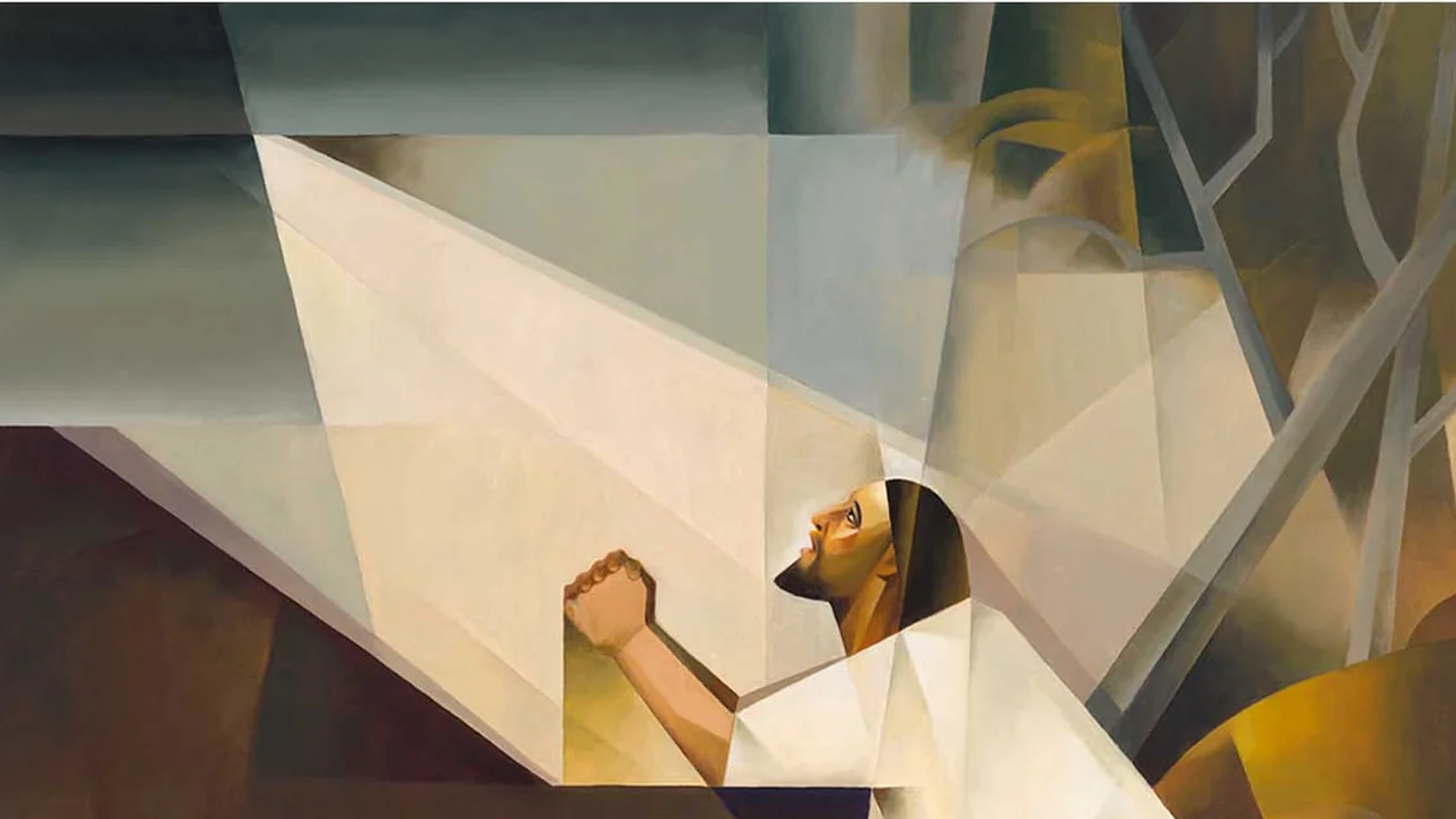
When I read that scene, it’s important, vital even, that Jesus, God Incarnate, is deeply disturbed by the suffering ahead of him. Had Jesus not been troubled, it would have underwritten some bizarre ideas of suffering itself being a good thing. Had Jesus not been troubled, it would have spoken of a God who was not sympathetic with humanity, a God completely out of step, a God who is deaf to the scream passing through our world, because who among us looks forward to suffering?
Jesus doesn’t welcome the violence. He doesn’t pretend that the cross is anything other than the horror it is.
Jesus, weeping, in anguish, sweating what looks like drops of blood, is greatly troubled because he knows that in the human flesh he has taken he will feel it all: the lashes, the blows, the weight of the cross beam, the piercing of the nails, the terrible struggle for breath; the insults of the crowd, the shame of such degradation, the cursed and violent state of utter rejection.
And yet, he willingly sets his eyes on the cross.
Make no mistake: Jesus is not about to switch on some sort of “God mode” painkiller that stops him feeling the pain. Some early heresies imagined this wrong idea of the ‘Christ’ vacating the body of ‘Jesus’ before the suffering began.[xxviii] But early church writers pushed back against such nonsense. God did not press his hands to his ears to mute the scream. God entered suffering, they argued.
In Gethsemane—nay, even before laying the foundation of the world—God set his face towards the cross, and he means to go through with it.
Why?
What would drive God to take on such suffering and brutality?
It’s at this moment that the theologians incline towards atonement theories, seeking to explain how Christ’s suffering achieves our salvation and forgiveness. And there is something to that. But I’m not asking how. I’m asking why.[xxix]
The writer of Hebrews, author of the longest sermon in the New Testament, put the answer this way:
‘For the joy set before him [Jesus] endured the cross…’
(Heb. 12:2b, NIV)
The joy. Like Hagar, Jesus goes into suffering because of the life, freedom and future it guarantees for God’s children. For you and for me.
The joy of bringing many sons and daughters into glory. The joy of reconciling us to God. The joy of rescuing people like you and me from sin and death, and bringing us into the life that God has for us.
The joy isn’t the suffering. God doesn’t delight in the brutality of crucifixion or ask us to regard suffering as something desirable. The joy is what lies beyond it.
Jesus willingly enters the wilderness of human suffering, not because suffering is good, but because of the future he intends to secure for us.
The joy of bringing us home.
The joy of setting us free—of making us wild donkeys, no longer used as instruments of sin and death.
The joy of ensuring that our stories are not ultimately defined by the suffering, sin, shame or death we experience in this world. The joy of ensuring that our lives, and creation itself, are not lost forever in the scream that passes through our world.
There are plenty of screams in our world. But the God revealed in Scripture is not a God who carries on walking. In Jesus, he is the God who comes all the way down into our suffering, taking it upon himself, so that you may have everlasting life.
Hagar discovered she was not unseen or unheard. That she was sought out by Divine love.
My prayer is this: As you behold the cross, may you, too, discover that you are not unseen.
And maybe, like Hagar, you too will bless God and acknowledge what he has done for you. That you would trust what God has said and done. That, like Hagar, you, too, would see the God who sees you.
For the joy set before him—the joy of your salvation—Jesus endured the cross.
‘The LORD is near to the brokenhearted and saves the crushed in spirit.’
— Ps. 34:18, ESV
ENDNOTES AND REFERENCES
[i] Romero, played by Steve Buscemi, Spy Kids 2: The Island of Lost Dreams (Rodriguez, R. (Director), Dimension Films, 2002)
[ii] From Munch’s diary entry of 22nd January 1892.
[iii] Romans 8:22
[iv] Genesis 3:10; Exodus 2:23; Revelation 8:1-4
[v] Tolkien goes on to add an important ‘but’, ‘But the historical version is, of course, not the only one.’ You can read where he will lead next, in his letter, on the 30th April 1944 (letter no. 64), as recorded in The Letters of J. R. R. Tolkien, Edited and select ed by Humphrey Carpenter with the assistance of Christopher Tolkien (HarperCollins Publishers, London, UK, 2023), p. 110
[vi] Genesis 12:2; 15:5
[vii] The text doesn’t say how Hagar came into Abram’s household. Many commentators assume Hagar was among the servants Pharoah gave to Abram, as mentioned in Gen. 12:16. Whilst probable, this can only be inferred rather than stated. Hagar’s “backstory” is not retold. If she was “given” away by Pharoah, then he, too, has merely treated her as property. But, for all we know, she could have arrived in Canaan seeking refuge, having to sell herself into service within a household. Her ‘name’ could also be a clue to her identity. As others have pointed out, Hagar could not be a name at all; as Ha-Gar simply translates to ‘the stranger’, ‘the foreigner’, ‘alien’ or ‘sojourner.’ [e.g. Wilda C. Gafney, Womanist Midrash: A Reintroduction the Women of the Torah and the Throne (Westminster John Knox Press, Louisville, Kentucky, 2017), p. 40].
It is also common to cite ancient Near Eastern surrogacy customs. Cuneiform tablets from the ancient Hurrian city of Nuzi (dated to around the 15th century BC, near modern-day Kirkuk in Iraq) provide important legal and cultural background on ancient Near Eastern surrogacy and marriage customs. Abram himself came from Ur, so his household would likely have been shaped by this existing culture. Of course, whilst probable, this to can only be inferred and scholars debate how closely they apply (though, I would say it’s highly feasible that Abram and Sarai were people of their time and place).
[viii] The story is a complex, but essential, one in the unfolding drama of God’s redemptive plan. I have touched on the story before (on a few occasions, actually). More recently, we touched on it as we went through the New Testament letter of Galatians, when I looked at Paul’s use of the story of Sarah and Hagar. You can read that here: FREE TO GOD | NO SKIN IN THE GAME (GAL. 4:21-5:1)
[ix] I need to state clearly, that I am not suggesting that the ancient Near East of Abram’s time bore any resemblance to Atwoods’ Gilead. I am merely reflecting upon the autonomy that Hagar would have lacked.
[x] As Atwood herself noted, ‘the [Handmaid’s Tale] is not “anti-religion”. It is against the use of religion as a front for tyranny; which is a different thing altogether.’ (from her introduction to The Handmaid’s Tale (Vintage Classics Edition, 2017), p. xiv.
[xi] A. Rebecca Basdeo Hill, Seeing and hearing Hagar: An affective reading of Genesis 16 (In die Skriflig / In Luce Verbi, Vol 58, No 1, https://doi.org/10.4102/ids.v58i1.3016, Feb 2024).
[xii] See CHRIST IN THE MARGINS | THE LEVITE’S CONCUBINE (JDG. 19)
[xiii] Genesis 16:6b
[xiv] Exodus 1:11; 3:7.
[xv] The other verb in the same Hebrew sentence speaking of Sarai’s treatment of Hagar, the verb describing Hagar’s flight (she flees, בָּרַח, bāraḥ), in Gen. 16:6, is also used in the Exodus narrative to describe the Israelite’s flight from Pharoah’s rule of Egypt (Ex. 14:5). An additional foreshadow of the Exodus story is also within the location of Hagar’s divine encounter: the wilderness of Shur. Israel, too, as a people, will find themselves in Shur along their flight (Ex. 15:22), and also beside a spring (though, a different one, which would be named Marah).
In it’s own way, the story is whispering that this account, Genesis 16, is an Exodus in reverse: an Egyptian slave oppressed by the household of the people of God. The very family through whom God will one day rescue slaves is, here, doing the oppressing, and God is already on the side of the oppressed.
It’s also a helpful reminder that, when we get to the Exodus, God is not anti-Egyptian. A point I have made before: GRAVE TO CRADLE | THE BIRTH OF IT ALL (EX 1:1—2:10)
For more on the Exodus echoes, see Phyliss Trible, Texts of Terror: Literary-Feminist Readings of Biblical Narratives, Ch.1, Hagar: The Desolation of Rejection (Fortress Press, 1984).
[xvi] You can listen to Olivier Banza’s message here CHRIST IN THE MARGINS | TAMAR
[xvii] Ibid, A. Rebecca Basdeo Hill.
[xviii] For some great insights into both extraordinary women, I’d recommend: Phyllis Trible and Letty M. Russell’s (eds), Hagar, Sarah, and their Children: Jewish, Christian and Muslim Perspectives (Westminster John Knox Press, 2006); Sandra Glahn’s (ed), Vindicating the Vixens: Revisiting Sexualised, Vilified, and Marginalised Women of the Bible (Kregal Publications, 2017); Wilda C. Gafney, Womanist Midrash: A Reintroduction to the Women of the Torah and the Throne (Westminster John Knox Press, 2017).
[xix] For those familiar with either the book or show, two central characters highlight this. Within the book (and its sequel, The Testaments) Aunt Lydia’s character is a stunning effigy, displaying both her “discomfort” and “approval” of the system. Within the show, however, the development of Serena Waterford’s character (Sarah to Offred’s Hagar, I suppose) is a stunning psychological analysis. Neither character are “villains”, in any typical fairy tale-like way. Both are caught in up the machinations of tyranny, attempting to “survive”.
[xx] Primo Levi discusses this ‘grey zone’ in his work, The Drowned and the Saved. Viktor Frankl, too, mentions this in the first half of his book, Man’s Search for Meaning, when describing his experiences within a concentration camp.
[xxi] Genesis 3:8-9
[xxii] Significant also, in that, just prior to this scene, Abram has been foretold about the sufferings on his descendants (Gen. 15: 13-16). Hagar, then, in a way of speaking, becomes a prophetic prefiguration of this suffering; a suffering servant, embodying something of the hardship Abram’s ‘household’ will know. Ironically, this ‘suffering servant’ suffers at the hands of Abram’s household. In light of this series’ topic, we could make something of this, too. But to do so here, would distract from the comparison I’m currently trying to make.
[xxiii] Cf. Gen. 16:11, Ex. 3:7
[xxiv] Hagar is the first woman in Scripture to be given the promise of a child. Sarai/Sarah is given her promise, directly from God, after this (Gen 18:10). Prior to this, God is clear with Abram/Abraham that Sarah is who God intends as the mother of the promised son, despite her barrenness (Gen. 17:15-19).
[xxv] Hagar is the first person in Scripture recorded as giving God a name. Think about that for a moment. The fact that this Egyptian servant, on the margins of Abram and Sarai’s story, is the person who gives us this name for God is remarkable. It’s one of those moments where the biblical narrative quietly overturns our expectations about who gets to see and understand God.
[xxvi] In Acts 9:22-25, Paul escapes Damascus in a basket to avoid a plot against his life. In Acts 9:29-30, Paul leaves Jerusalem to avoid another plot to murder him. In both cases, other believers facilitate his removal from harm. In Acts 14:5-6, both Paul and Barnabas are warned (one presumes through other believers) of a plot to have them stoned—they leave Iconium as a result. Similarly, in Acts 22:17-23, Paul shares his testimony of being encouraged by the Lord to flee the persecution he would face in Jerusalem and to go to the Gentiles instead. In response to this testimony, Paul, again, finds himself facing a dangerous mob. A Roman commander pulls Paul from the mob and orders him to be lashed for instigating a riot, but Paul has no qualms with using his Roman citizenship to avoid this harm. In Acts 23, Paul calls on the Torah and his heritage as a pharisee to, once again, appeal against persecution.
Even before Paul, in Acts 8:1, a wave of persecution hits the church in Jerusalem and the believers flee into Judea and Samaria. There is no tone of condemnation in this report.
Why did they flee? Well, in Matt. 10:23, Jesus teaches, ‘When you are persecuted in one place, flee to the next.’ In a similar way, in the context of domestic abuse, I would not suggest that Jesus instructs a continued exposure to abuse.
On early Christian attitudes to martyrdom, see The Martydom of Polycarp, ch. 4, which criticises a man who volunteered himself, and chs. 5-6, where Polycarp withdraws to a farm before his arrest.
Yes, there are periods in history (and sadly the present) were believers found themselves in circumstances they could not escape, and God strengthened them, in ways I cannot begin to imagine, to face those circumstances and to shine a light in very dark places.
Jesus only gave up his life when he knew the time had come. People had already attempted to kill Jesus in a previous episode of his ministry, and he slipped away through the crowds and left them (Luke 4:29-30). This should not be overlooked.
[xxvii] As a friend pointed out to me, after the service, a key difference to note here is that this was not others telling Hagar to return, using scripture and divine promises to put extra pressure on. This was God, personally speaking to Hagar.
[xxviii] For example, Ignatius of Antioch, in his letter To the Trallians (9 & 10), rejected the claim that Christ only ‘seemed’ to suffer (a heresy belonging to a school of though known as Docetism). Irenaeus, too, in Against Heresies (1.26.1), describes and rebukes Cerinthus’s teaching that the Christ descended on Jesus and departed before the passion.
[xxix] Admittedly, this is a crude division. So, for want of a fuller answer, I’d suggest reading Athanasius’ ancient classic, On the Incarnation.


Leave a Reply